

*This article was updated with the latest information on December 14, 2025.
3+ Shocking Reasons You Need Golf Cart Insurance in Your Gated Community NOW!
Golf Cart Insurance in Your Gated Community
A cart can scrape an SUV at jogging speed and still trigger three things instantly: a stiff neck, an “urgent” HOA email thread, and a quiet panic about who’s actually paying.
That’s the real problem: the road feels private, but the liability math isn’t. Between homeowners exclusions, auto-policy gray zones, guest passengers, and umbrella insurance gaps that make “we’re covered” feel true… until it isn’t, people end up insured for the story they wish happened—not the one that did.
Keep guessing, and the price of a “minor” incident can become medical bills + property repairs + a coverage denial you can’t negotiate away (especially once you realize how fast people start googling what to do after an insurance claim gets messy).
What you actually need
Golf cart insurance is a dedicated policy (or endorsement) that treats a cart like a vehicle exposure: it can include liability, medical payments, and optional physical damage coverage, with clear boundaries for community roads, crossings, and upgrades.
This post helps you choose a sane coverage tier fast, set deductibles you won’t hate later, and get quote-ready in one sprint—using the same checklist-and-calculator method I wish I’d had before my first awkward claim conversation.
Good—now keep scrolling.
- ✓ Pick a coverage tier in 60 seconds
- ✓ Spot the homeowners/auto liability gap
- ✓ Run a 15-minute quote sprint
Table of Contents
This block intentionally holds space so the page stays stable while other elements load.
The gated community myth that quietly burns wallets
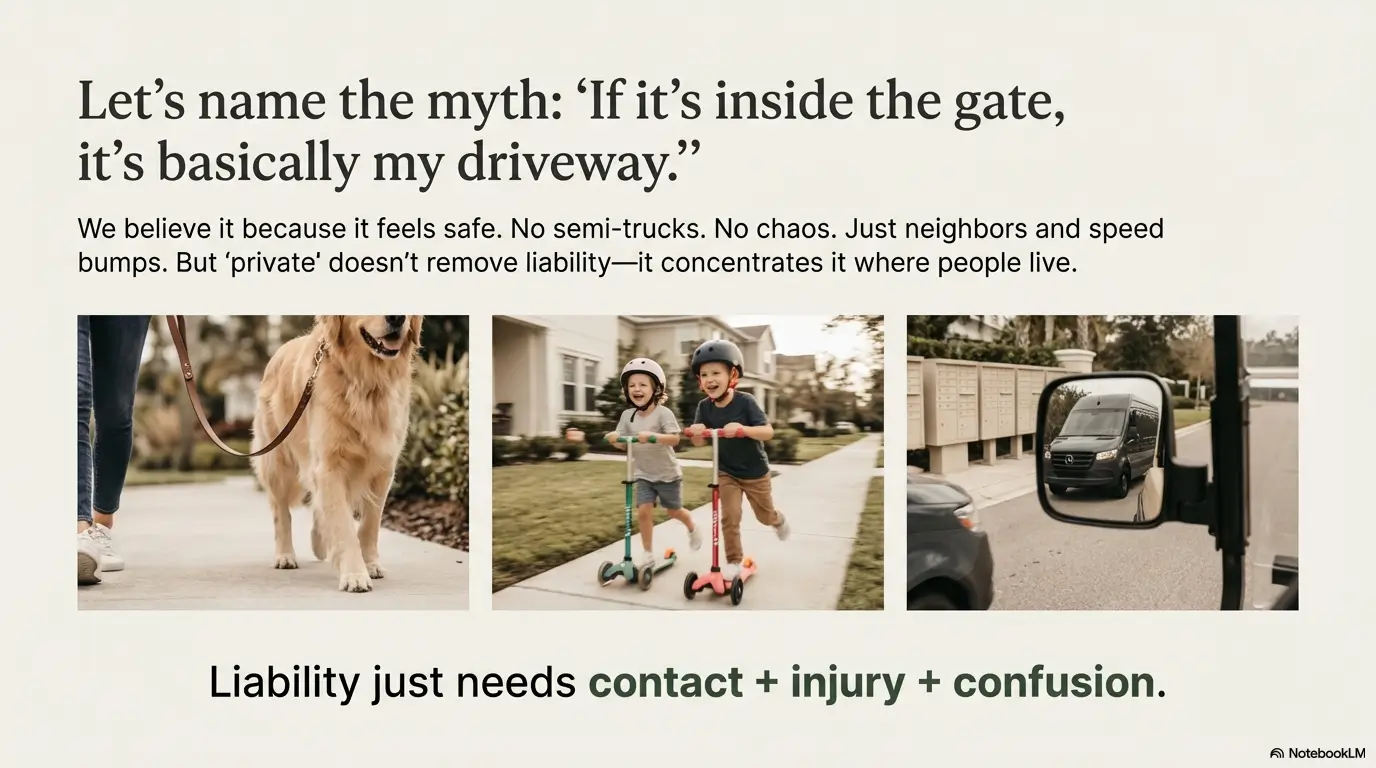
Let’s name the myth: “If it’s inside the gate, it’s basically my driveway.” I get why we believe it. There’s no highway. No semi-trucks. No chaos. Just palm trees, speed bumps, and that one neighbor who treats the cart path like a Monaco qualifying lap.
But “inside the gate” usually means more people, more repetition, and more witnesses. Carts weave past dog walkers, kids on scooters, delivery vans, and parked cars that cost more than my first apartment deposit. Liability doesn’t need 60 mph. It just needs contact + injury + confusion.
My own wake-up moment was embarrassingly small: a slow turn, a curb, a passenger who didn’t brace, and a bruised wrist that became “Who’s paying for urgent care?” within 30 minutes (and yes, even that “simple” visit can get complicated fast depending on how your U.S. health insurance actually handles urgent care and follow-up bills). The surprise wasn’t the bump. It was how fast the paperwork started.
- More neighbors = more exposure
- Minor crashes still create medical bills
- HOAs can add rules (and pressure) overnight
Apply in 60 seconds: Write down where your cart actually goes in a normal week.
Quick scannable check:
- Do you carry guests at least 2 times a month?
- Does your cart cross or approach a public road at least 1 time a week?
- Has your HOA ever emailed about “vehicle” rules in the last 12 months?
Reason #1: Injuries happen fast—even at “walking speed”
Golf carts feel harmless because they’re familiar. The vibe is sunscreen and small talk. But safety engineering is not a vibe; it’s hardware. Many carts still lack the basics you take for granted in cars: doors, airbags, reinforced cabins, even proper restraints.
Here’s the pattern that keeps showing up in modern injury reporting: falls and ejections. In late 2025, a children’s hospital research update described falls or ejections as a major share of golf cart injuries, with head and face injuries showing up frequently. Translation: you don’t need a massive collision. You need a sideways jolt, a sharp turn, or a passenger who’s half-sitting, half-standing.
My “oh no” moment came on a sunny afternoon when a friend hopped in without fully settling, and my cart rolled over a seam in the pavement. Nothing dramatic. Yet her phone flew, her elbow hit the rail, and my brain did the cost math: imaging, follow-up, time off work. The cart was fine. The humans were… not thrilled.
Show me the nerdy details
In low-speed open vehicles, injury risk often comes from occupant movement: lateral sway, uneven pavement, curb strikes, and abrupt steering. When people are unrestrained or perched sideways, the body becomes the “loose cargo.” The impact that matters is sometimes the fall from the seat, not the speed of the cart.
Two numbers to hold in your head: most carts in communities live in a band of 10–25 mph, and a person can hit the ground from seat height in less than 1 second. That’s why “we were going slow” doesn’t protect your finances.
Pull-quote: The most expensive golf cart accident is the “small” one that injures a person and confuses your insurance.
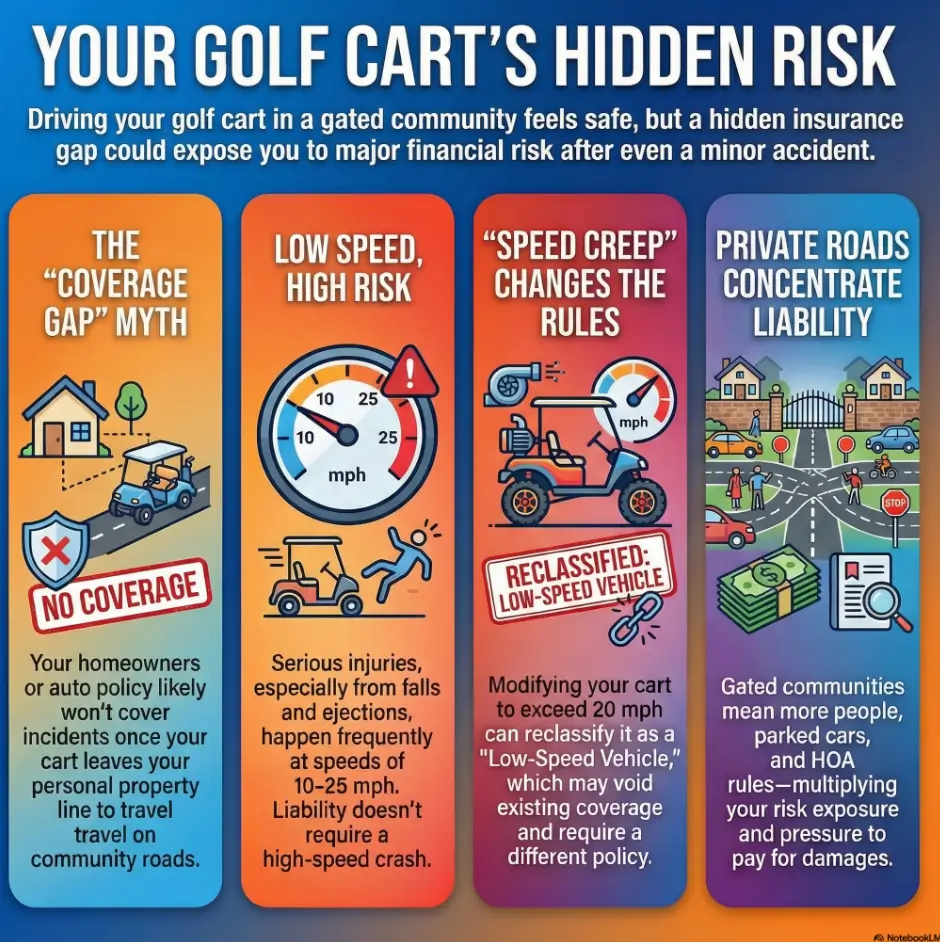
Reason #2: The coverage gap between homeowners, auto, and “it’s just a cart”
This is the one that shocks people—because it’s not about crashes. It’s about assumptions.
Many owners assume one of two things:
- “My homeowners policy covers it because it happens near home.”
- “My auto policy covers it because it’s a vehicle.”
Sometimes you get lucky. Sometimes you get a claim denial with a polite paragraph that reads like a breakup text: “We wish you well.” And when denial turns into a real fight, people quickly learn the difference between “annoying” and “expensive”—the same moment they start searching for an auto insurance claim attorney who understands how denials actually get challenged.
The tricky part is that coverage can depend on where the cart is used, how it’s classified in your state or country, whether it’s modified, and whether the incident is treated as “motor vehicle liability” under your policy language.
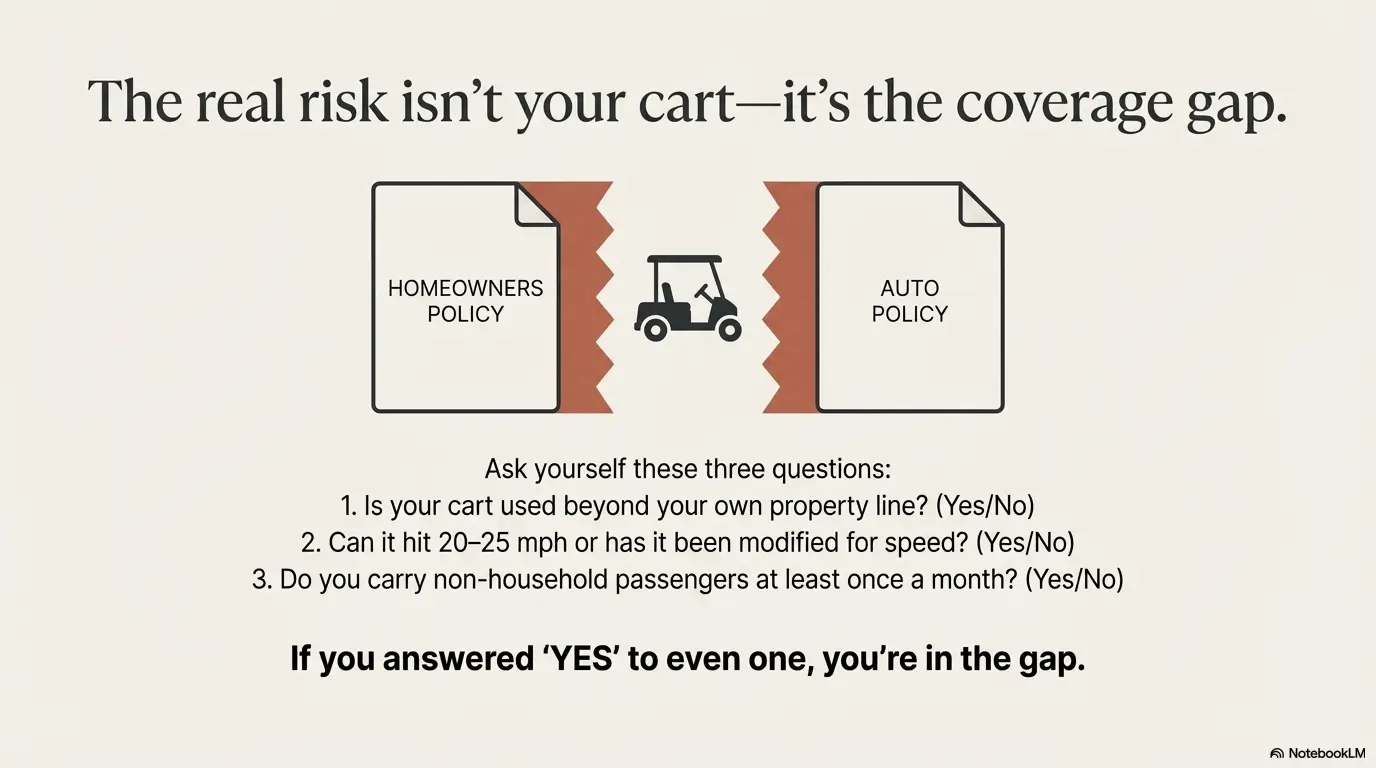
If you want a fast, sane approach, ask yourself three yes-or-no questions before you assume anything:
- Is your cart used beyond your own property line (roads, paths, community lanes)?
- Can it hit 20–25 mph or has it been modified for speed?
- Do you carry non-household passengers at least once a month?
If you answered “yes” to even one, you’re in the zone where a standalone golf cart policy (or a properly added endorsement) often makes the most sense—because it’s built to treat your cart like the liability magnet it can become.
- Homeowners coverage can exclude vehicle liability
- Auto coverage may not automatically include carts
- Passengers and public-road contact change everything
Apply in 60 seconds: Find your policy declarations page and search for “golf cart” and “motor vehicle liability.”
Show me the nerdy details
Insurance decisions often hinge on definitions: “motor vehicle,” “insured location,” “public road,” and “business use.” Two policies can look similar but treat a golf cart completely differently depending on these terms. That’s why the same accident can be paid quickly for one neighbor and denied for another.
Humor, but true: if your plan is “I’ll explain it was basically a toy,” remember toys don’t usually come with VINs, chargers, and $3,000 lift kits.
Reason #3: Speed creep turns carts into low-speed vehicles
In gated communities, speed creep is almost a lifestyle. Someone adds a faster controller. Someone swaps tires. Someone casually says, “It tops out around 25.” And suddenly you’re not in “golf cart” territory—you’re flirting with “low-speed vehicle” rules depending on where you drive.
In the United States, the low-speed vehicle concept is tied to a narrow speed band—typically over 20 mph but not more than 25 mph—and federal safety standards exist for that category. Your local rules (DMV, city, state) may decide where it can be driven, what equipment it must have, and whether insurance is required. The point isn’t to memorize statutes. The point is: your cart’s top speed can change the paperwork universe you live in.
My favorite “oops” story: a neighbor proudly showed me a speedometer app. I congratulated him… and then asked the one question that made him blink: “Cool—did you tell your insurer?” The silence was loud enough to qualify as a deductible.
Show me the nerdy details
Classification often depends on measurable capabilities: top speed, required equipment, and where it’s operated. Once a cart behaves like a road vehicle, insurers and regulators tend to treat it like a road vehicle. Modifications can also affect coverage if the policy requires disclosure of material changes.
Pull-quote: The moment your cart can keep up with neighborhood traffic, your risk profile stops being “cute.”
What coverage actually looks like: a tier map you can shop
Most articles say “get liability” and call it a day. That’s like telling someone to “eat food” as nutrition advice. Let’s make it shoppable.
Below is a practical tier map. It’s not a promise of availability everywhere; it’s a way to compare quotes apples-to-apples in 10 minutes.
- Tier 1: Liability-only — for injury/property damage you cause. Best for low-value carts used strictly inside the community.
- Tier 2: Liability + Medical Payments — adds small, quick medical coverage for occupants (useful for minor injuries).
- Tier 3: Tier 2 + Comprehensive — adds non-collision damage: theft, vandalism, weather events.
- Tier 4: Tier 3 + Collision — adds damage to your cart from crashes, curbs, poles, and “I swear that mailbox moved.”
- Tier 5: Tier 4 + Uninsured/Underinsured coverage (where offered) — protects you if someone else causes injury and doesn’t have enough coverage (and yes, the “they had nothing” scenario is exactly why people read guides like what happens after an auto accident when the other driver has no insurance).
Reality check: If you carry guests, Tier 2–4 usually makes more sense than Tier 1.
Anecdote (because we’re humans): I once cheaped out on “extras” because I wanted to feel financially responsible. Then a freak hailstorm turned my cart’s plastic roof into modern art. The cart still drove. My dignity did not.
Scannable “what to ask for” list:
- Liability limit options (ask for at least 2 choices so you can compare)
- Medical payments (even a small amount can reduce drama)
- Comprehensive + collision availability
- Accessory coverage for upgrades (lights, stereo, lift kit, custom wheels)
- Clarify where it’s covered: community roads, golf course, public-road crossings (and if your cart touches golf facilities, it helps to understand the broader liability logic behind driving range liability insurance and injury exposure)
60-second eligibility checklist: do you need a standalone policy?
This is the fastest way to decide whether you should pursue a dedicated golf cart policy (or a specific endorsement) instead of hoping your existing policies magically “count it.”
- Yes/No: Cart leaves your own property line (community roads, paths, common areas).
- Yes/No: You carry guests or non-household riders at least 1 time per month.
- Yes/No: Top speed is near the 20–25 mph band, or it’s been modified.
- Yes/No: Your HOA has written vehicle rules or can fine for damage.
- Yes/No: You’ve added upgrades worth more than $500 (lights, wheels, enclosure, stereo).
Next step: If you have 2+ “Yes,” request quotes that include Tier 2–4 options, not just liability-only.
Neutral action: Save this checklist and confirm your insurer’s definition of “golf cart” before you assume coverage.
Humor break: If your cart has a Bluetooth speaker louder than your car’s horn, it’s not a “toy.” It’s a lifestyle vehicle with a liability shadow.
Out-of-pocket reality: a deductible menu you won’t regret later
People obsess over premiums, then get blindsided by out-of-pocket costs. Deductibles are the part you feel immediately when something breaks, cracks, or gets stolen. Below is a simple menu that helps you choose without overthinking.
| Option | Typical use-case | Trade-off |
|---|---|---|
| $0–$250 | You want fast, low-friction repairs for common damage. | Usually higher premium; less “self-insure.” |
| $500 | Balanced choice for most gated-community owners. | You pay real money if something happens, but not a nightmare. |
| $1,000 | You rarely file claims and can absorb a bigger hit. | Small incidents may become “out-of-pocket only.” |
| $2,500+ | You’re essentially self-insuring physical damage. | Premium may drop, but a theft event hurts. |
Neutral action: Screenshot this table and confirm deductible options on the carrier’s official quote page.
Anecdote: I once chose a high deductible to “be disciplined.” Then a vandal scratched a perfect spiral into my side panel. My discipline lasted 7 minutes. My out-of-pocket lasted longer.
Mini calculator: pick a sensible tier in under a minute
If you’re time-poor, you need a default recommendation you can test against quotes. This mini calculator gives you a starting tier and a short note. It stores nothing.
Suggested tier: (enter values, then run)
Neutral action: Use the suggested tier as your baseline, then request at least 2 quote variants above and below it.
Gated-community triggers: HOA rules, guests, and shared blame
Inside a gated community, the accident itself is only half the story. The other half is social and administrative: HOA rules, neighbors, security cameras, and the fact that “everyone knows everyone.”
Three triggers make golf cart insurance especially relevant here:
- Guest exposure: Friends visiting for dinner, grandparents riding along, kids hopping in “just for a minute.” That’s a liability multiplier.
- Property density: Parked cars, golf course property, community mailboxes, landscaping—expensive targets within a small radius.
- Rule layering: HOA guidance can change faster than state law, and “you should have had coverage” becomes a moral judgment, not a legal one.
Anecdote: I once watched a cart bump a decorative stone sign. The repair estimate arrived in 48 hours. The group chat arrived in 4 minutes. Humans move faster than insurance.
- Guests change liability dynamics
- Camera footage reduces “it depends” arguments
- HOA pressure accelerates timelines
Apply in 60 seconds: Ask your HOA for the current cart rules and keep a copy (and if they want proof, “send me the COI today” is more common than people expect—see what that looks like in practice with same-day certificate of insurance workflows in California).
Short Story: when “private” turned very public
Short Story: Last summer, I borrowed a neighbor’s cart to carry two bags of mulch—an errand that should have taken 6 minutes. I rolled down a gentle slope, tapped the brakes, and felt a tiny skid. Not scary. Not loud. But the cart drifted just enough to graze a parked SUV. A faint scrape. A shrug. We all laughed… until the SUV owner stepped outside holding a phone, already recording.
The next day, the HOA asked for an incident report. Two days later, the SUV’s shop estimate showed a bumper sensor recalibration that cost more than my monthly grocery bill. The neighbor’s homeowners coverage didn’t respond the way they expected. The awkward part wasn’t paying. It was realizing we’d built our confidence on assumptions, not coverage. That’s the moment I decided: I’d rather pay for clarity than pay for surprises.
How to shop fast: the 15-minute quote sprint
Here’s how to do this without losing an afternoon. Think of it as a sprint, not a research project.
- Lock your facts in 3 minutes: cart make/model/year, top speed (stock or modified), where it’s driven, and estimated value.
- Choose a baseline tier in 1 minute using the calculator above.
- Request two quote variants in 6 minutes: one tier lower and one tier higher. This reveals the real cost of better protection.
- Ask the coverage boundary question in 2 minutes: “Is this covered only on private property, or also on community roads and crossings?”
- Document it in 3 minutes: get a written quote that includes limits, deductibles, and any exclusions (and if the conversation starts sliding into denial-risk territory, it helps to know how to find the best auto insurance lawyer near you before you need one).
Show me the nerdy details
“Quote variance” is a fast way to avoid anchoring bias. When you see Tier 3 vs Tier 4 side-by-side, you stop shopping on vague feelings and start shopping on clear trade-offs: out-of-pocket exposure, theft risk, and passenger medical coverage.
Pull-quote: Eligibility first, quotes second—you’ll save 20–30 minutes of back-and-forth.
- Serial/VIN info if available, plus purchase year
- Top speed and whether it’s modified
- Where it’s driven: community roads, golf course, public-road crossings
- Accessories and upgrade value (even rough numbers help)
- Who drives it: adults only, teens, guests
Neutral action: Save this list and confirm the insurer’s required documentation before you submit anything.
Anecdote: The first time I shopped without a list, I gave three different “approximate values” in one phone call. The agent was polite. My quote was… not stable.
Safety upgrades that pay back (even if premiums don’t move)
Insurance is a financial seatbelt, but real seatbelts are still undefeated. If your cart is used daily, a few upgrades reduce both injury odds and “this is going to be complicated” claims.
- Restraints and seating discipline: If belts exist, use them. If they don’t, stop treating standing riders like a cute community tradition.
- Visibility: Lights, reflectors, mirrors—especially if you’re driving at dusk.
- Speed governance: If your cart is tuned, consider limiting top speed where it’s used among pedestrians.
- Brakes and maintenance: Small systems fail quietly—until they don’t.
Also: recalls happen. In 2025, the US safety regulator posted golf-car-related recall information involving braking risk for certain models. Even if your cart isn’t in any notice, it’s a reminder that mechanical risk exists—and insurance is what keeps mechanical risk from becoming personal financial risk.
- Restraints matter more than speed
- Visibility reduces “I didn’t see you” moments
- Maintenance prevents avoidable crashes
Apply in 60 seconds: Do a quick walk-around: tires, brakes feel, and passenger handholds.
Not in the US? Here’s how to translate this to your country
If you’re reading from outside the United States—say Korea, the UK, Canada, Australia, or anywhere golf carts are used in resorts, retirement communities, apartment complexes, or private roads—the exact legal labels will differ, but the decision logic survives.
Use this translation framework:
- Classification: Is your cart treated as a motor vehicle, a low-speed vehicle, or a facility-only vehicle? The label affects insurance and permitted roads.
- Where it’s driven: Private property only vs shared community roads vs any public-road crossing. That boundary is everything.
- Mandatory insurance: Some places require liability coverage for certain classes of small vehicles; others rely on private-property rules and contracts.
- Enforcement reality: Even if the law is fuzzy, property managers and HOAs can impose proof-of-coverage requirements.
Local note for Korea: “Private property” usage can still create real civil liability if a person is injured, and large apartment complexes or resorts may have internal rules that effectively function like a mini-regulator. The practical move is to ask two questions: What class is my cart considered here? and What policy responds if I injure a guest? If you can answer those in writing, you’re ahead of most people by 90%.
Wrap it up: the next step you can finish in 15 minutes
Remember the hook: “private roads” don’t mean private consequences. They mean you’re driving where people live—where injuries, guests, and expectations multiply. The goal isn’t paranoia. It’s precision.
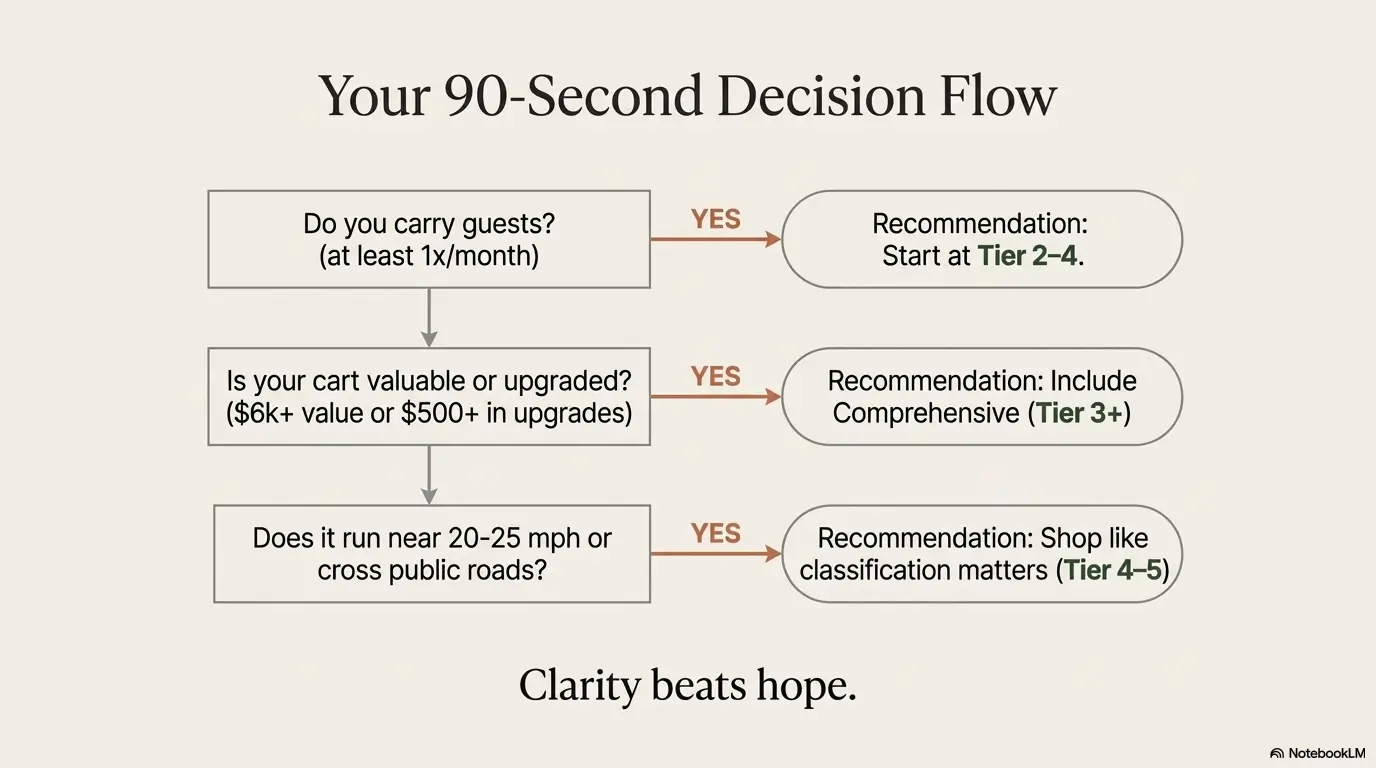
Accessibility note: This infographic is a step-by-step flowchart summarizing guest use, value, and speed/classification triggers.
Your 15-minute next step: Run the mini calculator, then request two quotes: one Tier lower and one Tier higher. Ask for the coverage boundary answer in writing—where it applies and where it stops. That’s it. Clarity beats hope.
Last reviewed: 2025-12. Checked official safety regulator pages, a pediatric injury research update, and federal low-speed vehicle standards for classification context.
FAQ
Do I really need golf cart insurance if I never leave my gated community?
If you share roads or paths with neighbors, guests, or pedestrians, you still have liability exposure. The most common “inside the gate” problem is an injury or a parked-car incident that becomes a medical and property claim. 60-second action: write down your three most common routes and confirm whether your existing policies explicitly mention golf carts.
Will my homeowners insurance automatically cover golf cart accidents?
Not automatically. Many policies treat “motor vehicle liability” differently than “around the home” incidents, and definitions matter. You need to confirm how your policy defines the cart and where it’s covered. 60-second action: search your policy documents for “golf cart” and “motor vehicle liability.”
What coverage tier should I start with for a family cart used daily?
If you carry family members or guests regularly, a practical starting point is often Tier 2–4: liability plus medical payments, and physical-damage coverage if the cart is valuable. 60-second action: plug your cart value, guest rides, and top speed into the estimator above and use that tier as your baseline.
Does modifying speed affect insurance?
It can. Modifications may change classification in some areas, and insurers may require disclosure of material changes. Even when legal rules are unclear, insurance underwriting often isn’t. 60-second action: list your modifications and ask your insurer—by email or chat—for written confirmation they’re covered.
What should I gather before I compare quotes?
Cart make/model/year, top speed, where it’s operated, rough value, and upgrades. Without that, quotes become inconsistent and hard to compare. 60-second action: take a phone photo of the model info/serial plate and write your top speed estimate.
How do I avoid paying for coverage I don’t need?
Compare adjacent tiers and isolate what changed: limits, deductibles, coverage boundary, and whether medical payments or physical damage is included. The goal is not “more.” The goal is the right layer. 60-second action: request one quote one tier lower than your baseline and one tier higher, then compare differences line-by-line.