
7+ Niche Tax Deductions Remote Workers Miss That Could Save You Thousands!
Hey everyone, it’s your friendly neighborhood tax guru here!
I know, I know—taxes are about as exciting as watching paint dry.
But what if I told you that a little bit of digging could unearth some serious cash?
We’re talking about finding money you didn’t even know you were leaving on the table.
Especially for us remote workers, the tax landscape is a wild, often confusing, and sometimes frustrating place.
You’ve probably heard all about the standard home office deduction, but what about the smaller, more specific deductions that can add up to a huge difference?
That’s exactly what we’re going to dive into today.
Forget the generic advice you find everywhere else.
We’re going to talk about the real, nitty-gritty stuff that can make a massive impact on your bottom line.
We’ll explore how different states can either be your best friend or your biggest tax nightmare.
And trust me, a little knowledge here can save you thousands.
Let’s get this bread!
Table of Contents
The Wild, Wild West of State-Specific Remote Worker Deductions
This is where things get really interesting, and honestly, a little frustrating.
Working remotely isn’t as simple as just filing in the state you live in.
Your employer might be in another state, and some states, bless their hearts, have a nasty habit of trying to tax your income no matter where you physically are.
It’s like they’re playing a long-distance game of “gotcha!”
So let’s break down a few examples, because what’s a blog post without some real-world drama?
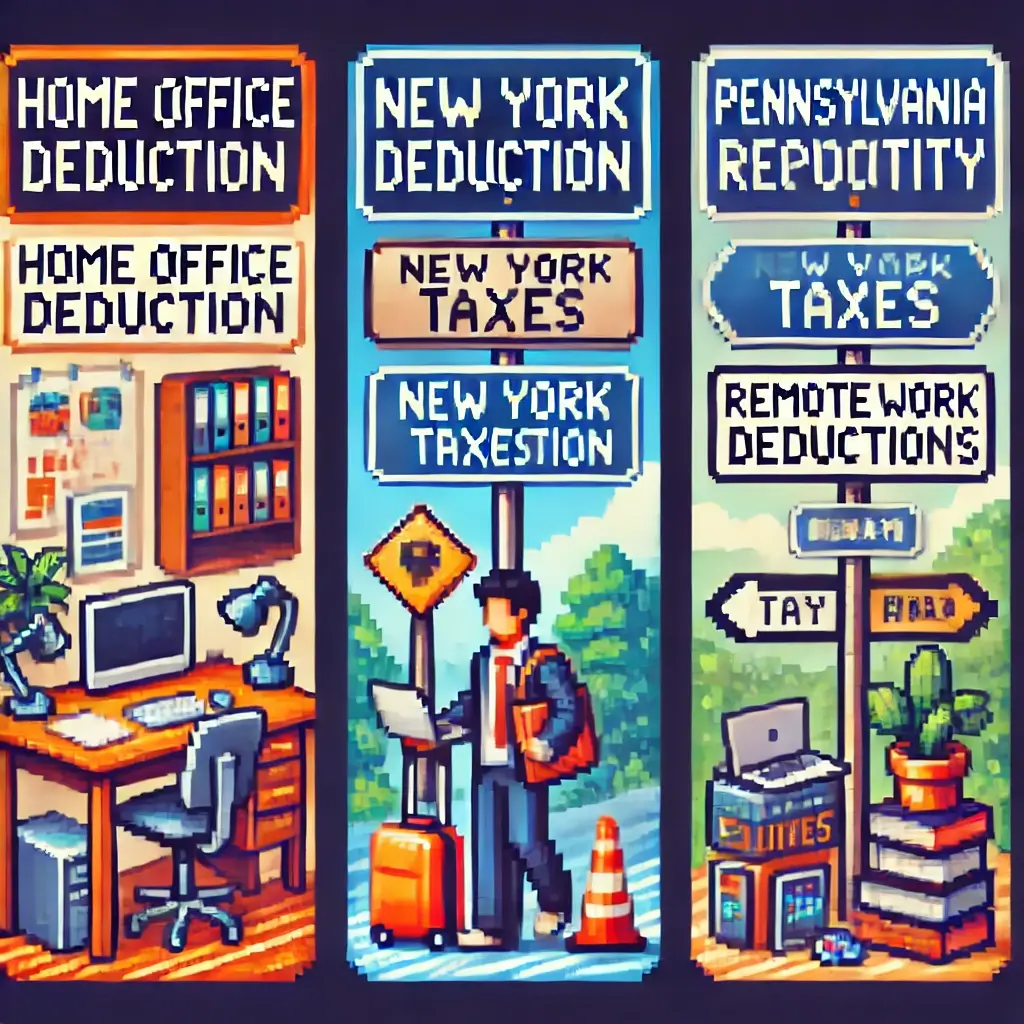
New York’s “Convenience of the Employer” Rule
This one is a classic head-scratcher.
If your employer is based in New York and you’re a remote worker living in, say, New Jersey, New York still considers your income taxable by them.
Why?
Because they say you’re working remotely for your “convenience,” not because the company requires it.
It’s a tricky rule, and the only way to avoid it is if your employer has a *bona fide* office in your home state and your remote work is *required* by the company.
This is where documentation becomes your best friend.
Get everything in writing from your employer.
Pennsylvania: The Reciprocity King
On the other end of the spectrum, you have states like Pennsylvania that have tax reciprocity agreements with a bunch of other states, including New Jersey, Ohio, Indiana, and more.
This means if you live in one of these states but work in PA, you only pay taxes to your state of residence.
It’s a beautiful thing—no double taxation drama!
Make sure you fill out the right forms with your employer (like Form REV-419) to ensure they withhold the correct state taxes.
California’s Pro-Rated Nightmare (or Dream?)
California is a state many people dream of moving to, but their tax system can be a nightmare if you’re not careful.
If you move to California mid-year, you’re expected to pay California state income tax on all your income *for the entire year*, even the income earned before you moved.
The good news?
If you work for a California company but live elsewhere, you only pay California taxes on the portion of your work performed *while you were physically in California*.
This requires careful tracking of your work days, which is why a good old-fashioned calendar or spreadsheet is your best friend.
It’s not a deduction, but it’s a huge tax trap that many remote workers fall into, and it’s worth knowing about.
Navigating these state tax differences is like playing a high-stakes game of chess.
A single wrong move can cost you.
That’s why a little bit of research and maybe a chat with a tax professional who specializes in multi-state returns is so crucial.
Don’t just assume your tax software has it all figured out.
I’ve seen it happen.
It’s not pretty.
Let’s check out a helpful link that breaks down state reciprocity agreements.
You’ll want to save this one for future reference!
Beyond the Home Office: The Secret Stash of Deductions
The home office deduction is like the celebrity of remote work deductions—everyone knows about it.
But it’s often misunderstood and underutilized.
The IRS has a simple method (the simplified option) where you can deduct $5 per square foot of your home used for business, up to 300 square feet.
It’s easy, but it’s not always the best.
The regular method is where you can really unlock the value, but it requires a lot more record-keeping.
With the regular method, you calculate the percentage of your home used for business and deduct a portion of things like your mortgage interest or rent, utilities, homeowner’s insurance, and even repairs.
For example, if your home office is 10% of your home’s total square footage, you can deduct 10% of your electricity bill.
Seems small, but it adds up quickly over a year.
The “Dedicated Business Use” Rule
Here’s the catch: the space has to be used *regularly and exclusively* for your business.
You can’t claim the deduction for a living room where you sometimes answer emails.
It has to be a dedicated space.
I know a guy who tried to deduct his kitchen table because that’s where he “worked.”
Let’s just say his tax audit was a lot less fun than he had anticipated.
So, if you’re using a spare bedroom that’s only for your work, great!
If it’s also where you have your Peloton, well, that’s a different story.
Beyond Utilities: Hidden Home Deductions
This is the good stuff.
Did you have to get a new roof?
If you’re using the regular method, a portion of that expense could be deductible.
Same goes for painting your office, or getting new flooring.
These are called “capital improvements” and they can be deducted over several years.
It’s a way to recoup some of those big-ticket items.
Let’s not forget about home security systems.
If your home office contains valuable equipment, a portion of the cost of your security system might be deductible.
It’s not a common deduction, but it’s one of those niche things that can really make a difference.
Now, for a bit of a visual break, let’s look at how these numbers can add up.
The Power of Niche Deductions: An Infographic
Home Office Expenses
Proportion of home expenses (rent, utilities)
Software Subscriptions
Deductible for business use
Training & Education
If it maintains or improves job skills
These are just a few examples. Your actual deductions will vary.
Tech & Tools: Are Your Gadgets Deductible?
We live in a world of subscriptions and gadgets.
It feels like every week there’s a new software you “need” or a new gadget that promises to make you more productive.
The good news is that many of these can be deductible.
The key is that the item must be “ordinary and necessary” for your work.
It’s a bit of a vague term, but think of it this way: would a reasonable person in your line of work need this to do their job?
Software Subscriptions and Apps
This is a big one for remote workers.
Think about your Adobe Creative Cloud subscription if you’re a designer, your Microsoft 365 or Google Workspace account, or even that fancy project management software like Asana or Trello.
These are all 100% deductible.
Keep a record of your payments, and you’re good to go.
Even a small monthly cost adds up to a nice deduction at the end of the year.
Home Office Equipment
Your new ergonomic chair, a high-quality monitor, a new laptop, or even a fancy standing desk—these are all deductible.
For smaller items, you can usually deduct the full cost in the year you buy them.
For bigger purchases (think thousands of dollars), you might have to depreciate them over a few years, which means you deduct a portion of the cost each year.
The rule of thumb is to check with a professional, but for most people, the full deduction is available.
I remember a client who bought a brand-new MacBook Pro for work and almost forgot to deduct it.
That’s a $2,500 deduction right there!
It’s a deduction that almost all remote workers should be taking advantage of.
The Brainiac’s Deduction: Continuing Education
The world of work is always changing, and we remote workers know this better than anyone.
What’s relevant today might be old news tomorrow.
The good news is that the IRS encourages you to keep your skills sharp.
If you take a course or attend a seminar to maintain or improve your skills for your current job, you can likely deduct the cost.
This includes the cost of the course, books, supplies, and even travel to and from the event.
What Qualifies?
The key here is that the education must relate to your *current* job.
If you’re a software engineer taking a course on the latest coding language, that’s a clear win.
If you’re a software engineer taking a pottery class to “unwind,” that’s probably not going to fly.
The IRS has a clear distinction between “maintaining skills” and “qualifying for a new trade or business.”
You can’t deduct the cost of a law degree if you’re a paralegal, for example, because it’s preparing you for a new profession.
But if you’re a paralegal taking a certification course in a new legal software, that’s a go.
When Your “Commute” Becomes a Business Trip
Most remote workers don’t have a daily commute, which is one of the best parts of the deal.
But what about when you have to meet a client, visit the corporate office, or attend a conference?
The good news is that these trips can be deductible.
The “Away from Home” Rule
To deduct travel expenses, you must be traveling away from your “tax home” (your main place of business) for a period longer than a normal workday, and you need to sleep or rest to meet the demands of your work.
This is a big one.
If you fly to another city for a two-day conference, you can deduct your flights, hotel, and even some of your meals.
Even if you’re just driving to another city for a day trip to meet a client, you can deduct the mileage.
The standard mileage rate changes every year, so you’ll want to keep an eye on the latest IRS rules.
As of now, it’s pretty generous.
Keep a detailed log of your business trips, including the purpose of the trip, the dates, and a record of your expenses.
A simple spreadsheet or an app is all you need.
No need for a fancy accountant if you’re meticulous with your records.
Miscellaneous Mishaps & Deductions
This is where things get truly niche and where a lot of people miss out.
The little things add up, and if you’re not paying attention, you’re leaving money on the table.
Bank Fees & Business Insurance
If you have a separate bank account for your business, any fees you pay for it are deductible.
Same goes for business insurance, like liability insurance.
If you’re a freelancer, this is a no-brainer.
Professional Dues & Subscriptions
Are you a member of a professional organization related to your work?
Deductible.
Do you subscribe to an industry-specific magazine or newsletter?
Deductible.
These are small things, but they add up to a few hundred dollars a year, which is better in your pocket than the IRS’s.
Cell Phone & Internet Bills
This is a big one.
If you use your personal cell phone and home internet for business, you can deduct a portion of the cost.
This isn’t a 100% deduction.
You have to figure out the percentage of business use.
A good way to do this is to get a separate bill from your carrier that shows business calls and data, or to just do a simple, honest calculation.
For example, if you use your phone for work 50% of the time, you can deduct 50% of your bill.
It’s not perfect, but it’s a great start.
How to Audit-Proof Your Remote Deductions
This is the part that makes everyone nervous.
The dreaded audit.
But let me tell you, if you have your ducks in a row, it’s really not that scary.
The number one rule?
Documentation.
Keep Meticulous Records
For every deduction you claim, you need a paper trail.
This includes receipts, invoices, and even notes on your calendar.
If you buy a new monitor, keep the receipt.
If you pay a monthly subscription, keep a record of the bank statement withdrawal.
I’m not saying you need to save every single scrap of paper, but at the very least, take a picture with your phone and save it in a dedicated folder on your computer or in a cloud service.
The IRS loves a good, clean record.
Be Reasonable
Don’t get greedy.
If you only work remotely for a few hours a day from your home, don’t claim 100% of your utilities as a business expense.
Be honest and reasonable with your calculations.
The IRS has a nose for this kind of stuff.
Claiming a large, unrealistic amount is a surefire way to get a letter from them.
I’ve seen people try to claim their entire mortgage as a home office expense.
Spoiler alert: it didn’t end well.
This is a great place to check out some IRS publications on remote work deductions.
Final Thoughts: Don’t Leave Money on the Table
It’s a dog-eat-dog world out there, and the last thing you want to do is voluntarily give more of your hard-earned money to the government than you have to.
The remote work revolution has changed everything, but with great flexibility comes great tax responsibility.
Take the time to understand these niche deductions.
Keep excellent records.
And when in doubt, consult a tax professional.
It might cost you a few hundred dollars, but it could save you thousands in the long run.
Your future self will thank you.
Happy saving!
Remote work, tax deductions, home office, state taxes, IRS, remote worker
🔗 Special Event Liability for Your Block Party Posted 2025-08-18 03:41 +00:00 🔗 Homeowners Policy Fails Posted 2025-08-17 02:45 +00:00 🔗 Crucial Insurance Types Every Rideshare Driver Posted 2025-08-16 10:24 +00:00 🔗 Gaming & Esports Stocks Posted 2025-08-16 09:39 +00:00 🔗 Food Truck Commercial Auto Insurance Posted Unknown Date 🔗 What the Heck Are Opportunity Zones Anyway? Posted 2025-08-16