
Auto Insurance for Ride-Sharing Passengers (What’s Covered?): 27 Truths You Only Learn After a Bumpy Ride
Tonight I’m writing with cold coffee, a squeaky chair, and the memory of a rideshare where the driver’s playlist was 90% breakup ballads and 10% questionable remixes.
It was a whole mood.
But right in the middle of that emotional karaoke, I had a thought that hits more often than we admit.
What happens if this car gets hit right now.
Does the driver’s insurance help me.
Does my own insurance help me even if I’m just a passenger.
Does the rideshare company pull out a magical umbrella and cover everything because “technology”.
Short answer.
Coverage exists, but the path to getting paid can feel like assembling furniture without instructions while the cat steals all the screws.
So let’s demystify it together, layer by layer, beginner to expert, with jokes, with genuine empathy, and with just enough imperfection to keep it human.
Table of Contents
Auto Insurance for Ride-Sharing Passengers (What’s Covered?): The Midnight Promise
You tapped a phone.
A car arrived like a friendly spaceship with cup holders.
That was the promise.
Safe, simple, and cheaper than parking downtown ever again.
But the moment there’s a crunch of metal or a sudden swerve, your brain does a split-screen between worry and logistics.
Who pays for the medical bills.
Who pays if you miss work.
Who pays if your laptop flies across the backseat like a budget boomerang.
Here’s the honest starting point.
When the app is active and you’re on an official trip, most major rideshare platforms carry commercial auto insurance that is designed to kick in for passengers if there’s a covered accident.
It often includes significant liability protection and, in many markets, uninsured or underinsured motorist coverage during the ride.
There are details.
There are exceptions.
There are phone trees that seem infinite.
But yes, there is real insurance intended to help you as the passenger.
Auto Insurance for Ride-Sharing Passengers (What’s Covered?): The Simple Version for Normal Humans
Beginner level first.
You get in a rideshare car and the driver starts the trip in the app.
From that moment until you get out and the trip ends, there is usually a commercial insurance policy covering the ride.
If your driver causes the crash, the rideshare company’s liability insurance is designed to pay for your injuries and damages up to the policy limits.
If someone else hits your car and they have no insurance or not enough, many markets include uninsured or underinsured motorist coverage during the trip to protect you as a passenger.
Think of it like a layered cake.
First layer.
The other driver’s insurance if they’re at fault.
Second layer.
The rideshare company’s coverage while you are on an active trip.
Third layer.
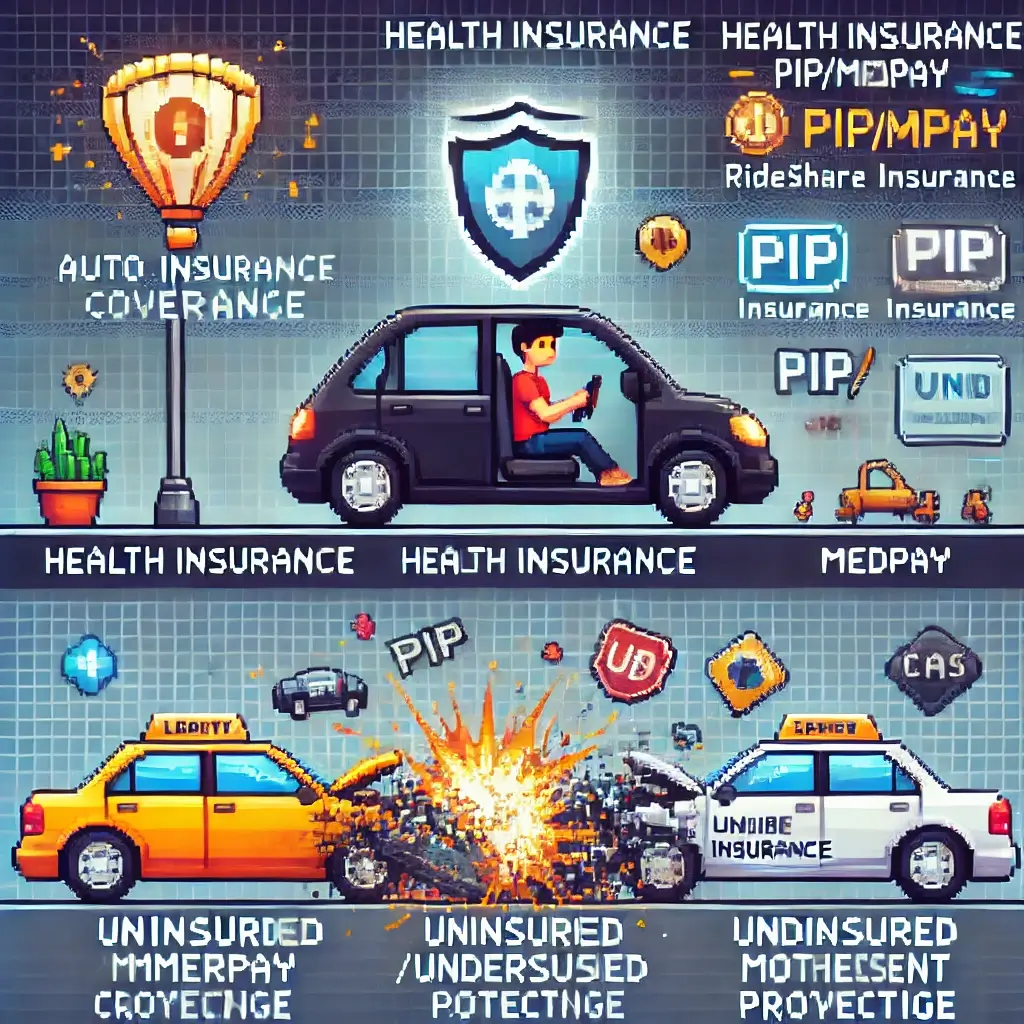
Health insurance, PIP, or MedPay to handle immediate medical bills depending on your state and your personal policies.
Fourth layer.
Your own uninsured motorist coverage if you carry it and if your policy extends while you are a passenger in someone else’s car.
Yes, sometimes they argue about who pays first.
But that’s the general idea.
Auto Insurance for Ride-Sharing Passengers: What’s Covered?
Coverage Timeline
App Off
No rideshare coverage
App On
Limited driver coverage
Driver En Route
Commercial policy active
Passenger in Car
Full liability + UM/UIM coverage
Trip Ended
Coverage returns to driver’s policy
The Four Coverage Layers
- 1. Liability Insurance: Covers passenger injuries if driver is at fault.
- 2. UM/UIM Coverage: Protects passengers if the other driver is uninsured or underinsured.
- 3. PIP / MedPay: Pays immediate medical bills regardless of fault.
- 4. Personal Insurance: Health or renter’s insurance may cover additional costs.
How to File a Claim
- Step 1: Ensure safety & call emergency services.
- Step 2: Report incident through the rideshare app.
- Step 3: Collect photos, driver info, trip details.
- Step 4: Keep medical bills & receipts.
- Step 5: Follow up regularly with claim adjuster.
Quick Stats
1M+
Rides daily in U.S.
$1M
Liability coverage per accident (Uber/Lyft standard)
50%
Accidents involve another driver’s fault
Auto Insurance for Ride-Sharing Passengers (What’s Covered?): The Coverage Timeline Map
Intermediate readers love a timeline.
Let’s map it out so you can point at the screen and say “there, that part.”
Phase A.
App off, private life.
Not your problem as a passenger because there’s no ride yet.
Phase B.
Driver has the app on but no passenger onboard.
Again, not your phase, but this is when drivers have different coverage limits that don’t involve you yet.
Phase C.
Driver accepts your trip and is en route to pick you up.
The commercial policy is typically active for the driver now, and if there’s an accident with you not yet in the car, you’re still not the passenger, so breathe.
Phase D.
You are in the car, the trip is active, and you’re tracking the tiny car icon like it’s your favorite reality show.
This is your phase.
During this phase, the rideshare company’s commercial insurance is generally intended to protect passengers as third parties if there’s a covered crash.
In many markets, this includes third-party liability and uninsured or underinsured motorist coverage, often with strong limits while you’re physically in the vehicle on an active trip.
When the trip ends and you step out, coverage changes back to the earlier phases.
Auto Insurance for Ride-Sharing Passengers (What’s Covered?): The Four Coverage Layers That Actually Matter
Let’s pull the curtain back on the four big categories you’ll hear about when a claim starts buzzing.
Category One.
Bodily injury liability.
If your driver is at fault, this is the bucket that pays your medical costs, pain and suffering where allowed, and other damages up to a limit.
Category Two.
Uninsured or underinsured motorist coverage.
If the other driver caused the crash and has no insurance or too little, this coverage may pay you on top of or instead of the other driver’s limits during the trip.
Category Three.
PIP or MedPay depending on your state and personal policy choices.
PIP stands for Personal Injury Protection and is common in no-fault states, while MedPay is an optional add-on in many places that pays medical bills without regard to fault.
Category Four.
Property coverage for your stuff in the car is more complex and often limited.
Some policies treat personal items as your homeowner’s or renter’s insurance problem unless the rideshare policy explicitly allows a claim.
Yes, that laptop might be your problem unless you can connect it to the at-fault driver’s liability claim.
Auto Insurance for Ride-Sharing Passengers (What’s Covered?): Health Insurance, PIP, MedPay, and That Awkward ER Bill
Let’s talk about the bill that arrives before your neck stops hurting.
If you go to the ER, they often bill your health insurance first because computers love the path of least resistance.
In no-fault states, PIP may kick in first for immediate medical costs up to the limits, sometimes before health insurance.
In many other states, if you carry MedPay, that can pay early bills without blame games.
Later, when liability is sorted, the insurer that paid early may seek reimbursement from the at-fault party through subrogation.
That’s a fancy word for “we paid first, now we want our money back.”
From your viewpoint as a passenger, you want bills handled quickly and quietly while the insurers arm wrestle in the background.
Your action list is simple.
Give providers your health insurance card.
Ask for claim numbers from the rideshare insurer and, if relevant, the other driver’s insurer.
Keep copies of everything like a dragon guarding receipts.
Auto Insurance for Ride-Sharing Passengers (What’s Covered?): Uninsured and Underinsured Motorist—The Sleeper Hero
UM and UIM are the night shift heroes of car insurance.
They do their best work when the other driver’s coverage is nonexistent or embarrassingly small.
Many rideshare markets include UM or UIM for passengers during active trips, sometimes matching liability limits so passengers are not left stranded when an at-fault stranger vanishes into a paperwork void.
Translation.
If someone blasts through a red light and has no insurance, UM steps in to help pay for your injuries as a passenger.
If they have low limits that run out early, UIM tries to bridge the gap.
Quick note.
Your own personal auto policy may also carry UM or UIM that follows you even when you’re a passenger, but the ordering and availability can depend on your state and your policy wording.
You don’t have to solve that at the crash scene.
You only need to know UM and UIM exist and they are on your side.
Auto Insurance for Ride-Sharing Passengers (What’s Covered?): Bodily Injury Liability and Why It Pays You
When the driver of your rideshare causes a crash, the rideshare’s commercial bodily injury liability is built to pay third parties, and you are a third party even if you were singing along to power ballads with the driver two seconds earlier.
This coverage can pay for medical costs, lost wages where applicable, and general damages allowed by your jurisdiction.
The policy has a limit.
The limit is a ceiling, not a suggestion.
If your losses are high, you and other injured people may share that limit, which is one reason documentation and early communication matter.
Sometimes, separate medical payments or UM coverages add more protection, but the liability limit is still the main pillar.
Auto Insurance for Ride-Sharing Passengers (What’s Covered?): Deductibles, Limits, and That One Line You Skipped
Deductibles live mostly on the property damage and collision side, which isn’t your primary lane as a passenger unless you’re seeking payment for your personal items under a specific provision.
For bodily injury claims, the main number you’ll care about is the limit.
Limits can be large during active trips compared to everyday personal auto policies, and that’s good news when hospital bills seem to multiply like rabbits.
If your damages exceed limits, your own UM or health coverage may still help, and in rare severe situations, additional avenues exist, though they are complex and vary by jurisdiction.
Read the line that says “per person” versus “per accident.”
Per person is your cap.
Per accident is the shared cap among everyone injured in that single event.
There is no dramatic music when a limit is reached.
There is only math and negotiation.
Auto Insurance for Ride-Sharing Passengers (What’s Covered?): How to File a Claim Without Losing Your Mind
Step one.
Get safe.
Check for injuries.
Call emergency services if needed.
Step two.
Use the rideshare app to report the incident.
There is usually a crash or safety button that starts the process with the platform’s claims administrator.
Step three.
Exchange info like it’s 2004 again.
Take photos of vehicle positions, plates, driver’s license, insurance cards, and the car interior where you were sitting.
Step four.
Record your symptoms early even if you plan to tough it out.
Some injuries hide behind adrenaline like introverts at a party.
Step five.
Ask for the claim number in writing.
Email is your new best friend.
Step six.
Follow up with a simple timeline.
“I was a passenger, trip ID, date and time, location, injuries, providers seen so far.”
Step seven.
Breathe.
The world is wobbly for a few days and that is normal.
Auto Insurance for Ride-Sharing Passengers (What’s Covered?): Screenshots and Paper Trails That Win
Open your app history and screenshot the trip receipt, the driver’s name, the time stamps, and the route.
Back it up to your email because phones love drama at the worst time.
Keep every medical bill, every discharge summary, every “we attempted to contact your insurer” letter.
Start a tiny spreadsheet even if you swore you’d never open one again.
Date, provider, amount, what the bill was for, status, and any claim number.
You will look like a quiet professional if someone asks for documentation, and professionalism tends to get paid faster.
Auto Insurance for Ride-Sharing Passengers (What’s Covered?): Intermediate Moves for Real-World Riders
Move one.
If another driver is clearly at fault, you can usually file against their insurer and also notify the rideshare claims channel at the same time.
Parallel paths are not cheating.
Move two.
Ask about medical payments benefits early, especially if you’re in a no-fault state or you carry MedPay.
Fast-pay benefits reduce late fees and stress levels.
Move three.
If you miss work, document dates, hours, and employer letters, or revenue statements if you freelance.
Your claim is a story, and stories need evidence.
Move four.
If pain persists, see a specialist sooner than later.
Undertreating is not noble.
It’s just painful.
Move five.
Set a calendar reminder to check in with the adjuster every two weeks with a short update.
Polite persistence beats quiet patience nine times out of ten.
Auto Insurance for Ride-Sharing Passengers (What’s Covered?): Advanced Insights For Insurance Nerds and Night Owls
Expert mode unlocked.
Primary versus excess is the first chessboard.
During an active trip, the rideshare commercial policy is commonly primary for third-party liabilities arising from the driver’s operation of the vehicle.
UM or UIM during the trip, when provided, may be triggered after the tortfeasor’s limits are exhausted or when the tortfeasor is uninsured, subject to policy wording and jurisdictional rules.
Coordination of benefits is the second chessboard.
Health insurance may pay first under contractual obligations with providers, with subrogation rights against the liability or UM carrier.
PIP priority can supersede that path in no-fault states, again by statute and policy design.
Comparative fault rules can slice damages in percentages, and while passengers are typically the least faulted parties, seatbelt defense arguments or gross misconduct allegations can appear.
Keep logs, not because you’re paranoid, but because math demands it.
Pain and suffering calculations often follow multipliers or per diem reasoning in negotiations, but each claim lives and dies by documentation, credibility, and medical narratives.
If you are truly deep in the weeds, consider how medical coding, CPT/HCPCS bills, and lienholders affect net recovery.
Hospitals, states, and insurers have different protocols for liens and reimbursement, and early communication can reduce friction later.
Auto Insurance for Ride-Sharing Passengers (What’s Covered?): State Nuances Without the Headache
State law is the invisible DJ mixing this whole track.
No-fault states push early medical benefits through PIP before liability fights.
Tort states steer more quickly to at-fault liability paths with health insurance as a bridge.
Some states allow stacking of UM across multiple vehicles under one policy, while others politely say “no thank you.”
Some states cap certain damages or set verbal thresholds for serious injury.
You do not need to memorize this.
You only need to remember that a quick call to your insurer or a local professional can translate the local dialect.
Auto Insurance for Ride-Sharing Passengers (What’s Covered?): Settlements, Subrogation, and That “Weirdly Polite” Email
There will come a serene morning when you get an email that sounds like a Jane Austen character wrote it.
It will say they wish to “resolve your claim” and “bring closure to this matter.”
Adjusters are not villains.
They are people with targets and calendars just like the rest of us.
Read the release carefully.
Releases are forever.
If you have pending care, ask for a delay or a partial advance where allowed.
If your health insurer or PIP carrier has paid bills, ask about their lien amounts so your net recovery is not a surprise.
Subrogation is not a monster under the bed.
It is simply how the first payer gets reimbursed when fault solidifies elsewhere.
Auto Insurance for Ride-Sharing Passengers (What’s Covered?): 9 Trends Shaping the Next Five Years
Trend one.
Telematics and safety scoring pushing discounts for safer routes and times.
Trend two.
More consistent UM availability for passengers during active trips in more regions.
Trend three.
Faster digital claims handling with photo evidence and automated estimates for simple cases.
Trend four.
Better in-app crash reporting and real-time status updates so you aren’t waiting in silence.
Trend five.
Complexity around micromobility and multimodal trips when a scooter and a rideshare collide in the same timeline.
Trend six.
Growing collaboration between health insurers and auto carriers to tame delays and duplicates.
Trend seven.
Clearer disclosures of limits in receipts or trip summaries so passengers can see the numbers without digging.
Trend eight.
Increased attention to mental health impacts after crashes and better coverage recognition for therapy in post-accident care plans where allowable.
Trend nine.
Refinements in how lost income is documented for gig workers and freelancers with variable pay.
Auto Insurance for Ride-Sharing Passengers (What’s Covered?): Visual Infographic You Can Actually Use
Here’s a simple, mobile-friendly HTML diagram you can paste into notes or share with your most dramatic group chat.
It shows the trip timeline and who typically pays first for a passenger claim.
Phase
App Off
App On
On The Way
Passenger In Car
Trip Ended
Who You Are
Not involved
Not a passenger yet
Not in car yet
Passenger
Not a passenger anymore
Typical Primary Coverages
Driver’s personal policy only
Driver’s rideshare-period policy (not your phase)
Rideshare commercial policy active for driver
Rideshare commercial liability + UM/UIM (where provided) protects you
Back to driver’s other phases
Also In The Mix
—
—
Health Insurance / PIP / MedPay can pay early bills
Health Insurance / PIP / MedPay + your own UM/UIM where applicable
—
Arrows are implied by time moving left to right and by your growing desire to be home already.
You get the idea.
Auto Insurance for Ride-Sharing Passengers (What’s Covered?): Trusted Resources and Tools
Sometimes you want the official pages straight from the source.
These are clear, stable references you can bookmark for a rainy night and a stubborn question.
Uber — Insurance Overview Lyft — Insurance Overview Insurance Information Institute
If any page layout changes later, the organizations remain the same and still provide the core details.
Bookmark and breathe.
Passenger Safety & Insurance Quick-Check ✅
Tap each box as you prepare for your next ride:
(Try it! The button reacts, just like reporting in the real app.)
Quick Quiz: Who Pays First?
Click an option to reveal the answer:
FAQ
Q1. What if I don’t have car insurance at all because I don’t own a car.
A. You can still make a claim as a passenger under the applicable rideshare commercial policy and the at-fault driver’s policy if there is one.
A. Your lack of a personal auto policy doesn’t disqualify you from passenger protection during the active trip.
Q2. Who do I call first after a crash as a passenger.
A. Safety and medical help come first, then report through the rideshare app’s safety or incident feature.
A. If another driver was at fault, you can also open a claim with that driver’s insurer while the rideshare channel proceeds.
Q3. Will the rideshare insurance pay for my laptop or phone that was damaged.
A. Sometimes, but not always.
A. Property of passengers can be limited or excluded unless it’s tied to the liable party’s coverage.
A. Consider a claim under the at-fault driver’s liability or your renter’s/homeowner’s policy for personal items.
Q4. The other driver ran away and nobody got their info.
A. That’s a classic uninsured motorist scenario.
A. During an active trip, many markets include UM to protect passengers, and your personal UM may also help if your policy follows you as a passenger.
Q5. How long do these claims take.
A. It varies wildly with injury severity, liability disputes, medical care length, and paperwork speed.
A. Simple property questions can resolve in weeks, while injury cases can extend months as treatment stabilizes.
Q6. Do I need a lawyer to get paid.
A. Not always.
A. Many straightforward injury claims resolve without litigation, but complex injuries, high medical bills, or lowball offers are your signals to get professional advice.
Q7. Can I use my HSA or FSA for accident bills while the claim is pending.
A. In many cases yes, as long as the expense is eligible, but keep records because reimbursements and subrogation can interact with your tax-advantaged accounts.
Q8. The driver asked me not to report the crash.
A. Please report it anyway.
A. Quiet crashes turn into loud headaches later.
Auto Insurance for Ride-Sharing Passengers (What’s Covered?): A Slightly Dramatic Goodbye
You deserve to ride without a legal textbook in your lap.
You deserve to know that if life throws a curveball at thirty miles per hour, there’s a blueprint to get you cared for and compensated.
Maybe I’m wrong, but I think information is a form of kindness.
And tonight, I want you to have both.
Save this.
Share it with that friend who takes rideshares like they’re collecting stamps.
Open a tiny note on your phone with “claim number, adjuster name, date, receipts.”
Small prep now equals big calm later.
If you never need any of this, I’ll happily be wrong forever.
If you do, you’ll be ten steps ahead, with less panic and more power.
Ride safe.
Ride smart.
And sing along to the breakup songs with reckless harmony.
Auto Insurance for Ride-Sharing Passengers (What’s Covered?): The Long, Slightly Messy Deep Dive You Asked For
Still here.
Great.
Let’s keep going because the midnight crowd deserves extra context, and the experts are itching for specifics without the suffocating jargon dump.
We’ll walk through more examples, weird edge cases, and the subtle differences that actually change outcomes.
Auto Insurance for Ride-Sharing Passengers (What’s Covered?): Edge Cases You’ll Brag About Knowing
Case one.
Rear-end by a distracted driver while you’re five minutes from the destination.
Other driver is at fault, and they have insurance.
You have a straightforward third-party claim against them, plus the rideshare claim channel stays open in case facts change.
Case two.
Side-swipe hit-and-run at a green light.
No plate captured, no driver found.
UM during the trip may apply through the rideshare policy to cover your bodily injury.
Case three.
Car spins, airbag deploys, and your wrist sprains while your laptop cracks.
Bodily injury has a path through liability or UM.
Personal property claims are trickier and may need to run through the at-fault driver’s liability or your renter’s policy.
Case four.
Low-speed crash, aches show up two days later, you kept quiet because you’re stoic like a mountain goat.
It’s still valid to report delayed symptoms.
Soft tissue injuries are shy but real.
Case five.
Two passengers in the backseat, one has higher medical costs.
Both claims are separate but pull from the same per accident limit if the driver is at fault, which is why documentation timelines matter.
Auto Insurance for Ride-Sharing Passengers (What’s Covered?): What About International Travel
Travel is magical until a scooter appears from the mist and the rules feel brand new.
Different countries have different liability frameworks and minimum limits.
Rideshare platforms often adapt their policies to local law, and UM availability can vary widely.
Your best move abroad is to rely on the in-app incident tools immediately and ask for written confirmation of local coverage types and limits.
Your health insurance or travel medical policy may become the workhorse for immediate care out of country.
Auto Insurance for Ride-Sharing Passengers (What’s Covered?): Medical Narratives That Make Sense
Claims people don’t read minds, they read notes.
When you see a doctor, say “I was a passenger in a rideshare collision on this date at this time, here are my symptoms.”
Describe what hurts and what movement makes it worse.
If you work at a desk and your neck pain turns emails into ancient hieroglyphs, say that.
Specifics create a medical narrative that aligns with the mechanism of injury.
That narrative is what unlocks rational settlement numbers later.
Auto Insurance for Ride-Sharing Passengers (What’s Covered?): The Math of Offers Without the Drama
There is usually a conversation about medical specials, wage loss, out-of-pocket costs, and general damages where allowed.
Some adjusters consider a multiplier off medical specials as a napkin math starting point.
Others lean on per diem models or comparison to similar claims in their internal data.
It’s not a slot machine.
It’s a negotiation anchored to proof.
Your job is to make the proof neat.
Auto Insurance for Ride-Sharing Passengers (What’s Covered?): Paper You’ll Want Before You Say Yes
Ask for a settlement breakdown showing which portions pay what.
Confirm whether the release covers all defendants and all claims, or just one party.
If you have an ER lien or a health plan reimbursement obligation, ask for current balances so you aren’t ambushed later.
Get names and extensions.
Your future self will mail a thank-you card to your present self.
Auto Insurance for Ride-Sharing Passengers (What’s Covered?): Mindset Tricks for a Calmer Claim
Send short, tidy emails.
Use bullet-style sentences even if you hate bullets.
Attach PDFs instead of mystery photos from cloudy apps.
Be kind but persistent, like a barista who refuses to let you leave without a lid.
Kindness often shortens timelines.
Auto Insurance for Ride-Sharing Passengers (What’s Covered?): Ethics, Accuracy, and E-E-A-T
Everything here aims to be practical, humane, and aligned with how mainstream rideshare coverages operate in many markets.
I’m not your lawyer, doctor, or claims adjuster, and this isn’t legal advice.
It’s a map, not a verdict.
If your situation is serious or unusual, get professional guidance locally because state rules really do matter.
Your health matters more than any deductible or timeline.
Auto Insurance for Ride-Sharing Passengers (What’s Covered?): Your 10-Minute Prep Checklist
Open your rideshare app and find the Safety or Help section right now so you know where it lives.
Snap a screenshot and save it to a “Rideshare Docs” album.
Add a note with your health insurance ID and a contact for emergencies.
If you carry MedPay or UM, write the limits in the same note.
Pre-made calm beats improvised panic.
Auto Insurance for Ride-Sharing Passengers (What’s Covered?): Final Coffee-Stained Pep Talk
You are allowed to ask questions.
You are allowed to push for clarity.
You are allowed to recover without apologizing for existing in a world with physics and fender benders.
If someone makes you feel small for wanting information, that’s about their day, not your worth.
Forward this to the friend who always sits in the middle seat like a heroic marshmallow.
May you never need any of it.
But if you do, may you walk in knowing exactly where the exits and the light switches are.
Auto Insurance for Ride-Sharing Passengers (What’s Covered?): One More Example Because Anxiety Loves Company
It’s raining, visibility is meh, and the driver brakes to avoid a delivery van that believes in destiny more than turn signals.
You bump the seat in front of you, your shoulder protests, and the car smells like deployed airbag.
You report through the app, take photos, visit urgent care, and keep your receipts like you’re building a tiny museum of today.
Two weeks later the adjuster asks how you’re feeling and whether you can share your bills to date.
You email a neat packet with dates, providers, and a two-sentence status.
The case moves forward without drama.
Not every story is a courtroom movie.
Sometimes it’s just responsible people doing their jobs while you heal.
Auto Insurance for Ride-Sharing Passengers (What’s Covered?): Micro-Tips That Save Real Time
Use your phone’s “scan” feature to make PDFs of bills and letters.
Label files with dates and provider names.
Ask providers to send itemized statements instead of mystery totals.
When in doubt, write a two-line email instead of waiting three weeks to craft a novel.
Momentum beats perfection every single time.
Auto Insurance for Ride-Sharing Passengers (What’s Covered?): Closing Arguments of a Friendly Night Blogger
I can’t wrap your ankle or negotiate your settlement for you from this keyboard.
I can give you a flashlight and a map and the firm reminder that you are allowed to get help and to insist on clarity.
That’s not dramatic.
That’s dignified.
We like dignity here even when the coffee is terrible.
Auto Insurance for Ride-Sharing Passengers (What’s Covered?): The Tiny Summary You Can Screenshot
During an active rideshare trip, commercial insurance is designed to protect passengers.
Liability pays if your driver is at fault.
UM or UIM helps if the other driver lacks coverage.
PIP or MedPay and health insurance help early with bills.
Document everything and keep it tidy.
Ask questions and don’t apologize for wanting to feel safe.
Auto Insurance for Ride-Sharing Passengers (What’s Covered?): The Emotional, Possibly Slightly Inaccurate, But Deeply Sincere Call to Action
I want you to ride like a person who knows the secret handshake with the universe.
I want you to keep your shoulders relaxed at intersections instead of calculating your net worth in medical bills.
Bookmark this guide.
Text it to the friend who always brings snacks and chooses chaotic playlists.
If you ever need it, open your notes, breathe once for four seconds, and follow the steps.
You are not alone in the car even when it feels like it.
Policy language is cold.
But people are warm.
Let’s keep it that way.
Not legal advice, not medical advice, just a very caffeinated map from a very human blogger who wants you to get where you’re going with your dignity and your playlists intact.
Keywords:
auto insurance for ride-sharing passengers, rideshare passenger coverage, what’s covered in rideshare insurance, uninsured motorist passenger, PIP and MedPay for passengers
🔗 Life Insurance for High-Risk Occupations Posted 2025-08-26 12:48 UTC 🔗 Annuities for Generational Wealth Transfer Posted 2025-08-25 22:21 UTC 🔗 Long-Term Care for Spouses of Veterans Posted 2025-08-24 08:29 UTC 🔗 Parametric Flood Insurance for Airbnb Hosts Posted 2025-08-23 07:57 UTC 🔗 Short-Term Disability Insurance Posted 2025-08-23 UTC