
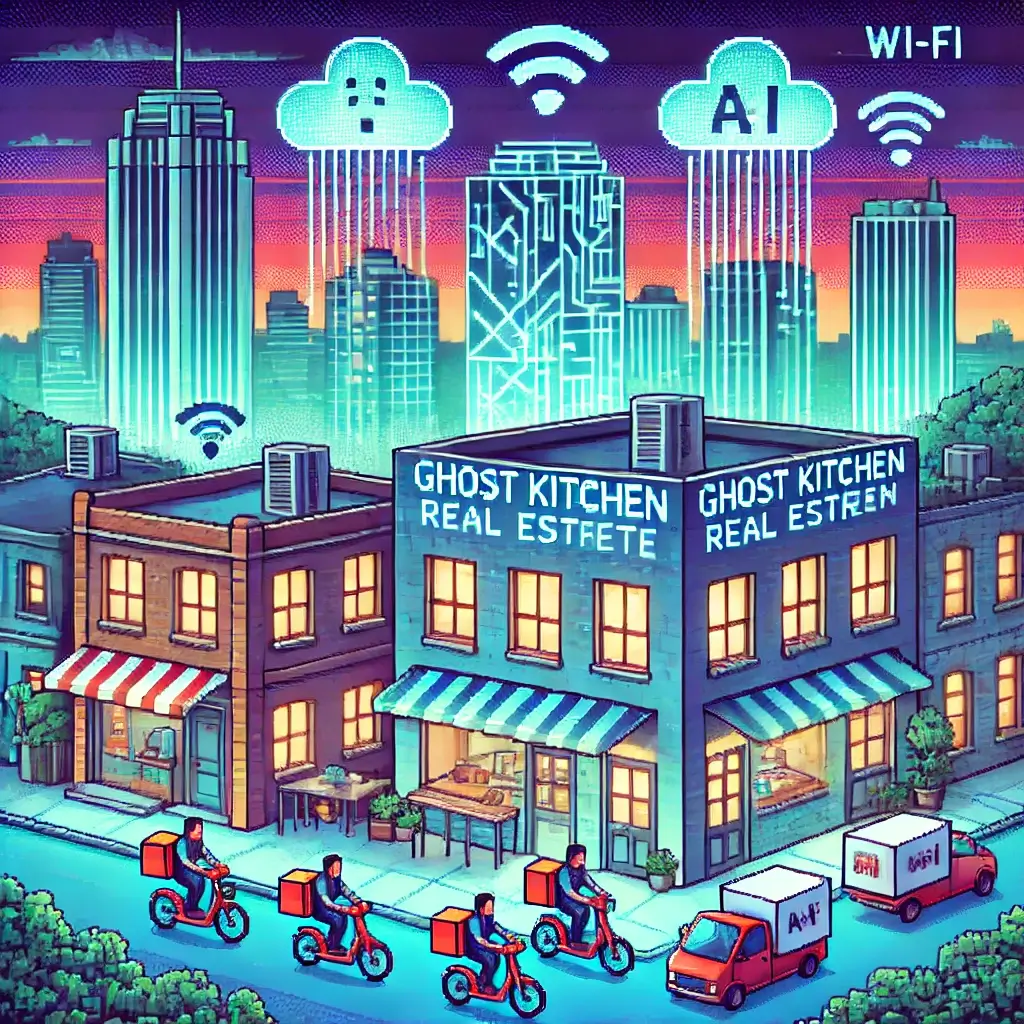
Unlocking 10X Profits: 7 Reasons Ghost Kitchen Real Estate is Your Next Big Move!
Alright, let’s get real for a moment. Have you ever ordered food through an app and wondered where it actually came from? Not from your usual sit-down spot, but some mysterious, super-efficient kitchen that just… makes food?
Well, my friend, you’ve stumbled upon the magic of **ghost kitchens**, and let me tell you, they’re not just a passing fad. They’re a full-blown revolution in the food industry, and more importantly, a goldmine for savvy real estate investors.
Forget everything you thought you knew about traditional restaurant real estate. We’re talking about a whole new beast here: properties purpose-built for “ghost kitchen” operations and food delivery hubs. And if you’re not paying attention, you’re missing out on some serious potential.
I mean, who would’ve thought that the humble takeaway could spawn such a massive opportunity? It’s like the universe conspired to create the perfect blend of tech, food, and property. And trust me, as someone who’s been navigating the murky waters of investments for a while, this one’s got a glow about it that’s hard to ignore.
Let’s dive in, shall we? Because what I’m about to share with you isn’t just theory; it’s the future of food service, wrapped up in a neat, profitable real estate package.
Oh, and before we go too deep, I just want to make a quick note: I’m not a financial advisor. This is just my perspective from seeing the market evolve, and a lot of what I’m sharing comes from deep dives and conversations with folks who are neck-deep in this industry. Always do your own due diligence, and maybe, just maybe, you’ll see what I see.
—Table of Contents
- 1. What Exactly Are Ghost Kitchens Anyway? Your Secret Ingredient to Understanding.
- 2. The Explosive Growth of Food Delivery: Why Your Next Meal is an Investment Opportunity.
- 3. The Real Estate Angle: Why Ghost Kitchens are a Landlord’s Dream.
- 4. The Tech Backbone: How Innovation Fuels Ghost Kitchen Real Estate.
- 5. Case Studies: Real-World Successes in Ghost Kitchen Real Estate.
- 6. Navigating the Challenges: What to Watch Out For in Ghost Kitchen Investing.
- 7. The Future Is Now: Why You Can’t Afford to Ignore Ghost Kitchen Real Estate.
- Additional Resources.
1. What Exactly Are Ghost Kitchens Anyway? Your Secret Ingredient to Understanding.
Think of a ghost kitchen, also known as a dark kitchen, virtual kitchen, or cloud kitchen, as a professional cooking facility built solely for preparing delivery-only meals. There’s no dining room, no wait staff, and no fancy decor for customers to admire. It’s all about efficiency, speed, and getting delicious food to your doorstep.
Imagine a bustling kitchen, full of chefs, but completely hidden from public view. It’s like the Batcave of the culinary world, churning out gourmet dishes without anyone ever seeing the caped crusaders behind the counter. Pretty cool, right?
These operations often house multiple brands under one roof, sometimes even brands owned by the same company, each with its own virtual storefront on food delivery apps. So, that burger you ordered from “Grill Master” and the tacos from “Taco Takedown” might actually be cooked just feet away from each other in the same facility. Mind-blowing, I know!
From a business perspective, it’s brilliant. Restaurants can experiment with new concepts, expand their reach into new neighborhoods without the massive overhead of a traditional brick-and-mortar location, and cater specifically to the ever-growing demand for delivery.
I remember talking to a restaurant owner a few years back who was struggling with high rent and dwindling dine-in customers. He was tearing his hair out trying to figure out how to stay afloat. When I brought up the idea of a ghost kitchen, his eyes lit up. It was like he’d found a secret cheat code for the restaurant business. And honestly, it is a bit like that.
For us, the real estate folks, this means a demand for a very specific type of industrial or commercial space. We’re not talking about prime retail frontage; we’re talking about strategically located, well-equipped kitchens designed for maximum output. It’s a whole new ballgame, and the rules are excitingly in our favor.
The beauty of it lies in its adaptability. A ghost kitchen can be a standalone facility, a shared kitchen space where multiple brands rent bays, or even a repurposed section of an existing restaurant. This flexibility is a huge part of its appeal for operators, and therefore, for landlords like us. The less friction there is for a tenant to set up shop, the more attractive the property becomes.
2. The Explosive Growth of Food Delivery: Why Your Next Meal is an Investment Opportunity.
Let’s face it: ordering food with a few taps on your phone has become second nature for millions. The global online food delivery market is absolutely skyrocketing, and it shows no signs of slowing down.
Remember when delivery was just for pizza and Chinese food? Those days are long gone. Now, you can get gourmet meals, specialized diets, and even obscure cravings delivered right to your door. This isn’t just convenience; it’s a lifestyle shift. And where there’s a significant lifestyle shift, there’s usually a massive investment opportunity lurking.
The COVID-19 pandemic, while certainly a challenging time, acted as a supercharger for this trend. Suddenly, everyone was ordering in, and the infrastructure for delivery had to scale up at an unprecedented pace. Ghost kitchens were perfectly positioned to meet this surging demand, proving their resilience and adaptability.
According to Statista, the online food delivery segment is projected to reach a mind-boggling $1.1 trillion by 2029. Let that sink in for a moment. One point one TRILLION dollars! We’re not talking about small potatoes here; this is a feast of opportunities.
This growth isn’t just about consumer behavior; it’s also driven by technological advancements. Seamless ordering apps, sophisticated logistics, and efficient delivery networks have made it easier than ever to get food from the kitchen to your couch in record time. It’s like a finely tuned orchestra, and ghost kitchens are the star soloists.
When you consider these numbers, it becomes crystal clear why investing in the infrastructure that supports this explosion – namely, ghost kitchen real estate – is a no-brainer. You’re not just betting on a trend; you’re investing in a fundamental change in how people eat and how restaurants operate. It’s like buying land during the gold rush, but instead of gold, we’re dealing with delicious, delivered food.
I’ve seen so many trends come and go, but this one feels different. It’s got legs, and it’s built on a foundation of pure convenience and efficiency that consumers are simply not going to give up. So, if you’re looking for where the smart money is going, just follow the food delivery drivers. They’re literally leading the way to your next big investment.
3. The Real Estate Angle: Why Ghost Kitchens are a Landlord’s Dream.
Now, let’s talk brass tacks: why is ghost kitchen real estate so attractive from a landlord’s perspective? It boils down to several key advantages that make these properties incredibly lucrative.
Lower Build-Out Costs & Faster Turnaround
Unlike traditional restaurants, ghost kitchens don’t need elaborate dining areas, fancy restrooms, or customer-facing amenities. This drastically reduces the initial build-out costs for property owners. You’re essentially building a highly functional, industrial-grade kitchen, not a showroom.
This also means faster tenant turnover. When a new ghost kitchen operator comes in, they can often set up shop much quicker than a traditional restaurant, which means less downtime and more consistent rental income for you. It’s like building a factory versus a luxury hotel. One gets to production much faster.
Higher Utilization & Efficiency
Because they’re delivery-only, ghost kitchens can operate almost 24/7, maximizing the use of the space. They’re designed for peak efficiency, often with multiple brands sharing equipment or operating in shifts. This higher utilization translates directly into better rental yields per square foot.
Imagine a property that’s constantly producing revenue, rather than sitting half-empty during off-peak hours. That’s the ghost kitchen advantage. It’s a non-stop culinary machine, and you get to own the factory.
Diverse Tenant Pool & Reduced Risk
Ghost kitchen facilities can attract a wide array of tenants, from established restaurant chains looking to expand their delivery footprint to emerging food startups testing new concepts. This diversity reduces reliance on any single tenant, spreading out your risk.
Plus, many ghost kitchen operators are well-funded companies with strong business models, offering more stable tenancy compared to independent, often cash-strapped, traditional restaurants. It’s like having a portfolio of tenants, all specializing in one booming area, rather than putting all your eggs in one delicate basket.
Strategic Locations, Not Prime Retail
Ghost kitchens don’t need high foot traffic. Instead, they need to be strategically located in areas that allow for efficient delivery to dense residential or commercial zones. This often means properties in industrial parks, light commercial zones, or even converted warehouses – spaces that are typically less expensive to acquire and develop than prime retail locations.
You can get more bang for your buck on the acquisition side, while still tapping into a massive revenue stream. It’s about being smart, not flashy. You’re buying the engine, not the shiny car body.
Long-Term Lease Potential
Operators investing in specialized kitchen equipment and infrastructure often prefer longer-term leases to recoup their investments. This provides landlords with predictable, long-term rental income and stability, which is music to any investor’s ears.
Think of it: less tenant churn, less time spent finding new renters, and more time enjoying consistent cash flow. It’s a win-win for everyone involved, especially for your bank account.
I once had a client who was hesitant about this niche. He was used to the old ways, the high-street retail, the traditional leases. But after a few months of me showing him the numbers, the low vacancy rates in these specific industrial parks, and the consistent demand, he finally took the plunge. And guess what? He’s now looking for his third ghost kitchen property. The proof, as they say, is in the pudding – or in this case, the perfectly delivered meal.
This isn’t just about renting out a space; it’s about providing essential infrastructure for a rapidly evolving industry. And that, my friends, is where the real power lies in ghost kitchen real estate investment.
4. The Tech Backbone: How Innovation Fuels Ghost Kitchen Real Estate.
You can’t talk about ghost kitchens without talking about technology. It’s the beating heart of the entire operation, from order placement to delivery, and it has a profound impact on the real estate supporting it.
The entire ecosystem relies on sophisticated software platforms. We’re talking about integrated ordering systems that pull from multiple delivery apps (DoorDash, Uber Eats, Grubhub, you name it), kitchen display systems (KDS) that optimize workflow, inventory management software, and even AI-powered tools for demand forecasting. It’s a tech marvel, really.
This reliance on tech means that ghost kitchen properties need robust internet infrastructure. We’re not talking about your grandma’s dial-up here; we’re talking high-speed, reliable fiber optics that can handle a constant stream of data. For us real estate investors, this translates into a need for properties that are either already wired for the future or can be easily upgraded.
Beyond connectivity, think about the physical technology within the kitchens. State-of-the-art ventilation systems, specialized cooking equipment, smart sensors for temperature control – these aren’t just nice-to-haves; they’re essential. Properties that are designed or easily adaptable to accommodate this kind of advanced equipment will be highly sought after.
I remember one operator telling me how their KDS was so good, it could tell them which chef was fastest at making a certain dish, and then optimize the order flow accordingly. That kind of efficiency is only possible with cutting-edge tech, and it’s what makes these operations so profitable.
Furthermore, technology is revolutionizing logistics. Optimized routing for delivery drivers, real-time tracking, and even drone or robot delivery in the not-too-distant future will further enhance the efficiency of ghost kitchen networks. This future-proofing aspect makes these real estate investments even more appealing.
When you’re evaluating a potential ghost kitchen property, don’t just look at the brick and mortar. Look at the digital infrastructure. Does it have the bandwidth? Can it support the smart equipment of tomorrow? Because in this game, if the tech isn’t humming, the kitchen isn’t cooking.
It’s fascinating to see how the physical and digital worlds are merging in this space. It’s not just about walls and roofs anymore; it’s about conduits and fiber, about uptime and data processing. It’s a geek’s paradise, and a smart investor’s playground.
5. Case Studies: Real-World Successes in Ghost Kitchen Real Estate.
It’s one thing to talk about theories and projections, but seeing real-world examples always helps solidify the concept. Let’s look at a few examples of how ghost kitchen real estate has played out successfully.
CloudKitchens: The Pioneer of Ghost Kitchen Real Estate
Perhaps the most prominent player in this space is CloudKitchens, founded by Uber co-founder Travis Kalanick. They acquire real estate, build out shared commercial kitchen spaces, and then lease them to various restaurant brands. Their model is all about optimizing locations for delivery, creating high-density food hubs in urban and suburban areas.
They’ve raised billions of dollars, proving investor confidence in the model. Their success demonstrates that there’s massive demand for purpose-built, shared kitchen facilities that reduce overhead for food businesses and streamline delivery.
I’ve heard stories from operators who saw their delivery radius expand dramatically just by moving into a CloudKitchens facility. It’s not just about the space; it’s about the ecosystem they provide. They make it almost too easy for restaurants to jump into the delivery game.
Kitchen United: A Different Spin on Shared Kitchens
Kitchen United is another major player that focuses on providing fully equipped ghost kitchen spaces. What’s interesting about them is their strategic partnerships with grocery stores and malls, turning underutilized retail spaces into bustling food delivery hubs.
This innovative approach shows how existing real estate can be repurposed and given new life, adding value to properties that might otherwise be struggling. It’s a fantastic example of adaptive reuse, and it opens up a whole new category of potential properties for investors.
Imagine taking a dead mall anchor store and transforming it into a vibrant food production center. That’s exactly what Kitchen United is doing, and it’s genius. It’s like a phoenix rising from the ashes, but instead of fire, it’s fueled by delicious food orders.
Local Success Stories: The Independent Players
It’s not just the big fish making waves. Many smaller, independent developers and landlords are finding success by acquiring industrial properties, converting them into multi-kitchen ghost facilities, and leasing them out. These often cater to local businesses and burgeoning food entrepreneurs.
I know a developer in a mid-sized city who bought an old bakery building for a song. He refurbished it, installed multiple kitchen bays with shared cold storage and prep areas, and within months, it was fully leased. His tenants range from a popular local caterer looking for extra capacity to a startup specializing in healthy meal kits.
These individual success stories highlight the versatility and broad applicability of the ghost kitchen real estate model. You don’t have to be a multi-billion dollar company to get in on this action. Sometimes, it’s the smaller, agile players who find the best deals and create the most tailored solutions for their local markets.
These examples aren’t just isolated incidents; they’re clear indicators of a powerful and sustainable trend. They show that purpose-built ghost kitchen properties are not only viable but are generating significant returns for those who invest in them.
6. Navigating the Challenges: What to Watch Out For in Ghost Kitchen Investing.
Now, I’m not here to paint an overly rosy picture and tell you it’s all rainbows and unicorns. Like any investment, ghost kitchen real estate comes with its own set of challenges. Being aware of these can help you mitigate risks and make more informed decisions.
Market Saturation in Some Areas
While the market is growing, certain highly concentrated urban areas might see an increasing number of ghost kitchen facilities. This could lead to increased competition for tenants and potentially drive down rental rates or increase vacancy periods if not managed carefully.
It’s essential to conduct thorough market research on local demand and existing supply. Don’t just jump in because everyone else is; make sure there’s still room at the table in your target market. It’s like finding a good fishing spot. You want to be where the fish are, but not where every other fisherman in the county is already casting their line.
Regulatory and Permitting Complexities
Commercial kitchens, especially those handling multiple food businesses, are subject to stringent health, safety, and zoning regulations. Navigating permits, inspections, and compliance can be complex and time-consuming. You need to be prepared for the red tape, or hire someone who is a master at untangling it.
This isn’t just about building a wall; it’s about grease traps, ventilation, fire suppression systems, and food handling certifications. Get it wrong, and you could face costly delays or fines. Always consult with local authorities and experts familiar with food service regulations. Don’t skimp on this part; it can bite you hard later.
Technological Obsolescence
As we discussed, technology is integral to ghost kitchens. However, technology evolves rapidly. What’s state-of-the-art today might be outdated in a few years. Property owners need to consider future-proofing their facilities, which might involve periodic upgrades to infrastructure and equipment.
This isn’t a “set it and forget it” kind of investment. It requires a forward-thinking approach and a willingness to reinvest to stay competitive. Think of it like owning a data center. You always need to be thinking about the next upgrade, not just the current setup.
Finding the Right Location (and not just any cheap space)
While ghost kitchens don’t need prime retail, they do need *strategic* locations. Proximity to dense residential areas, good access for delivery drivers, and efficient routes are crucial. A cheap property in the middle of nowhere, even if it’s perfectly zoned, won’t cut it if it adds 20 minutes to every delivery time.
It’s a delicate balance between cost and logistical advantage. Don’t just buy the cheapest industrial space you can find. Do your homework on delivery zones and population density. Location, location, location still matters, just with a different set of criteria.
Tenant Management and Shared Infrastructure
Managing multiple tenants in a shared kitchen facility can present unique challenges. Issues around shared equipment, cleanliness, scheduling, and utility usage need clear agreements and strong management. If one tenant isn’t pulling their weight, it can impact everyone else.
You’re not just a landlord; you’re also a facility manager, and sometimes, a mediator. Having robust lease agreements and a proactive management approach is key to keeping everything running smoothly. It’s like running a co-working space, but with more grease and less quiet typing.
Despite these challenges, with careful planning, due diligence, and a robust understanding of the market, the rewards of ghost kitchen real estate can far outweigh the risks. It’s about being smart, not scared. Every great opportunity has its hurdles, and overcoming them is part of the fun – and the profit.
7. The Future Is Now: Why You Can’t Afford to Ignore Ghost Kitchen Real Estate.
So, where does this all leave us? Right on the cusp of a transformative investment opportunity. The growth drivers for ghost kitchens – consumer demand for delivery, technological advancements, and the inherent efficiency for food businesses – are not going anywhere. In fact, they’re accelerating.
Investing in properties purpose-built for “ghost kitchen” operations isn’t just about riding a trend; it’s about investing in the future infrastructure of the food service industry. It’s a strategic move that aligns with fundamental shifts in consumer behavior and business models.
Consider the long-term play. As more and more food consumption shifts to off-premise dining, the need for these specialized kitchen hubs will only intensify. This means consistent demand for your properties, stable rental income, and potentially significant appreciation in value.
It’s like being an early investor in data centers when the internet first took off. You’re providing the essential physical space for a rapidly expanding digital economy. The parallel is striking, and the potential returns could be just as impressive.
I’ve seen too many investors stick to what they know, even when the writing is on the wall for new opportunities. Don’t be that person. The world is changing, and smart money moves with it. The ghost kitchen sector isn’t just knocking on the door; it’s already got its feet under the table and is ordering dessert.
Whether you’re a seasoned real estate investor looking to diversify your portfolio, or a newcomer seeking a high-growth niche, ghost kitchen real estate offers a compelling proposition. It’s an exciting, dynamic, and incredibly relevant sector that’s poised for continued expansion.
So, take a good, hard look at your investment strategy. Are you still thinking in terms of traditional retail, or are you ready to embrace the revolution? Because the aroma of profit in ghost kitchen real estate is getting stronger by the day. Don’t miss out on this delicious opportunity.
Now, if you’ll excuse me, all this talk about food has made me hungry. I think I’ll just order something in… from a ghost kitchen, of course!
Additional Resources
Want to dig a bit deeper? Here are some fantastic resources that can provide more insights into the ghost kitchen market and food delivery industry:
Restaurant Business Online – Ghost Kitchens: What Are They And How Do They Work?
Eater – What Are Ghost Kitchens, Anyway?
QSR Magazine – The State of Ghost Kitchens
Ghost Kitchens, Real Estate Investment, Food Delivery Hubs, Commercial Property, Virtual Restaurants