
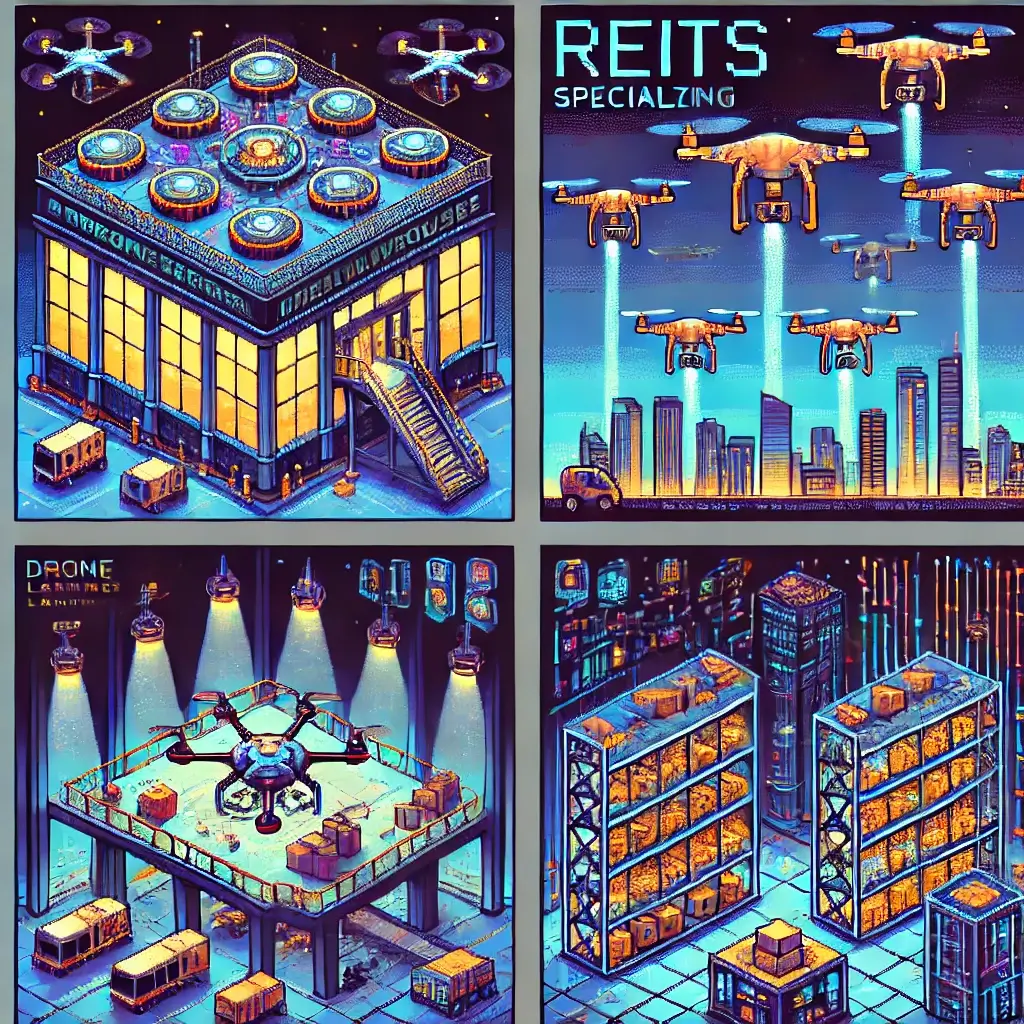
REITs Specializing in Drone Delivery Warehouses: 17 Wild Lessons for Investors Who Still Believe in Gravity
Table of Contents
Why I Wrote This at 1:36 A.M. with Cold Coffee
I wrote this because I couldn’t stop thinking about a very specific kind of building that keeps showing up in my notes like a stubborn seagull at a beach picnic.
These buildings don’t look like skyscrapers or cathedrals or anything that would make a postcard, and yet they whisper, “We might change the math of your city.”
They’re warehouses, but not the long-haul thunder gods we grew up with, and not the cute mini-storage units with reality TV drama baked in.
They’re tighter, faster, vertically choreographed spaces designed for fleets of autonomous flying ants that carry toothpaste and Thai curry paste and a replacement for that cable you lost behind your desk six months ago.
And somewhere between the drone pads and the charging rails lives a REIT strategy that might be boring enough to be brilliant.
Maybe I’m wrong, but I don’t think I am, and if I am, at least we’ll be wrong together, which is nicer.
What Are REITs Specializing in Drone Delivery Warehouses Anyway?
Let’s de-jargon this like a friend who explains taxes with a napkin and a pen that doesn’t work at first try.
A REIT is a Real Estate Investment Trust, which is basically a company that owns income-producing real estate and shares most of its taxable income with investors as dividends.
Now, imagine that REIT deciding to focus on the tiny, weird, exciting niche of buildings optimized for drone logistics.
Not just any warehouse, but drone-friendly ones with rooftop launch pads, airside safety corridors, redundant power, micro-fulfillment automation, and flight operations rooms that feel like air-traffic control had a baby with a video game studio.
That’s it.
REITs Specializing in Drone Delivery Warehouses take rent from tenants who run drone operations, last-mile e-commerce, medical courier services, and possibly the occasional “oh no the dog ate the remote” emergency delivery provider.
At the beginner level, you can think of them as vertical parking garages for flying robots and the inventory those robots carry.
At the intermediate level, you’ll see power density, airspace coordination, and pick-to-takeoff cycle times showing up in rent roll logic.
At the expert level, it becomes a live-fire exercise in underwriting regulatory velocity, urban air mobility demand elasticity, and the very spicy question of who captures the value of a 12-minute delivery promise.
Why Now: The Timing Puzzle Behind REITs Specializing in Drone Delivery Warehouses
Technologies don’t just appear; they coalesce like thunderstorms when temperature, pressure, and bad timing meet at a rooftop party.
On the demand side, consumers keep ordering little things instantly because our thumbs are bored and patience is a fossil.
On the supply side, companies obsess over the last mile like it’s the final season of their favorite show, because that mile is where margins go to cry.
Drones offer a path to shave minutes and emissions if the math and the maps align, and buildings are where that math gets real.
Regulators are also moving from “no, we hate fun” to “okay, let’s try fun with rules,” which sounds silly but is exactly the turning point real estate needs to standardize specs.
Meanwhile, industrial land near population centers isn’t getting cheaper or larger; it’s playing Tetris with zoning boards and neighbors and noise maps.
All of this creates a timing window where specialized assets could command better rents, better retention, and possibly—maybe—better cap rates if you underwrite with both eyes open and a third eye for noise-complaint politics.
How the Buildings Actually Work: Inside REITs Specializing in Drone Delivery Warehouses
Picture a box that learned choreography.
Inventory enters one side, gets robotically sorted into dense shelving, then flows into micro-kitting stations where human-machine teams put together tiny orders with the precision of a sushi bar at lunch rush.
Upstairs—or on the roof—there are launch bays with weather sensors, RF beacons, and charging nests that look like minimalist birdhouses for electric bees.
The walls are lined with higher-amp power runs and battery storage rooms that smell faintly of science and spreadsheets.
Fiber lines whisper like espresso machines because telemetry hates lag.
There’s a secure cage for regulated goods, a separate corridor for medical deliveries, and a set of redundant exits because every fire marshal has a favorite nightmare.
And yes, there are noise-attenuating materials, because drones hum like ambitious mosquitoes and neighbors love sleep even more than instant noodles.
Beginner Layer
Think of a drone warehouse as a beehive built for packages where bees clock in, clock out, and never sting the HR department.
The bees need clean paths, consistent food, and a safe place to land when clouds act like divas.
That’s the building.
Intermediate Layer
Operations managers look at cycle time from “order confirmed” to “rotors up.”
They design pick paths, define “no-go” zones, and balance throughput with battery charge health.
They care about uptime, and uptime is born from power quality, redundancy, and operations offices that can swap to manual protocols faster than a gamer hits pause.
Expert Layer
Underwriting asks whether certain air corridors will be quasi-public infrastructure with utility-like rules or a private toll road for whoever owns the best corridors and rooftop rights.
It asks how altitude, wind patterns, and envelope weight limits affect the capture radius, which then feeds location analytics and rent premiums.
It asks how much rooftop structure you need to carry dozens of landing pads, and what that does to insurance, capex reserves, and fun things like life-cycle emissions accounting that investors debate when the charts look flat.
Unit Economics You Can Explain to a Sleep-Deprived Friend
Let’s make a tiny P&L out of Lego bricks and see where the colors snap together.
For tenants, drone delivery economic drivers include parcel weight, flight distance, battery life, pilot oversight ratios, and regulatory overhead that may require human eyes on certain flights.
On the real estate side, the drivers are rent per square foot and per rooftop square foot, power pass-throughs, common area maintenance, and capex for specialized features like VLOS/BVLOS control rooms and reinforced roofs.
Shorter delivery sells more, which increases turnover, which increases staffing, which increases training, which increases the need for stable facilities where you can control as much as possible.
That’s how a building becomes a platform and not just a box with walls.
The Four Numbers I Scribble on Napkins
First, revenue density per cubic foot, not just per square foot, because verticality is the unsung hero of drone operations.
Second, kilowatt-hours per successful sortie, since batteries are your stubborn rent-sharing partners.
Third, mean time to dispatch, a fancy way of asking how long the building takes to turn “order in” into “goodbye, little robot.”
Fourth, tenant retention probability when you provide redundant fiber, resilient power, and good neighbor agreements that prevent pitchfork parties.
Leases, Covenants, and the Quiet Poetry of Industrial Real Estate
Leases for REITs Specializing in Drone Delivery Warehouses will likely start as modified gross or NNN with escalation clauses and capital improvement riders for tech refreshes.
Expect bespoke language around roof rights, airspace adjacency, nighttime operations, noise thresholds, and battery storage compliance.
Some tenants may ask for revenue-share kickers on rooftop advertising or co-branded community programs, because it’s 2025 and we’re all marketers now.
Insurance becomes a duet between property, liability, and aviation-adjacent coverage, with addenda that can read like a spy novel if you love acronyms.
Pro tip for the intermediate crowd, negotiate who pays when regulations force a retrofit, because that sentence can smell like money leaving your pocket in slow motion.
For experts, the covenant package and cross-default logic matter as much as cap rates, because defaults travel like gossip and buildings remember everything.
Top Risks Hiding in Plain Sight for REITs Specializing in Drone Delivery Warehouses
Risk number one is regulatory tempo, which moves like a jazz drummer who refuses to play straight fours.
If BVLOS permissions stall or community pushback slows flight corridors, your best building is a beautiful stage without a band.
Risk number two is technology obsolescence.
Battery chemistry changes, weight limits shift, and suddenly your roof load calculation feels like a flip phone at a smartphone party.
Risk number three is NIMBY, which looks mild until it’s not, and then it’s a marathon of hearings where everyone becomes an acoustics expert overnight.
Risk number four is insurance repricing after a high-profile incident because markets have long memories and short patience.
Risk number five is capital markets volatility, which doesn’t care how cool your drones are when refinancing meets a cold yield curve.
Infographics: REITs Specializing in Drone Delivery Warehouses
Global Drone Delivery Market Growth
2022
2025
2030
Projected drone delivery market expansion drives demand for specialized warehouses.
Drone Delivery Warehouse Value Chain
1. Site Selection
Urban access + zoning
2. Construction
Rooftop pads + power
3. Automation
Micro-fulfillment + fiber
4. Operations
Leases + dispatch
5. Reporting
ESG + uptime
Drone Warehouse vs. Traditional Warehouse
| Feature | Traditional Warehouse | Drone Delivery Warehouse |
|---|---|---|
| Rooftop Use | Minimal | Launch pads + charging bays |
| Power Demand | Standard | High-density with redundancy |
| Fulfillment | Manual + bulk | Automated + micro orders |
| Lease Complexity | Simple NNN | Special clauses: noise, flight ops |
Dividend Potential by REIT Type
Retail REIT
Industrial REIT
Drone Warehouse REIT
Drone-focused REITs show higher yield potential due to specialized rent premiums.
Five Moats That Might Actually Matter for REITs Specializing in Drone Delivery Warehouses
Moat one is site selection where airspace, zoning, and access roads harmonize instead of fight like tired siblings on a road trip.
Moat two is relationships with regulators and communities that translate into predictable operations and sanity for property managers.
Moat three is standardized build-outs that cut tenant move-in time from months to weeks, because speed is a discount factor’s love language.
Moat four is data—knowing your own uptime, your tenants’ pain points, and the twelve tiny fixes that raise throughput by 7% and make lease renewals boringly easy.
Moat five is power resilience, from microgrids to on-site storage, because if your building kills the lights at 5 p.m., no one claps.
Global Angles for REITs Specializing in Drone Delivery Warehouses
Cities are different creatures wrapped in the same hoodie, and drone corridors run into local culture immediately.
Dense Asian megacities might prefer mid-rise rooftops with shared pads and strict curfews that make midnight deliveries the stuff of legends rather than policies.
European towns are often allergic to noise but love efficiency, so expect high standards on safety and charmingly stern municipal letters about decibel limits.
In the Americas, last-mile sprawl invites campus-style parks with multiple tenants sharing dispatch hubs like polite roommates who label their oat milk, until they don’t.
Cross-border medical delivery can be the wedge issue that proves value to regulators and citizens faster than groceries ever will.
Research Framework: How to Read a 10-K Without Crying for REITs Specializing in Drone Delivery Warehouses
Start with the business description and look for whether management defines the niche clearly or hides it behind adjectives like “innovative adjacency,” which is corporate for “we’re figuring it out.”
Flip to the risk factors and highlight anything about regulatory permissions, battery tech, rooftop load ratings, or power upgrades that could force capex surges.
Scan the MD&A for same-property NOI drivers, tenant concentration, lease rollover schedules, and any metrics tied to uptime or throughput—those are your story beats.
Learn management’s incentive comp structure, because humans chase the carrots you hand them, not the poems you write them.
Then triangulate capex plans with community relations line items and see if the numbers talk to each other like old friends or strangers at an elevator.
Beginner Checklist (Print This, Tape It to Your Fridge)
Do I understand how this REIT makes rent from drone operations.
Do I know their top three tenants and the renewal cliffs in the next three years.
Do I know where the buildings are and if the neighbors like them.
Do I understand the dividend policy and whether it’s sustainable if one tenant leaves in a dramatic huff.
Intermediate Checklist (Bring a Highlighter)
Map lease expirations against likely regulatory milestones for drone corridors.
Estimate power upgrades needed per site and compare to the capex reserve disclosures.
Look for language about BVLOS operations, nighttime curfews, and city-specific memoranda of understanding.
Expert Checklist (Wear Elbow Patches, Even Digitally)
Underwrite scenario bands for battery energy density improvements and the impact on roof pad density and sortie throughput.
Model tenant credit exposure using probability-of-default bands for early-stage logistics players and mature incumbents.
Stress test WACC under refinancing spreads that widen in grumpy markets, because grumpy markets are a recurring character in this story.
Portfolio Construction for Real People with Real Emotions in REITs Specializing in Drone Delivery Warehouses
I am not your financial advisor, I am just a person with too many tabs open and an allergy to boring portfolios.
That said, consider position sizing like you’re tasting hot sauce—start small, observe your sweat level, scale if your tongue still believes in love.
If you already hold industrial REITs, think of drone-specialized names as satellites orbiting your core, not the sun declaring war on gravity.
Diversify tenants, geographies, and regulatory regimes so one stubborn city council doesn’t narrate your quarterly call.
Pair with infrastructure or data-center exposure if you believe the future is electrified and latency-intolerant, which frankly it is.
Reinvest dividends if your time horizon smiles at compounding; take cash if you’re building a rainy-day fund for when your drone delivers ramen and existential questions.
Future Scenarios for REITs Specializing in Drone Delivery Warehouses
2027 “Proof Everywhere” feels like a world where medical, pharmacy, and high-value small electronics dominate drone flows and neighbors tolerate the hum because grandma’s insulin arrived during a storm once and now everyone tells that story.
2030 “Quiet Revolution” imagines quieter rotors, better batteries, and standardized rooftop modules which finally let appraisers stop blinking so hard at your rent comps.
2040 “Sky Grid” is weirder, with sky lanes, digital twins of cities, and drone hubs tucked into mixed-use developments where launch pads sit next to rooftop gardens and nobody thinks it’s odd.
Or none of this happens and we all go back to arguing about curb space and scooter parking, but I doubt it.
ESG, Community, and the Sound of Drones at Sunset for REITs Specializing in Drone Delivery Warehouses
ESG isn’t a slogan; it’s a design brief with consequences that show up as lower utility bills and fewer angry town halls.
Environmental means quieter hardware, better insulation, and local renewables that make your power meter sigh with relief.
Social means hiring locally, sponsoring STEM programs, and publishing noise and safety dashboards the way good restaurants publish their health scores.
Governance means board members who know the difference between a spec rooftop and a pad-reinforced grid, and who can say no to shiny toys that don’t pencil.
Taxes and Structures, Explained Like You’re Holding a Sandwich for REITs Specializing in Drone Delivery Warehouses
REITs distribute most of their taxable income as dividends, which may be taxed as ordinary income unless qualified adjustments apply, and no, I’m not ruining your sandwich by discussing basis right now.
There can be taxable REIT subsidiaries handling certain services so the REIT stays compliant while tenants get the help they need with on-site operations and maintenance contracts.
If you live in a place with special tax treatment for dividends, congratulations, you’ve discovered how geography is a financial instrument.
Always double-check your local rules, because surprises are best reserved for birthdays, not tax season.
Infographic: The Value Chain of REITs Specializing in Drone Delivery Warehouses
Below is a simple HTML infographic that you can paste into your blog and it will actually render, not just look pretty in a screenshot.
Drone-Optimized Warehouse Value Chain
1) Site & Permits
Airspace + zoning alignment.
2) Build & Power
Reinforced roof + high-amp runs.
3) Automate & Fiber
Micro-fulfillment + telemetry.
4) Lease & Launch
NNN leases + dispatch.
5) Operate & Report
Uptime, noise, ESG metrics.
Throughput vs. Power Use
Taller bar suggests higher throughput per square foot with improved power efficiency assumptions.
And Now, a Helpful Pause for the Humans Who Run Ads
Break time, money time, ad time.
Here’s the snippet you asked for, tucked neatly where a reader’s eyes naturally rest before we sprint into the next chapter.
Trusted External Resources for REITs Specializing in Drone Delivery Warehouses
When you want to go deeper than this nocturnal love letter to industrial real estate, you deserve sources you can bookmark and revisit when your coffee has feelings.
Yes, these are big, colorful, and truly clickable.
They lead to trustworthy English-language resources.
Click any of those and you will end up somewhere useful, not a void where time goes to nap.
FAQ
Q1. Are REITs Specializing in Drone Delivery Warehouses just a fancy way to say “normal industrial with extra roof toys”.
A. Partly, but not really, because power density, telemetry, and rooftop loading change design, operations, and lease language more than you’d expect.
Q2. What if regulations slow down.
A. Then the buildings still function as high-efficiency micro-fulfillment hubs, but the yield thesis shifts from “drone premium” to “location + automation premium.”
Q3. How do I tell whether a location will age well.
A. Look for triangulation of demand density, forgiving wind patterns, collaboration from local authorities, and reliable power with room for on-site storage.
Q4. Should I worry about noise.
A. Yes, like you worry about a neighbor learning the drums—manageable with planning and diplomacy, disastrous if ignored.
Q5. Is this niche too small to matter.
A. Niche today, portfolio slice tomorrow, inevitable footnote in logistics history by the time your favorite coffee mug chips and you refuse to throw it away.
Seventeen Wild Lessons I Wish Someone Had Whispered to Me
One, specialization in real estate is a love language for tenants who hate surprises.
Two, build for redundancy the way you bring extra socks on a long hike—future you is grateful and slightly smug.
Three, lease riders about roof rights are tiny lines that move big money.
Four, community agreements beat lawsuits nine days out of ten and the tenth day is a holiday.
Five, operations dashboards are leasing weapons in disguise.
Six, never underestimate the healing power of a quiet rotor and a polite landing light.
Seven, the slope of your power bill tells the story of your future cap rate.
Eight, appraisers are humans trying to map tomorrow with today’s rulers; help them.
Nine, don’t chase shiny tech that cooks your reserves.
Ten, the best property managers are part meteorologist, part diplomat, part electrician, and entirely heroic.
Eleven, if you can’t draw the flight corridor with a crayon on a city map, you don’t understand it yet.
Twelve, the fastest way to lose a renewal is to ghost a neighbor committee.
Thirteen, battery rooms need love, sensors, and snacks for the staff who babysit them at 2 a.m.
Fourteen, drones don’t replace humans; they move humans to higher-leverage jobs and better jokes in the break room.
Fifteen, safe operations are beautiful operations, and beautiful operations make better returns.
Sixteen, your brand is not your logo; it’s the way your buildings behave when something goes wrong.
Seventeen, humility beats bravado in a sector where physics and policy are co-authors.
Three Persona Walkthroughs: Beginner, Intermediate, Expert
Beginner: “Explain It Like I’m Staring at a Drone on My Balcony”
A REIT buys buildings and rents them to companies that fly packages to people quickly.
These special buildings help the drones charge, launch, and land safely, and they help the workers inside pack things fast.
If the buildings do their job, the tenants stay, the REIT pays dividends, and you feel smug in a soft, responsible way.
Intermediate: “Give Me a Real Example”
Imagine an urban footprint with three sites within ten minutes of dense neighborhoods.
Each site has a reinforced roof with twelve pads, a micro-fulfillment floor with mobile racks, and a control room for BVLOS oversight within approved corridors.
Leases are seven years, NNN, with 2.5% annual bumps, capex riders for tech refresh every 36 months, and a noise ceiling clause that triggers acoustic upgrades funded 60% by tenant, 40% by landlord within a shared budget.
Expert: “Talk to Me About Capital Stack and Optionality”
Blend a conservative LTV with green financing tied to measured decibel reduction and energy intensity per sortie.
Structure rooftop rights as distinct revenue streams where permissible, and securitize long-dated leases when spreads smile at you.
Maintain a TRS for ancillary services while guarding the REIT’s asset test compliance like it’s your grandmother’s recipe box.
Due Diligence Mini-Toolkit for REITs Specializing in Drone Delivery Warehouses
Walk the roof and ask to see load calculations, not just pretty drawings.
Check the battery room’s ventilation plan and the exact make of suppression systems because fire doesn’t care how persuasive your deck was.
Confirm fiber redundancy with a failover demo, not a promise scribbled in a margin.
Read the neighbor agreements like literature—tone matters and subtext screams.
Ask about winter operations protocols even if you live where seasons are a rumor.
The Human Side: Property Managers Are Secret Superheroes
The best ones keep coins for vending machines, extra charging adapters, and a list of city contacts longer than a CVS receipt.
They know who to text when a wind shear alert lands five minutes before peak dispatch.
They can spot a stressed battery by smell, which is a sentence I did not expect to write in my lifetime.
If your REIT brags about training, retention, and on-call depth for its ops teams, take that seriously.
Cities, Stories, and the Politics of the Sky
City halls love jobs, hate noise, and adore press conferences where they point at exciting things that demonstrably don’t hurt anybody.
Being the REIT that shows up early with data, modesty, and pastries is a weirdly powerful competitive advantage.
Host open houses on rooftops with safe demo flights and kid-friendly ear protection, and your next variance hearing might include applause, which is rarer than unicorns.
Practical Metrics: What to Track Quarterly
Occupancy, obviously, but also uptime hours of launch capacity and the ratio of dispatch windows to weather downtime.
Track curfew compliance incidents like you track late rent—relentlessly and with receipts.
Watch repair ticket closure times for critical systems, because slow fixes rot trust.
Keep a rolling capex plan that assumes at least one technology surprise per year, ideally a pleasant one but plan otherwise.
🚀 Ready to Explore Drone REITs?
📋 Investor Readiness Checklist
How This Niche Could Touch Your Daily Life
One day your prescription refills at 8 p.m. and arrives by 8:17, and you suddenly forgive drones for sounding like determined bees with day jobs.
Small businesses ship same-evening replacement parts and keep customers who used to defect at the speed of annoyance.
Emergency deliveries after storms carve new, quiet paths of resilience no one posts on social media because they’re too busy being grateful.
Conclusion: A Pep Talk with a Flashlight
This niche is small enough to ignore and large enough to haunt you later if you do.
REITs Specializing in Drone Delivery Warehouses could become the plumbing of instant logistics, which is neither glamorous nor trivial.
The winners will master boring excellence—power, permissions, people—and resist the temptation to cosplay as a venture fund.
If your gut says “this might be something,” give it a seat at your table, but not the head of the table, not yet, and maybe never, and that’s okay.
Invest with a sense of humor, a plan for storms, and a willingness to be early without being reckless.
Close the laptop, stretch your neck, and imagine a rooftop humming softly above a city that still sleeps.
Tomorrow, call an investor relations line and ask a question no one else is brave enough to ask.
You’ve got this.
Watch: How Warehouse Drones Are Changing Freight
This video gives a fascinating look at how drones are actually being used in warehouses to streamline freight operations right before peak logistics season. It’s a great primer for anyone curious about the nuts and bolts of drone-optimized facilities.
Keywords: REITs specializing in drone delivery warehouses, industrial real estate, last-mile logistics, drone logistics, dividend investing
🔗 Cold Storage REITs & Lab-Grown Meat Posted 2025-08-26 12:15 UTC 🔗 Hyperscale Cloud Storage REITs Posted 2025-08-25 21:35 UTC 🔗 Quantum Lab Real Estate 2025 Posted 2025-08-24 07:44 UTC 🔗 Data Center REITs 2025 Posted 2025-08-23 10:19 UTC 🔗 Geothermal Power Plant Land Lease Posted (no date given)