

Step-by-Step: How a Lawyer Handles an Auto Insurance Claim From First Call to Settlement – 7 Shocking Lessons From My First Crash and the Proven Payout Strategy I Wish I’d Known
The night I had my first car crash, I honestly thought the worst part would be the sound of my bumper crumpling like a soda can—or maybe the tow truck bill that hit harder than the collision. Turns out, I was wrong.
The real chaos didn’t kick in until three days later, when an insurance adjuster called me with what she called a “friendly offer.” Spoiler alert: it wasn’t that friendly. Somewhere between the legal jargon and the weirdly chipper voice on the other end of the line, my brain turned into oatmeal. Cold oatmeal.
So if you’re currently buried under forms, medical bills, and cryptic deadlines, take a breath. You’re not alone—and no, you don’t need to become a part-time paralegal just to get through this.
In the next few minutes, I’ll walk you through exactly how auto insurance claim lawyers handle this stuff—step by step—from that very first phone call all the way to the (hopefully large) settlement check.
You’ll see the exact workflow lawyers use behind closed doors, the negotiation strategy I really wish I had known before I accidentally said something dumb on a recorded call, and a dead-simple 60-second estimator that’ll help you figure out your next move—today.
You’re not here to fight a legal war. You just want to walk away from this with a fair outcome without having your life hijacked by paperwork and phone tag for the next 12 months. That’s what this guide is for: a clear, behind-the-scenes look so you can talk to lawyers and insurance reps like someone who actually knows what they’re doing—even if you’re still figuring it out as you go.
Table of Contents
60-Second Check: Do You Really Need an Auto Insurance Claim Lawyer?
Answer these quickly—if you hit “yes” on two or more, it’s time to at least talk to a lawyer.
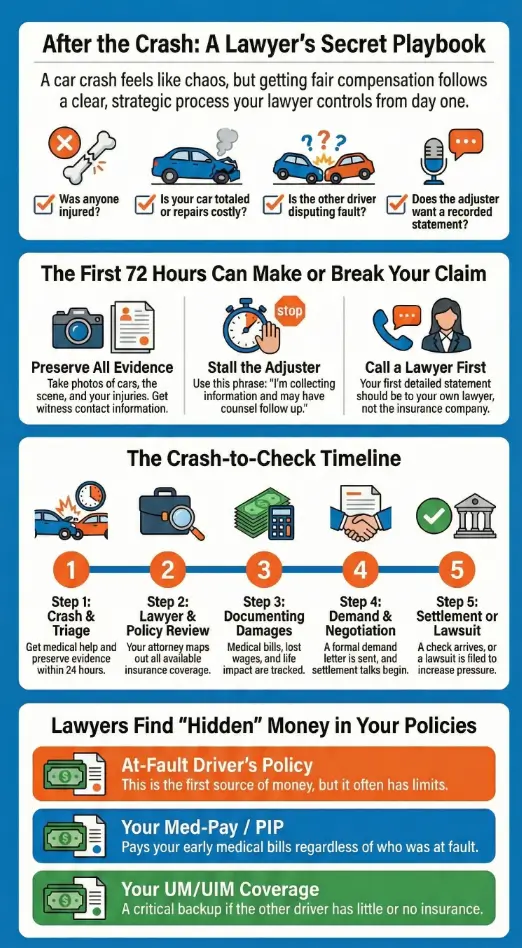
- Someone was injured (you, passenger, or the other driver).
- Your car is totaled or repair costs are more than a month of your take-home pay.
- The other driver is disputing fault or blaming you.
- An adjuster wants a recorded statement and you feel even slightly nervous.
- There’s talk of “policy limits,” “comparative negligence,” or “coverage issues.”
Next step: Take a photo of this checklist, circle your “yes” answers, and bring it to your first call with any auto insurance claim lawyer.
What Really Happens After a Crash (The Lawyer’s View)
From your side, a car accident feels like chaos: flashing lights, tow trucks, texts from family asking if you’re “okay” when you don’t even know what that means yet. From a lawyer’s side, the same crash looks like a timeline with deadlines, coverage tiers, evidence gaps, and negotiation leverage points.
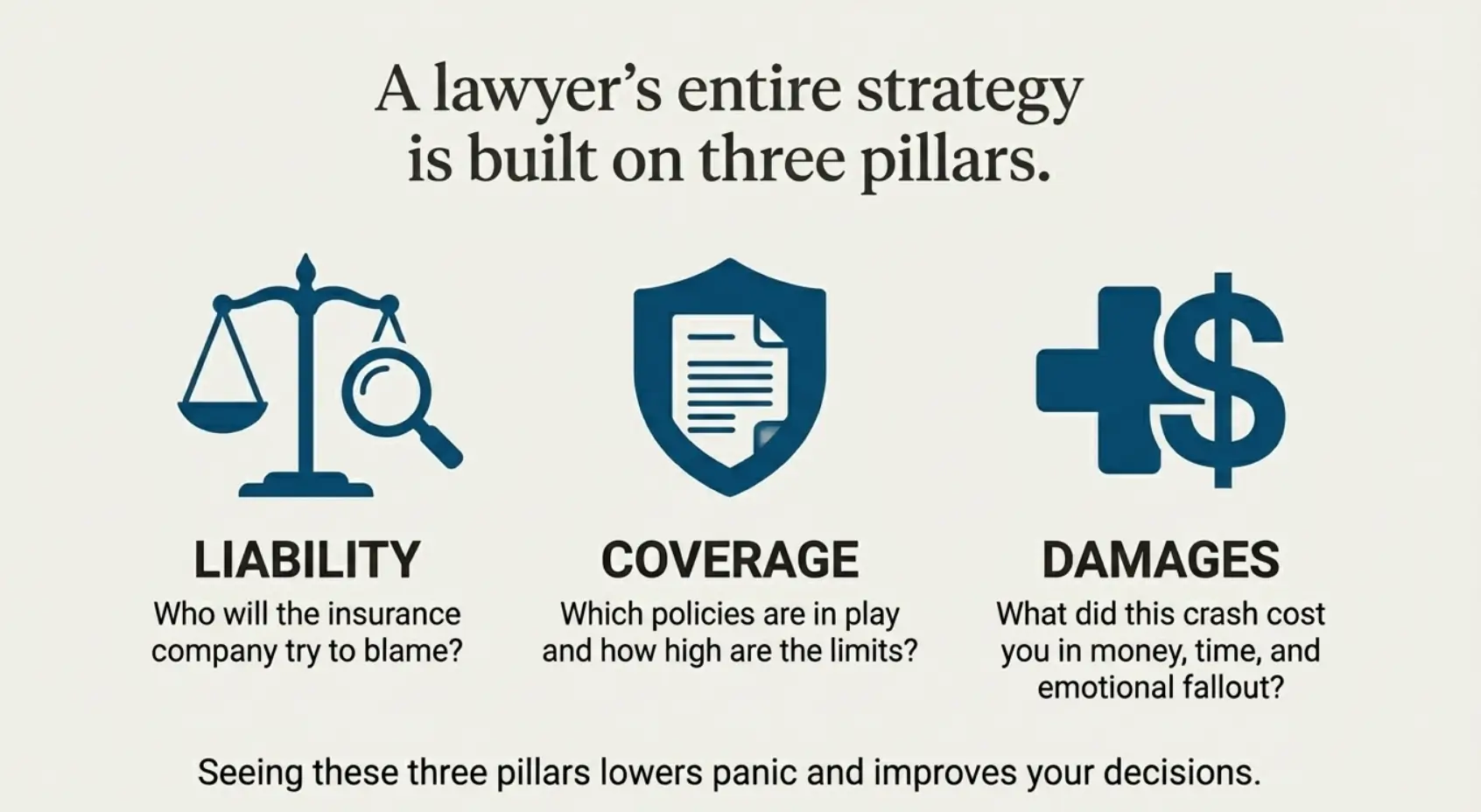
On day one, a good auto insurance claim lawyer is already thinking about three things:
- Liability – Who will the insurance company try to blame?
- Coverage – Which policies are in play and how high are the limits?
- Damages – What does this crash cost you in medical bills, car damage, time, and emotional fallout?
When I finally hired a lawyer after my first crash, I expected a long speech about justice. Instead, he grabbed a legal pad and drew a rough line: “Today” on one end, “Check clears” on the other. Underneath, he sketched steps: evidence, treatment, demand, negotiation, settlement. It looked boring. It was the most financially important doodle of my life.
“An auto insurance claim is not a conversation. It’s a process.” Once you see the process, you stop guessing and start making moves on purpose.
- Lawyers think in timelines, not drama.
- Evidence, coverage, and damages are the three pillars of your case.
- Seeing the steps lowers panic and improves your decisions.
Apply in 60 seconds: On a scrap of paper or your phone, draw a line from “Crash” to “Check” and leave space for steps—you’ll fill it in as you read.
Lesson 1: The First Call That Changes Your Claim
Here’s the first shocking lesson I learned the hard way: the most expensive thing you can say after a crash is “Sure, I’ll just handle this with the adjuster myself.” I did that. I joked on the phone. I tried to sound reasonable. The adjuster was charming, I was exhausted, and I answered questions that quietly shrank the value of my claim before I even saw a doctor’s bill.
When a lawyer takes over, that “first call” looks very different. Instead of you casually explaining what happened, your attorney:
- Stops recorded statements until you’re prepared.
- Clarifies what coverage applies (liability, collision, uninsured/underinsured, medical payments).
- Locks in key facts while memories are fresh and before stories “drift.”
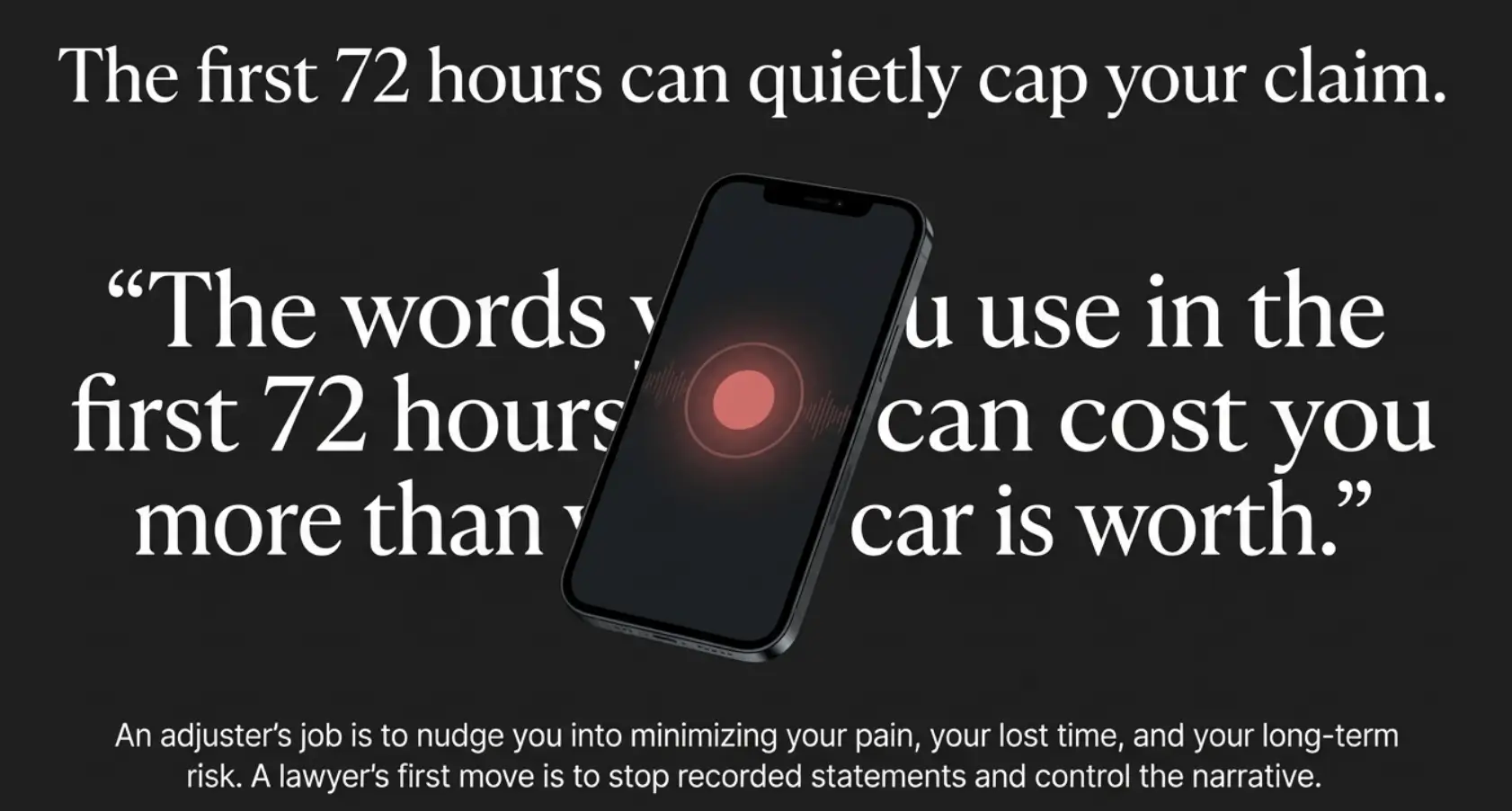
My lawyer later told me, “The words you use in the first 72 hours can cost you more than your car is worth.” That’s not fear-mongering; it’s pattern recognition. Adjusters handle hundreds of claims a year. They know exactly how to nudge you into minimizing your pain, your lost time, and your long-term risk.
Quote-Prep List: What to Have Ready Before You Call an Auto Insurance Claim Lawyer
- Photos or videos of the scene (even messy screenshots from texts).
- Police report number, if one exists.
- Insurance cards for everyone in your household (not just the driver).
- List of any doctors or clinics you’ve seen since the crash.
- Your work schedule and any days you’ve already missed.
Next step: Put these in a single folder (physical or digital) labeled “Crash – Claim” so you’re not scrambling mid-call.
- Early statements can quietly cap your payout.
- Lawyers control what’s said, how, and when.
- Simple prep turns a scary call into a focused strategy session.
Apply in 60 seconds: Write one sentence you’ll use to stall adjusters: “I’m collecting information and may have counsel follow up.” Save it in your phone.
Step 1: Triage the Crash Scene and Evidence in the First 24 Hours
Good lawyers aren’t magical. They’re just relentless about evidence—especially in the first 24 hours. You may not have hired anyone yet, but this is when you quietly start doing what a good auto insurance claim lawyer will later thank you for.
Think of this stage as “evidence triage.” The goal isn’t perfection; it’s preservation. Things to prioritize:
- Photos of all vehicles, license plates, road conditions, and skid marks.
- Names, phone numbers, and emails of witnesses (before they disappear into their own busy lives).
- Quick notes on pain and symptoms that night and the next morning.
During my first crash, I almost deleted photos because they looked “messy” and unflattering. Later, my lawyer zoomed into one shaky picture and pointed out a subtle bumper imprint that helped show angle and force. What looked useless to me was gold to him.
Mini Claim Snapshot: 60-Second Reality Check
Grab a pen. You’re not calculating your final payout—just getting a rough sense of scale.
- Estimate your car repair or replacement cost (A).
- Add medical bills so far (ER, urgent care, PT, etc.) (B).
- Add lost wages or unpaid time off (C).
Rough snapshot = A + B + C. If that number already feels painful—and treatment isn’t finished yet—it’s a sign an auto insurance claim lawyer may be worth it.
Next step: Write this number at the top of your crash timeline. Update it as new bills arrive.
Show me the nerdy details
Lawyers think in “buckets” of damages: economic (easy-to-count bills and lost income) and non-economic (pain, suffering, disruption to your life). Your quick A+B+C estimate only covers economic losses, but it tells your attorney how quickly the claim might bump up against policy limits, whether it justifies deeper investigation, and how aggressively to push the settlement process.
- Photos, names, and basic notes beat your memory six months later.
- A simple cost snapshot keeps you honest about how big this crash really is.
- Lawyers use your early evidence to pressure carriers sooner.
Apply in 60 seconds: Open your photos app and favorite every picture related to the crash so they live in one place.
Step 2: How an Auto Insurance Claim Lawyer Dissects Your Policy and Coverage Tiers
Here’s the part nobody wants to read, but your lawyer secretly loves: the policy. While you’re staring at your bruises and your bank app, your attorney is digging through declarations pages, endorsements, exclusions, and coverage tiers like a detective in a filing cabinet.
Why it matters:
- There may be multiple policies in play (yours, the other driver’s, employer’s, household members).
- Coverage tiers (liability, uninsured/underinsured, medical payments) change what’s actually collectible.
- Some benefits pay now (med-pay); some pay later (liability settlement); some are backups (UM/UIM).
Short Story: I once assumed the other driver’s small liability limit meant my claim had a hard ceiling. My attorney calmly asked for my own policy, flipped a few pages, and pointed to underinsured motorist coverage I’d forgotten I bought. What I thought was the “max” possible payout was, in reality, just step one.
Coverage Tier Map for Auto Insurance Claims After Injury Crashes, stacked by policy, 2025 (US)
Most auto insurance claim lawyers mentally map coverage like this:
- Liability coverage – The at-fault driver’s policy; often the first pot of money.
- Medical payments (med-pay) or personal injury protection – Pays certain medical bills regardless of fault, up to a set limit.
- Uninsured/underinsured motorist (UM/UIM) – Your backup when the other driver has no insurance or not enough.
Decision Card: Which Coverage Tier Should You Ask About First?
When to focus on the other driver’s liability first:
- Clear fault (rear-end at a red light, for example).
- Obvious visible damage and documented injuries.
When to ask your lawyer about UM/UIM immediately:
- Hit-and-run or the other driver had no insurance.
- Serious injuries and rumors of “minimal coverage.”
Next step: In your notes, list each possible coverage bucket and who it belongs to. That’s the map your auto insurance claim lawyer will walk you through.
- Multiple policies can apply to a single crash.
- Coverage tiers decide what gets paid early vs. late.
- Lawyers are trained to hunt for “hidden” coverage you might miss.
Apply in 60 seconds: Gather every auto insurance card in your household and snap front-and-back photos for your lawyer.
Step 3: Turning Bruises, Bills, and Missed Work Into a Compelling Damages Story
Insurance companies don’t pay you because you “had a bad time.” They pay you because someone—often your lawyer—tells a specific, documented story about how this crash changed your life and finances.
Behind the scenes, your auto insurance claim lawyer is quietly building that story with:
- Medical records and reports that connect your symptoms to the crash.
- Billing ledgers that translate every appointment into actual dollar amounts.
- Employment records that show lost wages, overtime, or opportunities.
I once described my pain to my lawyer as “annoying but manageable.” He looked at my calendar and pointed out that I’d canceled every social event for two months and stopped going to the gym. “That’s not ‘annoying,’” he said. “That’s life change.” He was right—and that reframe mattered when it came time to negotiate.
Average attorney fees for auto insurance claim lawyers after injury crashes, contingency-based, 2025 (US)
Most auto insurance claim lawyers work on a contingency fee: they’re paid a percentage of what they recover, typically only if they win or settle. Exact percentages vary by region and case complexity, but you’ll usually see a lower percentage if the case settles early and a higher one if a lawsuit is filed and trial prep begins.
Fee Snapshot: Typical Contingency Ranges (Illustrative Only)
| Stage | Illustrative Range | Notes |
|---|---|---|
| Pre-suit settlement | About 25–33% | Negotiated before a lawsuit is filed. |
| After filing lawsuit | Around 33–40%+ | More work, more risk, higher fee. |
This is a general illustration only. Actual fee schedules depend on your jurisdiction, the firm, and the written agreement you sign.
Next step: Ask any lawyer you consult to walk you through their fee tiers in writing before you sign.
- Medical and wage records prove the math.
- Your day-to-day life changes prove the impact.
- Contingency fees align your lawyer’s incentives with your result.
Apply in 60 seconds: Start a simple “crash journal” noting pain levels, missed events, and work changes—it becomes raw material for your lawyer.
Step 4: Settlement Process, Timelines, and Payout Ranges in 2025 (US)
Once your treatment is reasonably stable and your lawyer has a clear picture of damages, the settlement process starts to move. From the outside, it looks like nothing is happening for months. From inside the law firm, there are dozens of moving parts: chasing records, confirming balances, negotiating medical liens, and timing the demand letter.
Very broadly speaking:
- Minor property-damage-only claims can wrap up in a few weeks to a few months.
- Injury claims with ongoing treatment often take 6–18 months or more.
- Claims that go into litigation can take significantly longer, especially in crowded court systems.
If you’re outside the US, timelines and processes may be very different. In some countries, claims go through government-backed schemes or mandatory mediation before a court ever sees them. If you live in a place like South Korea, Canada, or the UK, a lawyer in your region will know the specific deadlines, no-fault rules, and documentation standards that apply—don’t assume US-style advice fits your situation perfectly.
Infographic: Crash-to-Check Timeline With a Lawyer
Get medical help, stabilize the scene, call police if needed.
Photos, witness info, initial notes within 24 hours.
Coverage tiers mapped, liability analyzed.
Medical, wage loss, and life impact documented.
Demand letter, counteroffers, settlement talks.
Check arrives or lawsuit pushes forward.
- Shorter timelines usually mean smaller, simpler claims.
- Bigger injuries need more time for treatment and documentation.
- Your region’s laws and court speed heavily influence the schedule.
Apply in 60 seconds: Ask any lawyer you talk to for a realistic timeline range for a case like yours—not a promise, just a pattern.
Step 5: Demand Letters, Negotiation Scripts, and When Lawyers Get Aggressive
This is the part of the movie where everyone imagines dramatic courtroom speeches. In real life, many auto insurance claim lawyers win the biggest battles in demand letters and negotiation calls long before a judge enters the picture.
A strong demand package usually contains:
- A clear liability story (why the other side is at fault).
- A structured damages breakdown (medical costs, lost wages, future care, non-economic harms).
- Supporting records, bills, photos, and sometimes expert opinions.
My favorite surreal moment in my own case was hearing my lawyer calmly say on a call, “That offer doesn’t match your own file.” Then he read the adjuster’s notes back to them line-by-line. There was a long silence, followed by a revised number that jumped five figures. It felt like watching someone play chess with my stress.
Demand letter impact on settlement value after moderate injury crashes, 2025 (US)
The demand letter is often your first real chance to anchor the settlement process around your numbers, not the carrier’s. Lawyers don’t just list bills; they frame why low offers create risk for the insurer if the case goes to trial. That mix of documentation and threat—polite but firm—is what moves serious money.
- Demand letters set the tone for serious negotiations.
- Lawyers use the carrier’s own records to push back on lowball offers.
- You don’t have to sound tough on the phone—that’s your lawyer’s job.
Apply in 60 seconds: Write down one non-negotiable need (e.g., “enough to cover six months of PT”), so you remember what you’re actually fighting for.
Step 6: Lawsuit vs. Settlement – Choosing the Right Path
Not every auto insurance claim turns into a lawsuit. Many settle based on the demand package and a few rounds of negotiation. But sometimes your lawyer sits you down and says, “We may need to file.” That’s not drama; it’s a strategy choice.
Factors lawyers weigh:
- How unreasonable the current offers are.
- The strength of liability and the quality of your evidence.
- Local jury tendencies, court backlogs, and litigation costs.
In some US states, filing suit before the statute of limitations expires is non-negotiable if negotiations stall. In others, there may be pre-suit mediation requirements. In places like Florida, Texas, or California, state-specific rules can affect everything from filing fees to how comparative negligence is treated. If you’re outside the US entirely, your lawyer will explain how local law handles deadlines, court procedure, and fault.
Cost–benefit choice to file a lawsuit in contested auto insurance claims with coverage disputes, 2025 (US)
Filing a lawsuit can increase pressure on the insurer but also adds time and expense. Your attorney’s job is to explain the trade-offs: the potential upside in settlement value versus the extra months (or years) of waiting and the emotional bandwidth required from you.
Decision Card: When Settlement Now vs. Lawsuit Later Makes Sense
Consider pushing to settle now if:
- You have modest injuries and the offer already covers all bills and a fair buffer.
- You’re risk-averse and exhausted, and your lawyer says the offer is within a “reasonable” range.
Consider filing suit if:
- Your injuries are serious and life-changing.
- Offers are dramatically below documented damages.
- Your lawyer believes a jury would respond strongly to your story.
Next step: Ask your attorney to walk through best-case, typical, and worst-case outcomes for both paths in plain English.
- Some cases settle well without ever seeing a courtroom.
- Others need the pressure of a pending trial to unlock fair money.
- Your tolerance for risk and time matters as much as the numbers.
Apply in 60 seconds: Write down your “no later than” date—the point where you’d rather move on than keep fighting, and share it with your lawyer.
Proven Payout Strategy: 7 Lessons From My First Crash
By the time my first crash finally settled, I’d learned more about auto insurance than I ever wanted to. I’d also learned that the biggest payout shifts came from boring, simple moves—not genius legal tricks. Here are the seven lessons I wish someone had shoved into my glove compartment before impact.
- Lesson 1: Call a lawyer sooner than feels “reasonable.” I waited weeks, trying to be “polite” and handle things myself. That delay gave the insurer a head start on their version of events.
- Lesson 2: Treat your notes like evidence, not a diary. Dates, times, missed shifts, pain levels—these turned into real dollars later.
- Lesson 3: Don’t underestimate “small” injuries. What started as a “stiff neck” became months of PT. Early documentation made that escalation believable.
- Lesson 4: Ask about every possible coverage tier. I almost left my own underinsured motorist coverage unused.
- Lesson 5: Let your lawyer be the “difficult” one. I stayed polite; they handled the pushback and awkward money conversations.
- Lesson 6: Respect the timeline. The months between crash and settlement weren’t a void; they were used to build leverage.
- Lesson 7: Think in net, not gross. The real number is what you keep after fees, costs, and medical liens—not the headline settlement amount.
Short Story: On the day the settlement check finally arrived, it didn’t feel like “winning.” It felt like closing a chapter I’d been stuck in for far too long. The real victory wasn’t the number on the check; it was knowing I hadn’t quietly signed away my future medical bills to get there.
- Calling a lawyer early shapes every step that follows.
- Tracking your life impact creates real leverage.
- Understanding coverage and fees keeps your net recovery clear.
Apply in 60 seconds: List three lawyers you might call, note one question for each, and decide who gets the first 15-minute consult.
FAQ
1. Do I always need an auto insurance claim lawyer after a car accident?
No. For very minor crashes with no injuries and clear fault, some people handle claims directly with insurers. But if you have injuries, confusing coverage issues, or any hint of blame shifting, talking with an auto insurance claim lawyer can protect you from costly mistakes. 60-second action: Use the eligibility checklist above and, if you check two or more boxes, schedule at least one free consultation.
2. How long will my auto insurance claim take if I hire a lawyer?
There’s no universal timeline. Simple property-damage-only claims may wrap up within a few weeks or months. Injury claims often take longer because your lawyer wants a clear picture of your treatment and long-term impact before pushing for a final settlement. 60-second action: Ask each lawyer you speak with for a realistic timeline range based on cases like yours—not a promise, but a pattern.
3. Will hiring an auto insurance claim lawyer reduce my payout because of fees?
In tiny, straightforward claims, fees may not justify hiring a lawyer. But in many injury cases, a skilled lawyer can increase the gross settlement enough to leave you better off even after fees and case costs. The goal is not just a bigger check—it’s a smarter net result. 60-second action: During your consult, ask the lawyer to walk through a past example (with details anonymized) where their involvement materially changed the final net to the client.
4. What should I bring to my first meeting with an auto insurance claim lawyer?
Bring photos, police report information, all insurance cards, any medical records or bills you already have, and a simple timeline of what happened and when. Don’t stress if it’s messy; your lawyer can sort the chaos into a clear file. 60-second action: Create a single folder on your phone named “Crash – Lawyer” and move every related photo, PDF, or email into it.
5. What if the other driver doesn’t have insurance or has very low limits?
That’s when your own policy’s uninsured/underinsured motorist coverage may come into play, depending on your region and what you bought. A lawyer can review your declarations page to see whether there’s “hidden” backup protection. 60-second action: Pull up your auto policy, find the section labeled UM/UIM, and note the limits so you can ask targeted questions.
6. Is this article legal advice for my specific situation?
No. This guide is educational and designed to help you ask better questions and avoid common mistakes, but it’s not a substitute for personalized legal advice. Laws, timelines, and coverage rules vary by location and by the exact facts of your crash. 60-second action: If anything here feels uncomfortably close to your situation, write down your questions and discuss them with a licensed attorney in your area.
Conclusion: Your Next 15 Minutes
If you’ve made it this far, you already know more about the auto insurance claim process than I did in the weeks after my first crash. You’ve seen how a lawyer thinks about evidence, coverage tiers, damages, negotiations, and the settlement process—and how a few early decisions can quietly swing thousands of dollars in or out of your life.
In the next 15 minutes, you can quietly change the trajectory of your claim:
- Draw your own crash-to-check timeline based on the infographic.
- Run the 60-second eligibility and claim snapshot checks.
- Create a single folder for every photo, bill, and note related to the crash.
- Shortlist at least one auto insurance claim lawyer and schedule a consult.
None of this requires you to argue with an adjuster today. It just shifts you from “reacting to calls” into “running a strategy.” Whether you ultimately settle quickly or take the long road through litigation, you’ll be walking it with your eyes open—and with a payout strategy you actually understand, instead of one that happens to you by default.
Last reviewed: 2025-12. Always confirm current laws, deadlines, and coverage rules with a licensed professional in your region.
auto insurance claim lawyer, auto insurance claim attorney, car accident settlement process, hire a lawyer after car crash, auto insurance coverage tiers