
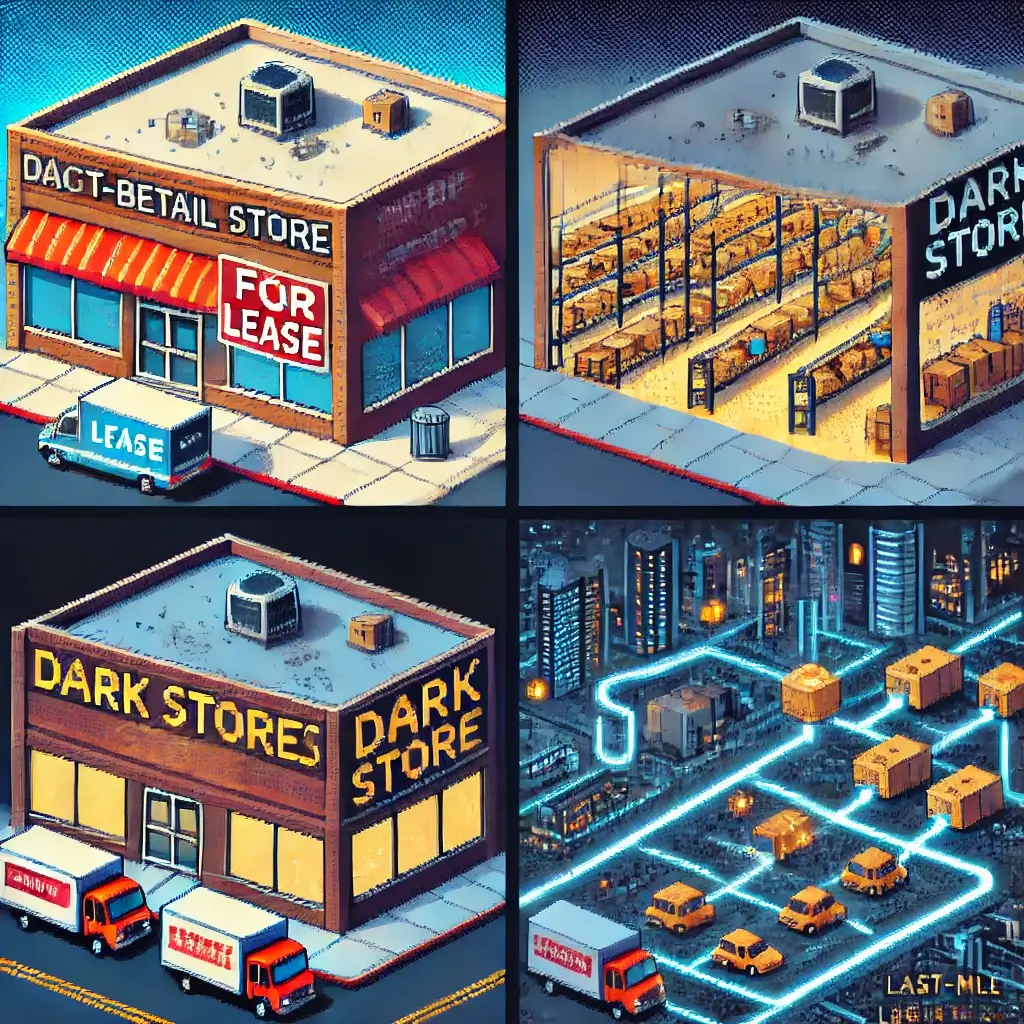
3 Seismic Shifts in Real Estate: The Dark Store Revolution
Hello, everyone.
It’s been a crazy ride, hasn’t it?
I mean, if you’ve been in real estate for any length of time, you’ve seen the landscape change more times than you can count.
Just when you think you’ve got a handle on things, a whole new trend emerges and shakes everything up.
Remember when we thought big-box retail was invincible?
Or when we all scoffed at this whole “e-commerce” thing, thinking it was just a fad?
Well, let’s just say a lot of us are eating our words right now.
The truth is, the retail world is a different beast today.
What used to be bustling malls and lively storefronts are now, in many places, silent monuments to a bygone era.
It’s an unsettling sight, to be sure, and for many property owners and investors, it’s a terrifying one.
But what if I told you that these empty shells aren’t just a symbol of decline, but a canvas for incredible new opportunity?
What if these vacant spaces are the very foundation of the next big thing in real estate?
I’m talking about something that’s not just a passing trend, but a fundamental shift in how we view and utilize commercial properties.
The term you need to get familiar with, if you aren’t already, is dark store real estate.
No, it’s not some spooky new Halloween attraction.
It’s a game-changer.
It’s the transformation of former retail spaces into highly efficient, tech-driven logistics hubs.
It’s the ultimate pivot, a brilliant solution to a glaring problem, and it’s happening right under our noses.
I’ve been in this business long enough to see a few cycles, and let me tell you, this one feels different.
It’s not just a correction; it’s a complete reimagining of the purpose of commercial space.
If you’re an investor, a developer, a property owner, or just someone who’s curious about where things are headed, you need to pay attention.
This isn’t about simply filling a vacant spot; it’s about capitalizing on the explosive growth of e-commerce and last-mile delivery.
It’s about turning a liability into a highly sought-after asset.
Ready to dive in?
Let’s walk through the three seismic shifts that are driving this dark store revolution.
We’ll talk about what it is, why it’s so important, and how you can get ahead of the curve.
First, here’s a quick overview of what we’ll cover so you can jump to the parts that interest you most.
—
Table of Contents
—
Shift 1: The E-commerce Tsunami and the Need for Speed
Okay, let’s start with the obvious.
Remember the days when you’d order something online and a week later, it would show up?
Those days are gone.
Completely and utterly gone.
Today’s consumer doesn’t just want things; they want them now.
Two-day shipping is the baseline, and next-day or even same-day delivery is quickly becoming the expectation.
This isn’t just about a slight increase in demand; it’s a full-blown tsunami that has completely re-written the logistics playbook.
Think about it like this: A traditional supply chain is a long, winding river.
Goods start far away at a major distribution center and slowly make their way downstream to a final destination.
It’s a process that takes time and has multiple stops along the way.
But today’s e-commerce is less like a river and more like a series of high-speed jets, all flying directly to the customer’s doorstep.
To meet this need for speed, companies need to be closer to their customers.
They can’t rely on a single warehouse 100 miles outside the city anymore.
They need a network of smaller, more localized hubs that can get packages to people in hours, not days.
And guess what properties are perfectly positioned to serve this need?
You got it: the very retail spaces that are now sitting empty.
These properties are already located in densely populated areas, often with excellent access to major roads and residential neighborhoods.
They’re built with parking lots for easy access and loading, and they have the square footage to house a small-scale fulfillment operation.
It’s the perfect match.
The demand from e-commerce giants and grocery delivery services for these kinds of “last-mile” logistics hubs is insatiable.
They’re looking for spaces that can act as mini-distribution centers, where orders can be processed, packed, and sent out for delivery with lightning speed.
This isn’t about replacing every single store with a warehouse.
It’s about strategically converting the right properties to meet the needs of a new market.
This is where the term dark store real estate truly shines.
These aren’t places you go to shop.
They’re behind-the-scenes powerhouses, the engine room of the modern economy.
It’s a massive market, and the opportunities are staggering.
—
Shift 2: The Repurposing of Vacant Retail: Turning Lemons into Gold
Let’s get real for a second.
We’ve all seen the news reports and the pictures of empty malls.
We’ve driven by the ghost towns of retail, the hulking buildings with boarded-up windows and overgrown parking lots.
For a long time, the prevailing wisdom was that these spaces were a lost cause.
They were a symbol of the “retail apocalypse,” a term I’ve always found a bit dramatic, but I get the sentiment.
But what if the apocalypse was just the beginning?
What if we’re not witnessing the end, but the metamorphosis of real estate?
This is where the creative genius of repurposing comes in.
Former retail properties, especially big-box stores, have a lot going for them from a logistics perspective.
They have high ceilings, open floor plans, and robust power systems.
They’re already zoned for commercial use and have the necessary infrastructure for delivery trucks and customer parking (which can easily be repurposed for fleet vehicles).
The conversion process isn’t as complicated as you might think.
Instead of a multi-year construction project, you’re often looking at a renovation that focuses on efficiency.
This includes things like installing shelving systems, integrating automation technology, and optimizing the layout for fast picking and packing.
I spoke with a buddy of mine who did a conversion on an old Kmart building last year.
He told me that the most surprising thing was how little they had to change structurally.
They basically stripped the interior, laid down a new epoxy floor, and installed a few conveyor belts.
The result was a fully functional, highly efficient dark store that was up and running in a fraction of the time and cost of building from the ground up.
The financial upside is huge.
Instead of a vacant property that’s costing you money in taxes and maintenance, you have a revenue-generating asset with a long-term tenant.
The demand for these logistics spaces is so high that you can often secure a strong lease with a well-established company, providing a stable income stream for years to come.
This is where the real estate smart money is going.
It’s not about finding the next hot retail concept; it’s about providing the backbone for the concepts that are already dominating the market.
It’s about transforming a depreciating asset into a growth-oriented investment.
—
Shift 3: The Dark Store Model in Action: Who’s Doing It and How?
So, this all sounds great in theory, right?
But who’s actually doing it?
I can tell you it’s not just a few fringe players.
We’re talking about the biggest names in retail and logistics.
Grocery stores, for example, have been at the forefront of this trend.
Instead of having their in-store employees pick groceries for online orders while dodging regular shoppers, they’re converting underperforming stores into dedicated fulfillment centers.
This allows them to process orders much faster, with greater accuracy, and without disrupting the in-person shopping experience.
Some of the larger chains are even building automated dark stores with robotic systems that can sort and pack orders in minutes.
It’s a beautiful thing to watch, I’ll tell you.
Then you have the e-commerce giants and third-party logistics companies.
They’re scooping up these properties left and right, creating a dense network of last-mile hubs.
Think of it as a spiderweb, with each dark store acting as a central node, allowing for faster and more efficient deliveries to the surrounding area.
The demand is so strong that in some urban areas, a prime dark store location can command a higher rent per square foot than a traditional retail space.
That’s not a typo.
The value proposition is just that compelling.
Now, a lot of people ask me, “Is this just for big companies?”
And my answer is a resounding “No.”
While the big players are certainly leading the charge, there are opportunities for smaller investors and developers, too.
You could be a part of this by acquiring a smaller, vacant storefront and leasing it to a local delivery service, a ghost kitchen operator, or a niche e-commerce brand that needs a local fulfillment center.
The principles are the same, just on a different scale.
The market is expanding so rapidly that there’s room for everyone, from the massive institutional investor to the individual looking for a smart property play.
This isn’t just about a change in real estate; it’s about a change in consumer behavior and the business models that are built to serve it.
—
Navigating the Future: Your Playbook for Dark Store Real Estate
So, what does all of this mean for you?
If you’re sitting on a vacant retail property, or you’re an investor looking for the next big opportunity, the time to act is now.
This isn’t a future trend; it’s a present reality.
Here’s my advice, based on years of watching the market shift and evolve:
First, you need to think like a logistics expert, not a retailer.
Don’t just look at a property and see a storefront.
See it for its bones: its location, its access to major roads, its power infrastructure, and its square footage.
These are the things that logistics companies care about.
Second, get creative with your partnerships.
Talk to e-commerce companies, last-mile delivery services, and even local restaurants that are looking for ghost kitchen space.
The tenant pool for these properties is much larger and more diverse than you might think.
Third, don’t be afraid of the technology.
Automated systems, inventory management software, and robotics are no longer things of science fiction.
They’re a crucial part of what makes a dark store so valuable.
Partner with companies that can help you integrate this tech and make your property a turnkey solution for a logistics tenant.
The bottom line is this: The retail apocalypse is a misnomer.
It’s not the end of commercial real estate; it’s the beginning of a new chapter.
The buildings are still there, they just need a new purpose.
And with dark store real estate, we have a purpose that’s not just viable, but absolutely essential to the future of our economy.
I’ve seen so many people miss out on the last big trends because they were too slow to adapt.
Don’t be one of them.
The opportunity is right in front of you, literally in the form of every vacant retail store you pass.
It’s time to stop seeing a problem and start seeing a solution.
It’s time to turn those lemons into gold.
The future is here, and it’s dark.
And that, my friends, is a very good thing.
—
dark store real estate, retail repurposing, logistics, e-commerce, last-mile delivery
🔗 Speedy E-Commerce Deliveries Posted 2025-08-11 06:58 UTC 🔗 Coworking Space REITs Posted 2025-08-10 03:51 UTC 🔗 Micro Hospital & Urgent Care Center REITs Posted 2025-08-09 02:55 UTC 🔗 Land Lease REITs Posted 2025-08-08 03:06 UTC 🔗 Aquaculture Farm Real Estate Posted (Date not provided) 🔗 3 Reasons Last-Mile Logistics is Changing Urban Delivery Posted (Date not provided)