
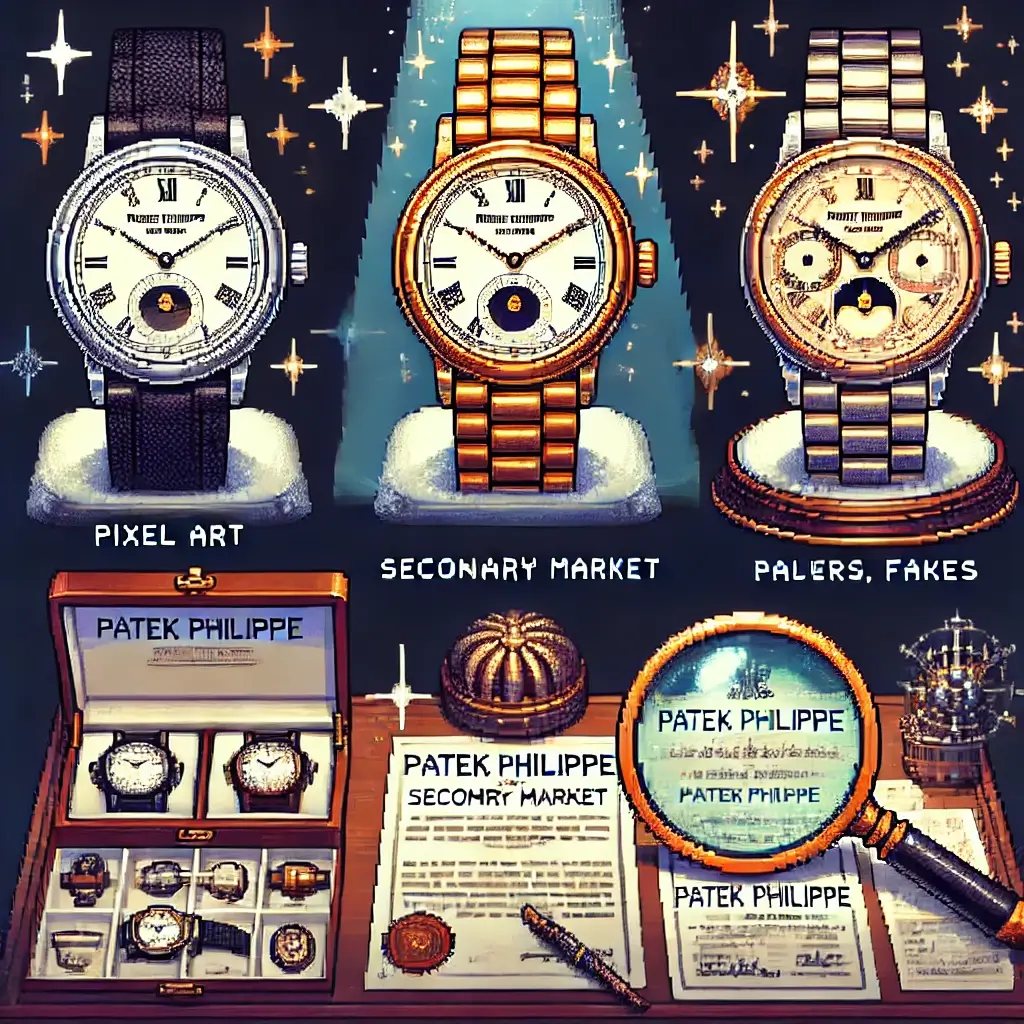
The 5 Golden Rules of the Patek Philippe Secondary Market
Welcome, fellow watch enthusiasts.
Have you ever found yourself scrolling through endless listings for a Patek Philippe, feeling a mix of excitement and sheer terror?
You’re not alone.
Navigating the secondary market for these horological masterpieces is a lot like deep-sea diving without a map.
It’s thrilling, but one wrong move can be a very expensive mistake.
As someone who has spent more than a decade in this high-stakes game—both as a buyer and, yes, as a seller who has had to learn some hard lessons—I’ve seen it all.
I’ve seen people score incredible deals that felt like a lottery win, and I’ve watched others get burned by seemingly perfect watches that turned out to be anything but.
My goal here is to be your guide, your trusted dive buddy, as we explore this fascinating, and sometimes treacherous, world.
This isn’t just a list of tips; it’s a a roadmap built on years of experience, filled with the kind of advice you won’t find in a brochure.
We’ll talk about everything from spotting a fake to negotiating like a pro, all while keeping our wits—and our wallets—intact.
So, grab a coffee, sit back, and let’s demystify the Patek Philippe secondary market once and for all.
Let’s get into the nitty-gritty, shall we?
We’ve got a lot to cover, and your future watch collection depends on it.
First, let’s lay out our plan.
We’ll start with the foundation: why Patek Philippe holds its value, and then we’ll dive deep into the practical steps for a successful purchase.
This is not just for the seasoned collector; it’s for anyone who has ever dreamed of owning a piece of history.
Table of Contents
Let’s go.
1. Why Patek Philippe Dominates the Secondary Market: It’s Not Just a Watch, It’s an Asset
Let’s get one thing straight: Patek Philippe isn’t a watch you just buy.
It’s a legacy.
It’s a piece of history you can wear on your wrist.
But why does this brand, more than any other, command such a ferocious presence on the secondary market?
Why do people willingly pay hundreds of thousands, and sometimes millions, for a pre-owned timepiece?
It’s a question I get all the time, and the answer is multi-faceted, like a finely-cut diamond.
First, there’s the incredible scarcity.
Patek Philippe operates on a level of production that is, frankly, archaic in our mass-production world.
They make only a limited number of watches each year—some say around 60,000, but the exact number is a closely guarded secret.
To put that in perspective, Rolex produces nearly a million watches annually.
This isn’t about being inefficient; it’s a deliberate choice to maintain an almost unattainable level of exclusivity.
They are artisans, not factory workers, and every single component is finished by hand.
It’s this painstaking, century-old process that gives each watch its soul.
Second, there’s the brand’s unwavering commitment to quality.
Patek Philippe has its own set of rules, the Patek Philippe Seal, which is even stricter than the Geneva Seal.
They literally audit themselves to ensure every watch is a masterpiece.
This is not just a marketing gimmick; it’s a promise.
It’s the reason Patek has been repairing and restoring watches they made over a century ago.
They don’t just sell you a watch; they sell you a lifetime service.
And let’s not forget the emotional aspect.
Patek Philippe watches are famous for their slogan, “You never actually own a Patek Philippe. You merely look after it for the next generation.”
It sounds a bit cheesy, I know, but it’s a powerful idea.
It transforms the watch from a mere accessory into a family heirloom.
When you buy a Patek, you are not just acquiring an object; you are becoming a temporary guardian of a lineage.
This emotional connection, combined with the extreme scarcity and artisanal quality, creates a perfect storm for the secondary market.
It’s an ecosystem where demand far outstrips supply, leading to insane price appreciation for certain models.
Think of it like this: You are not just buying a Patek; you are buying a ticket to a very exclusive club.
And that ticket, my friend, is worth its weight in gold.
For a deeper dive into the brand’s history and philosophy, check out the Patek Philippe official website.
It’s a masterclass in branding and horology.
We’ll move on to the real work now—your homework.
2. Your First Step: Do Your Homework on the Patek Philippe Model
Okay, so you’ve decided you want to buy a Patek Philippe.
Great.
But before you start scouring Chrono24 like a madman, you need to do your homework.
This is not just about finding a good deal; it’s about protecting yourself from a financial disaster.
Think of it like this: you wouldn’t buy a house without a proper inspection, so why would you buy a six-figure watch without a deep dive?
Here’s a story: a friend of mine, let’s call him Alex, was ecstatic when he found a Patek Philippe Calatrava from the 1950s at what he thought was a steal.
The price was so low it should have set off alarm bells, but he was blinded by the deal.
He bought it, only to find out later that the dial had been professionally repainted.
The value dropped by about 50%.
A repainted dial, a seemingly small detail, can completely tank a vintage watch’s value.
This is the kind of mistake you can avoid with a little legwork.
First, understand the specific model you’re interested in.
Are you looking for a Nautilus?
A Calatrava?
A perpetual calendar?
Each line has its own history, its own quirks, and its own market dynamics.
You need to know the reference number like you know your own phone number.
For example, a Nautilus 5711 is a completely different beast from a 5712, and the price difference is staggering.
Next, study the market price.
Don’t just look at one or two listings.
Look at dozens.
Use a platform like WatchCharts or the historical data on Chrono24 to understand the average asking price and how it has fluctuated over time.
A watch that seems too cheap is almost always too good to be true.
A watch that’s priced significantly above the market had better have a fantastic reason for it, like impeccable provenance or a unique dial variant.
Finally, become a mini-expert on the model’s specific characteristics.
Does the crown have the correct markings?
Are the hands the right style?
Is the typography on the dial consistent with the era of the watch?
This level of detail might seem obsessive, but it’s what separates a savvy buyer from a victim.
You can find a ton of this information on watch forums and specialized blogs.
They are a goldmine of shared knowledge and collective expertise.
Don’t be afraid to ask questions; the watch community is generally very welcoming and loves to share knowledge.
3. The Battlefield: Reputable Platforms to Buy and Sell Your Patek Philippe
This is where the rubber meets the road.
The secondary market is vast, and not all platforms are created equal.
Think of it like shopping for a car.
Would you rather buy a Ferrari from a back-alley dealer or from a certified, high-end luxury dealership?
I thought so.
Here are the major players and what you need to know about them.
First, there are the big online marketplaces like Chrono24.
They are the global hub for watch sales, with millions of listings.
Their strength is their sheer size and reach.
Their weak spot?
You are dealing with thousands of different sellers, from reputable dealers to private individuals who might not be as transparent.
Chrono24 has a “Trusted Seller” program and an escrow service that holds your money until you confirm the watch is authentic, which is a massive safety net.
Always, always, always use their escrow service.
It’s a no-brainer.
Next, you have auction houses like Sotheby’s and Christie’s.
This is the big leagues.
When you buy from an auction house, you are paying a premium (the buyer’s premium can be 20-25%!), but you are also getting a watch that has been thoroughly vetted by a team of experts.
The provenance is usually impeccable, and the experience is top-tier.
This is the best place to go for rare, one-of-a-kind pieces.
It’s a different kind of thrill, but a very safe one.
Finally, there are the grey market dealers and brick-and-mortar stores.
These are the guys you might find at local watch shows or through word of mouth.
The benefit here is the personal connection.
You can often see the watch in person, which is invaluable.
They often have lower prices because they don’t have the massive overhead of a big auction house.
The downside is that trust is paramount.
You need to do your own due diligence on the dealer’s reputation.
Look for reviews, ask for references, and make sure they have a physical location you can visit.
I always advise using a reputable site that has a strong verification process.
For a good starting point to explore auction results and dealer listings, check out these reliable sources.
4. The Three Pillars of Value: Condition, Papers, and Provenance
Okay, so you’ve done your research, you’ve found a seller, and you’re ready to make a move.
Hold your horses.
Before you even think about pressing “buy,” you need to evaluate the watch based on these three critical factors.
They are the trinity of the secondary market, and neglecting any one of them can cost you a fortune.
Condition: The Physical State of Your Patek Philippe
This might seem obvious, but it’s more nuanced than you think.
A “mint” watch is not just a watch that looks new.
It’s a watch that has been barely touched, with sharp, unpolished case edges and a pristine dial.
A vintage Patek with a freshly polished case can be worth significantly less than one with original “patina” and character.
Polishing a Patek is like sanding down a vintage piece of furniture—it removes a part of its history and, crucially, its value.
Always ask for high-resolution photos from multiple angles, especially of the lugs, which are a dead giveaway for over-polishing.
Ask about the movement’s service history.
A watch that has been properly serviced by a certified Patek Philippe watchmaker is a huge plus.
Papers: The Proof of Your Patek Philippe’s Existence
Papers, also known as the “full set” or “box and papers,” are the Holy Grail for any watch collector.
This includes the original box, the certificate of origin (the birth certificate of your watch), and any service records.
A watch with a full set of papers can command a premium of 10-30% or even more, especially for highly sought-after models.
Why?
Because it provides undeniable proof of the watch’s authenticity and its original sales date.
It also helps track the watch’s history and confirms it hasn’t been Frankenstein’d with parts from other watches.
If a watch doesn’t have papers, it doesn’t mean it’s fake, but it does mean you need to be extra cautious and factor in a lower price.
Provenance: The Story Behind Your Patek Philippe
This is the most romantic part of the watch.
Provenance refers to the watch’s history of ownership.
Did it belong to a famous person?
Was it a gift for a special occasion?
A watch with a fascinating story can sell for a staggering amount.
Think of the Paul Newman Daytona.
It wasn’t just a watch; it was his watch, and it sold for over $17 million.
While most watches won’t have that kind of star power, a well-documented history, like a letter from the original owner or even a story passed down through a family, adds a layer of depth and value that cannot be replicated.
It transforms the watch from a mere object into a historical artifact.
Think of these three things as a safety checklist.
A watch with perfect scores in all three is a home run.
A watch with a poor score in one area should be priced accordingly.
And if it has a poor score in all three, well, you should probably just walk away.
5. Spotting a Fake Patek Philippe: A Gut Feeling and a Magnifying Glass
This is the one that keeps collectors up at night.
The fakes are getting better, and a counterfeit Patek Philippe can look alarmingly convincing to the untrained eye.
But here’s the good news: Patek Philippe’s are so complex and so meticulously crafted that a fake will almost always have a flaw.
It’s just a matter of knowing where to look.
Think of it like being a detective.
You’re looking for clues, not just a smoking gun.
The Weight and Feel Test
Hold a real Patek Philippe in your hand and you can feel the quality.
The weight, the balance, the tactile sensation of the winding crown—it’s a different experience.
Fakes often feel hollow or off-balance.
The bracelet links on a genuine Patek, for instance, are incredibly smooth and have a satisfying weight.
On a fake, they often feel light and flimsy.
The Dial and Typography
This is a dead giveaway for most fakes.
Patek Philippe’s dials are works of art.
The printing is incredibly precise, and the markers are perfectly applied.
On a fake, the printing might be slightly blurry, the font might be wrong, or the markers might be misaligned.
The “Swiss Made” text at the bottom of the dial should be perfectly centered and razor-sharp.
Get a jeweler’s loupe (a magnifying glass) and look closely.
The Movement
This is the heart of the watch, and it’s where Patek Philippe’s genius really shines.
Their movements are beautifully decorated, with Geneva stripes, perlage, and hand-chamfered bridges.
The Patek Philippe Seal is a small but critical detail.
A fake movement will almost never have this level of detail.
It might look good from a distance, but up close, it will look crude and unfinished.
Look for the Patek Philippe logo and the serial number engraved on the movement.
Finally, my best advice?
If you have any doubts, get the watch authenticated by a certified Patek Philippe service center.
Yes, it might cost a few hundred dollars, but it’s a small price to pay for peace of mind when you’re making a five- or six-figure purchase.
It’s the best insurance policy you can buy.
6. Final Thoughts on Your Patek Philippe Journey
Buying a Patek Philippe on the secondary market is an adventure.
It can be thrilling, nerve-wracking, and incredibly rewarding.
My hope is that this guide gives you the confidence to navigate it successfully.
Remember, the key is to be patient, do your homework, and trust your gut.
Don’t be pressured into a quick decision.
The right watch will be there when you are ready.
And when you finally have that Patek Philippe on your wrist, you’ll know that you didn’t just buy a watch; you earned a piece of history.
Happy hunting, my friends.
Patek Philippe, secondary market, watch collecting, Nautilus, watch value
🔗 Niche Tax Deductions Remote Workers Miss Posted 2025-08-18 07:02 UTC 🔗 Special Event Liability for Your Block Party Posted 2025-08-18 03:41 UTC 🔗 When Your Homeowner’s Policy Fails You Posted 2025-08-17 02:45 UTC 🔗 Crucial Insurance Types for Rideshare Drivers Posted 2025-08-16 10:24 UTC 🔗 Gaming & Esports Stocks You Should Watch Posted (Date not available) 🔗 The Shocking Secret History of 5 Iconic Birds Posted (Date not available)