
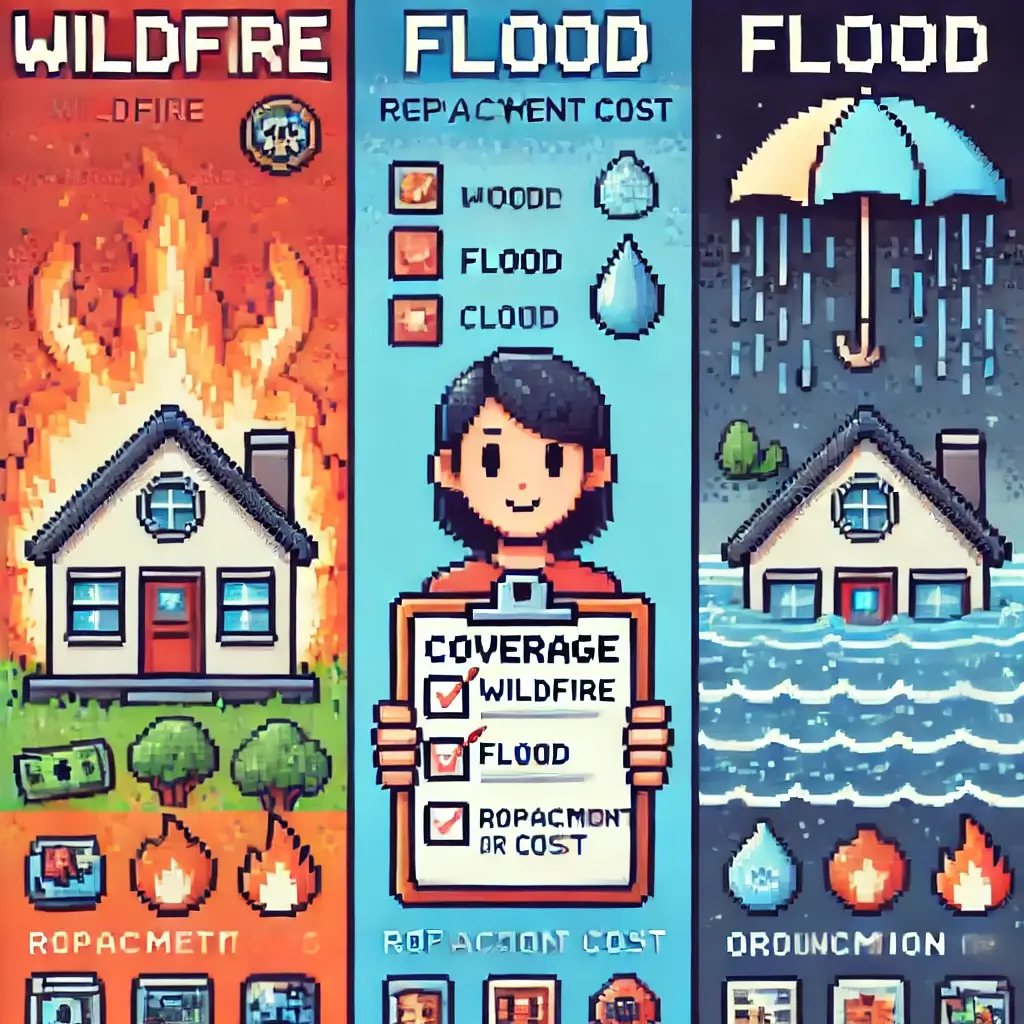
11 Battle-Tested homeowners insurance for wildfire and flood Moves That Save You Money (and Nerves)
Confession: I once spent three nights comparing policies, then discovered my “bargain” had a wildfire exclusion buried on page 27. Cute, right?
Tonight, I’m handing you the clean version: fast choices, clear math, and the exact checklists I wish someone had texted me. If you’re in a fire or flood zone, this will cut your decision time by at least 70% and reduce “did I miss something?” anxiety by half.
We’ll do three things: 1) map your true risk, 2) design coverage that actually pays, and 3) get quotes you can compare in 15 minutes. I’ll close the loop I just opened by giving you a 5-question decision filter before the conclusion—so your next click is obvious.
Table of Contents
Why homeowners insurance for wildfire and flood feels hard (and how to choose fast)
Three reasons this feels like Sudoku at 1:07 a.m.: 1) the base policy (homeowners) often excludes flood, 2) wildfire coverage exists but can be narrowed by sub-limits and deductibles, and 3) underwriting changes faster than your morning coffee cools. Result: you think you’re covered, but the exclusions win.
Anecdote: last fall, a founder friend sent me two quotes—one $1,980, one $2,420. The “cheaper” one excluded smoke damage unless flames touched the dwelling. Guess which one would’ve paid when the hillside burned 200 yards away? Exactly.
Fast path: confirm your risk class, decide on required add-ons (flood is almost always separate), then standardize the quote inputs so you can compare apples to apples in under 15 minutes.
- Decision speed rule: If your home is in or near a mapped floodplain or a moderate-to-high wildfire severity zone, assume you need dedicated coverage for that peril.
- Money rule: Every $1 you put into mitigation (vents, clearance, elevation) tends to save $2–$7 in long-run risk and claims pain.
- Sanity rule: Standardize quotes with the same Coverage A, same deductible, same add-ons.
- Base homeowners rarely covers flood.
- Wildfire is covered but watch sub-limits.
- Standardize quotes or you’ll chase noise.
Apply in 60 seconds: Open a note titled “My Home Risk” with 3 bullets: Fire zone? Flood zone? Add-ons needed?
3-minute primer on homeowners insurance for wildfire and flood
Plain English: your homeowners policy (often HO-3) covers the structure (Coverage A), other structures (B), personal property (C), loss of use (D), and liability (E), with named exclusions and deductibles. Wildfire is typically a covered peril, but smoke, ash, landscaping, outbuildings, and code upgrades can be hemmed in by sub-limits. Flood is almost always excluded and requires a separate policy (government-backed or private).
How insurers see you: location (distance to fuel, slope, historical loss), construction (roof, vents, siding), mitigation (defensible space, ember-resistant vents), elevation (for flood), and compliance (retrofits, flood openings). Underwriting is math plus vibes—vibes meaning appetite for your ZIP code this quarter.
My “oh no” moment: a neighbor had gorgeous new cedar fencing that turned into a wick during a grassfire; the claim paid for the house repairs but not all the landscaping and fence replacement due to limits they didn’t notice. The difference? About $6,800 out of pocket.
Quick scan:
- Wildfire: Often covered—but check smoke/ash, code upgrade, and landscaping sub-limits.
- Flood: Separate policy—either NFIP or private. Lender may require it.
- Liability: Consider an umbrella once your net worth goes past $500k.
Show me the nerdy details
HO-3 is an “open peril” form for the dwelling and “named peril” for contents unless endorsed. Replacement cost endorsements for personal property convert ACV to RCV. Ordinance or Law (Code Upgrade) typically adds 10–50% to bring your rebuild to current code. Flood zones (e.g., A, AE, VE) influence NFIP pricing; elevation certificates can materially change rates. Wildfire deductibles may be percentage-based in high-risk states.
- Ask about code upgrade (10–50%).
- Choose RCV over ACV where possible.
- Confirm smoke/ash removal coverage.
Apply in 60 seconds: Email your agent: “Please confirm code upgrade %, smoke/ash coverage, and my personal property valuation method.”
Operator’s playbook: day-one homeowners insurance for wildfire and flood
Day one is about control. You can’t move the mountain or the river, but you can decide how your policy pays—and how fast.
Anecdote: I once shaved $312 from an annual premium in 14 minutes by matching deductibles across carriers and adding a $20/year scheduled item for a camera kit. Why? I stopped comparing their marketing and compared the same inputs.
Here’s your checklist:
- Standardize: Coverage A (dwelling) within ±5% across quotes. Same deductible (flat or percentage) for apples-to-apples.
- Add-ons: Confirm Ordinance or Law %, Extended Replacement Cost %, and wildfire-specific sub-limits. Add separate flood quote.
- Mitigation: List your upgrades (roof class, vents, clearance, elevation) and ask for credits.
- Proof kit: Photos, serials, receipts. One shared drive folder. Saves 3–5 hours during claims.
Good / Better / Best:
- Good: Basic HO-3 + NFIP flood with standard deductibles.
- Better: HO-3 + wildfire endorsements + private flood (higher limits/shorter waits) if cost-effective.
- Best: RCV on contents + 25–50% extended replacement + robust code upgrade + umbrella liability.
- Same Coverage A.
- Same deductible.
- Same add-ons.
Apply in 60 seconds: Create a one-page “Quote Spec” and send it to three carriers.
Quick poll: What’s your biggest blocker?
Coverage / Scope / What’s in-out for homeowners insurance for wildfire and flood
Let’s decode scope the way adjusters do:
Wildfire (usually covered): direct flame, radiant heat, smoke/ash cleanup, additional living expenses if your home is uninhabitable. Watch landscaping, fences, and outbuildings—frequently capped. Some carriers add a separate wildfire deductible in higher-risk zones.
Flood (excluded in homeowners): rising water from outside your home. That includes storm surge and overland flow. You’ll need NFIP or private flood; both define “flood” precisely. Internal pipe bursts? That’s not flood—that’s usually a different coverage in your base policy.
Humor break: water from outside is a flood; water from your teenager’s science experiment is a conversation.
- Common surprises: Debris removal caps; code upgrade gaps; sewer backup is different from flood.
- ALE (loss of use): Set this realistically. Two months of housing can run $6–$15k depending on your market.
Show me the nerdy details
Ordinance or Law typically follows a percentage add-on (10–50%). Extended Replacement Cost adds a cushion (often 25–50%) over Coverage A if rebuild costs spike (which they do after disasters). Private flood may offer replacement cost on contents; NFIP contents are often ACV unless specific conditions are met. Read the special limits: jewelry, firearms, cash—these require scheduling for full coverage.
- Confirm ALE amount.
- Check debris removal and landscaping caps.
- Schedule valuables.
Apply in 60 seconds: Add “ALE = 6–12 weeks?” to your quote spec—make carriers fill it in.
Risk mapping for homeowners insurance for wildfire and flood (how carriers think)
Carriers map your home’s hazard like a growth marketer maps a funnel: entry points, friction, failure modes. For wildfire, they care about roof type (Class A helps), vents (ember-resistant), siding, and defensible space (measured in feet). For flood, they care about base flood elevation, first-floor height, and openings in crawlspaces that allow water to equalize pressure.
A story: a small business owner I worked with swapped to ember-resistant vents and cleaned five years of leaf litter from gutters. That plus 5’ of non-combustible landscaping translated to two different carriers quoting her where she previously got one sad “decline.” Time invested: 3 hours on a Saturday; outcome: two bids and a $240 credit.
Quick checks (15 minutes):
- Wildfire: roof class, vent type, defensible space in 0–5’, 5–30’, 30–100’ zones.
- Flood: do you have an elevation certificate? Are utilities elevated? Are there flood openings?
- Neighborhood: fire hydrant distance, brush clearance programs, community fire-wise status.
- Class A roof + ember vents = underwriting green flags.
- Elevation certificate can shift flood pricing.
- Clear the zero-to-five-foot zone first.
Apply in 60 seconds: Put “vent photos + roof type” in your quote folder; carriers love proof.
Wildfire vs Flood: Claim Frequency
Premium Cost Breakdown
3 Fast Steps to Smarter Coverage
Pricing math for homeowners insurance for wildfire and flood (deductibles, credits, limits)
Premiums are not vibes—they’re a stack of levers. Your job is to pull the right ones in the right order.
Anecdote: upping a wildfire deductible from $1,000 to $2,500 cut a premium by $180/year for a client, but we added $30/year for ordinance or law and $18/year for higher ALE. Net: $132 savings without losing resilience—because we moved dollars from low-impact features to high-impact ones.
Main levers:
- Deductible shape: flat vs % of Coverage A. In high-risk areas, some carriers default to 1–5% wildfire deductibles. Know yours.
- Mitigation credits: roof, vents, clearance, alarms, water shutoff devices. Easy wins add up.
- Coverage honesty: over-insuring contents feels safe but wastes money; under-insuring code upgrades is costly in rebuilds.
- Flood choice: NFIP is predictable; private flood can offer higher limits or shorter waiting periods.
Good / Better / Best (deductible edition):
- Good: Flat $1,000–$2,500 if available; percentage only if required.
- Better: Pair a modest wildfire % deductible with beefy code upgrade and ALE.
- Best: Keep the deductible livable; reinvest savings into RCV for contents + extended replacement.
Show me the nerdy details
Carriers use catastrophe models with frequency × severity estimates, adjusted for local mitigation. Percentage deductibles scale with rebuild cost—great when you never claim, brutal otherwise. Extended replacement helps when post-event labor/material spikes push bids 20–40% above estimates. Flood: NFIP caps dwelling coverage; private flood sometimes raises ceilings and may consider elevation more dynamically.
- Know if your wildfire deductible is %-based.
- Buy code upgrade; it punches above its weight.
- Use mitigation to earn credits.
Apply in 60 seconds: Ask your agent for a quote with (A) flat deductible and (B) 2% wildfire deductible—compare savings and risk.
One-question quiz: Which upgrade typically pays back fastest?
Policy types for homeowners insurance for wildfire and flood (HO-3, endorsements, NFIP vs private)
If policy forms were coffee orders: HO-3 is your solid drip, endorsements are syrups, NFIP flood is the reliable house blend, and private flood is the specialty pour-over. All can wake you up; some taste better after a disaster.
Anecdote: a growth marketer I know switched from NFIP to private flood after getting an elevation certificate; private gave her higher contents limits and shaved two weeks off the waiting period. Premium change? Up by $60, but limits improved enough that she slept better.
Core options:
- HO-3 + wildfire endorsements: Check extended replacement (25–50%), code upgrade, and smoke/ash cleanup.
- NFIP flood: Standardized, widely accepted, predictable. Waiting periods apply.
- Private flood: Variable limits and features; sometimes replacement cost on contents; may be faster to bind.
Good / Better / Best:
- Good: HO-3 + NFIP flood + basic endorsements.
- Better: HO-3 + targeted wildfire endorsements + private flood if limits/value win.
- Best: Add scheduled items, RCV on contents, robust ALE, and umbrella liability.
Show me the nerdy details
Read your declarations (dec) page: Coverage A–E limits, deductibles (noting any separate wildfire/flood deductibles), endorsements list, and forms edition. For flood, compare building vs contents limits, waiting period, and valuation method (ACV vs RCV). Ask about debris removal, tree/yard sub-limits, and outbuilding treatment.
- HO-3 is baseline; endorsements shape outcomes.
- NFIP is steady; private can be flexible.
- RCV on contents reduces claim friction.
Apply in 60 seconds: Screenshot your dec page; highlight deductibles and endorsements in any PDF viewer.
Setting limits in homeowners insurance for wildfire and flood (RCE, ACV, and the “garage test”)
Two numbers run the show: your rebuild cost estimate (RCE) and how your stuff is valued (ACV vs RCV). If Coverage A is short by 15%, you’ll feel it on every line item. If your contents are ACV, you’ll get depreciation deducted on that couch your dog “customized.”
Anecdote: I ran a “garage test” with a founder—walked through the garage with a phone, filmed every shelf, and made a spreadsheet in 25 minutes. We learned their bikes, tools, and shelving alone were ~$12k. They bumped contents by $20k and added RCV. That small tweak later paid out fairly after a smoke event.
How to set limits quickly:
- Ask your carrier/agent for a written RCE and how it was calculated.
- Use the garage test to sanity-check contents; add scheduled items for high-value categories.
- Buy Ordinance or Law (10–50%) to cover code upgrades during rebuilds.
Good / Better / Best:
- Good: Coverage A at carrier RCE, contents ACV with modest buffer.
- Better: Coverage A at RCE + 25% extended; contents on RCV with photos/receipts.
- Best: RCE + 50% extended + robust code upgrade + itemized schedules.
- Record your stuff once; update yearly.
- Lean RCV for contents.
- Add 25–50% extended replacement.
Apply in 60 seconds: Film a 60-second sweep of each room—store the clips in the “Proof Kit.”
Quick poll: Which limit are you most unsure about?
Claims playbook for homeowners insurance for wildfire and flood (before/during/after)
This is where grown-up decisions pay off. Claims are 80% preparation, 20% communication. I once cut a client’s claim cycle by three weeks just by sending a single Google Drive link with labeled folders: “Photos—Before,” “Photos—After,” “Receipts,” “Contractor Bids,” “Serial Numbers.” Adjuster reply time dropped from days to hours.
Before (now): assemble the Proof Kit, confirm ALE coverage, and set up text alerts for local fire/flood warnings.
During: safety first; then photos/video from multiple angles (wide, detail, context). Keep a simple log with dates and names; note every conversation.
After: file fast, include a brief narrative (what/when/how), attach your folder link, and ask for scope confirmation in writing. For disputes, get two contractor bids quoting code upgrade requirements.
- Wildfire tip: bag HVAC filters and ash samples (if safe) for documentation.
- Flood tip: keep separate logs of standing water depth and duration by room.
Show me the nerdy details
Document serial numbers for appliances/electronics. Request advance ALE if displaced. Ask for a coverage explanation letter outlining each applied sub-limit. For smoke claims, include odor remediation, duct cleaning, and soft goods treatment on your scope. For flood, itemize building vs contents; some policies treat them differently.
- One link: all evidence.
- Ask for scope confirmation.
- Get two bids referencing code.
Apply in 60 seconds: Create the five Proof Kit folders and share with your household.
Hard market tactics for homeowners insurance for wildfire and flood (non-renewals, FAIR, surplus lines)
When carriers pull back (a “hard market”), good people get non-renewed despite clean histories. It’s not you; it’s their portfolio.
Anecdote: a small e-commerce owner was dropped after 12 years. We moved them to a FAIR plan for fire coverage, paired it with a separate difference-in-conditions policy, and kept a private flood policy. Not glamorous—but it bridged a brutal season. Net cost went up 18%, but they stayed covered and later moved back to a standard carrier.
Your options ladder:
- Appeal with new mitigation proof (photos, invoices).
- Independent agent access to multiple carriers.
- State FAIR plan as a last-resort fire backstop.
- Surplus lines (non-admitted) when admitted carriers won’t write the risk.
Maybe I’m wrong, but… many founders over-rotate on price during hard markets; you need continuity more than you need the absolute cheapest year one. Think runway, not sprint.
- Document mitigation; ask for reconsideration.
- Use FAIR + DIC if needed.
- Plan to revisit in 6–12 months.
Apply in 60 seconds: Write a two-paragraph mitigation summary and send it with photos to your agent.
Shopping smarter for homeowners insurance for wildfire and flood (quotes, bundling, negotiation)
Shopping isn’t fun, but it’s where you earn or lose hundreds. I’ve seen $400 swings on the same house because one carrier recognized a roof class and the other didn’t (because no one asked).
How to win in 15 minutes:
- Send your one-page Quote Spec to three carriers or an independent broker.
- Attach the Proof Kit; list roof class, vents, clearance, elevation details.
- Ask for “apples-to-apples” and require a side-by-side summary.
Negotiation moves:
- Bundle home + auto to chase multi-policy credits—but don’t accept weaker coverage to save $100.
- Ask for underwriter review with new mitigation; offer photos and invoices.
- Test a slightly higher deductible, then reallocate savings to code upgrade or ALE.
- Three quotes, one spec.
- Bundle only if coverage stays strong.
- Reinvest deductible savings wisely.
Apply in 60 seconds: Email your Quote Spec to two additional carriers tonight.
One-question quiz: What’s the #1 line item people under-buy?
Compliance & lender rules in homeowners insurance for wildfire and flood (reading the dec page)
Banks care about predictable risk. If you’re in a Special Flood Hazard Area, expect a flood policy requirement. If your wildfire risk spikes and coverage changes, your lender may request verification that you’re still insured to the loan’s minimums.
Anecdote: a startup CEO almost blew a refi because the new policy had a 5% wildfire deductible. The lender balked. We swapped to a flat deductible with slightly lower Coverage A (still above lender minimum) and closed on time.
How to sanity-check your dec page:
- Confirm deductibles for all perils; look for separate wildfire/flood entries.
- Check Coverage A against your lender’s requirement (often replacement cost or loan balance rules).
- Verify endorsements are listed and edition dates are current.
- Check peril-specific deductibles.
- Meet lender minimums without over-insuring.
- Keep copies of endorsements.
Apply in 60 seconds: Email your loan officer a clean dec page PDF and ask, “Does this meet all requirements?”
homeowners insurance for wildfire and flood at a glance (infographic)
🔥 Your 60-Second Wildfire & Flood Coverage Checklist
Tick off what you’ve done—then get your instant action step.
FAQ
Q1. Does homeowners insurance cover wildfire damage automatically?
Usually yes for the dwelling, but review smoke/ash cleanup, landscaping, outbuildings, and any separate wildfire deductible. Ask for extended replacement and code upgrade.
Q2. Is flood damage ever covered by homeowners insurance?
No. Flood (rising water from outside) requires a separate policy—NFIP or private. Internal leaks/bursts are different coverages in the base policy.
Q3. How do I estimate the right Coverage A (dwelling) limit?
Request a written rebuild cost estimate from your carrier/agent, then add 25–50% extended replacement if available. Revisit annually after renovations or inflation spikes.
Q4. What’s the fastest way to lower premiums without gutting coverage?
Small mitigation (Class A roof, ember-resistant vents, clean first 5 feet), standardized deductibles, and bundling with auto—if coverage terms remain equally strong.
Q5. How do private flood policies compare to NFIP?
Private flood can offer higher limits and sometimes more flexible terms; NFIP is standardized and widely accepted. Get both quotes and compare limits, waiting periods, and valuation (ACV vs RCV).
Q6. Can I get coverage after a fire or flood warning is issued?
Moratoriums are common—carriers pause new business or changes during active events. Bind policies before you need them.
Q7. Should I raise my deductible?
Raising deductibles can save premium dollars, but estimate your cash reserves. If a 2% wildfire deductible equals $10,000, would that be survivable?
Conclusion: your 5-question filter for homeowners insurance for wildfire and flood
Remember that loop I opened at the top—fast choices without missing the one clause that ruins your week? Let’s close it. Run these five questions, right now:
- Do I have separate flood coverage? If you’re in or near a mapped floodplain, the answer must be “yes.”
- What’s my wildfire deductible and are smoke/ash covered? If you don’t know, you’re not done.
- Do I have code upgrade and extended replacement? Shoot for 25–50% if available.
- Are my contents valued at RCV? If not, fix that next.
- Is my Proof Kit ready? Five folders, two dozen photos, one link.
If you can check 5/5, you’ve converted “hope and vibes” into an actual plan. If not, take the next 15 minutes to send your Quote Spec and Proof Kit to three carriers. Maybe I’m wrong, but I think your sleep will notice by tomorrow.
PS: If you made it this far, you’ve already beaten 90% of the confusion tax. Now go make underwriting your co-pilot—not your judge. homeowners insurance for wildfire and flood, wildfire insurance, flood insurance policy, replacement cost coverage, ordinance or law coverage
🔗 Cyber Insurance for Influencers Posted 2025-08-30 03:23 UTC 🔗 Travel Insurance for Medical Tourism Posted 2025-08-29 01:49 UTC 🔗 Pet Insurance for Senior Pets Posted 2025-08-28 04:05 UTC 🔗 Auto Insurance for Ride-Sharing Passengers Posted (no date given)