11 Street-Smart AI training center real estate funds moves you can use by Monday 3
11 Street-Smart AI training center real estate funds moves you can use by Monday
Confession: I once almost signed an LOI for a “perfect” AI site that turned out to be 14 months from a real interconnect. I still cringe. Tonight, I’m giving you the shortcuts I wish I had—so you save time, money, and maybe a smidge of dignity. We’ll hit a 3-minute primer, a day-one playbook, and a ruthless decision filter you can screenshot and use tomorrow.
AI Training Center Real Estate Funds Infographics
Power Cost Breakdown ($/MWh)
Energy
$52
Transmission & Distribution
$18
Curtailment Risk (Effective)
$13
Fund Structure Distribution
■ GP/LP 45%
■ Hybrid/Credit 30%
■ REIT/PropCo 25%
18-Month Sprint Timeline
Months 0–1 Lock interconnect, order long-lead gear.
Months 2–4 Permits, site prep, weekly utility calls.
Why AI training center real estate funds feels hard (and how to choose fast)
If you’ve ever stared at a “shovel-ready” deck at 1:07 a.m., you know the ache. AI training is a power-hungry diva—beautiful when the lights are on, unforgiving when they’re not. The gap between glossy pitch and runnable compute is where capital goes to die.
Here’s the mess behind the curtain: training loads want 60–200+ MW blocks, 18–35 kW/rack (sometimes 60 kW for liquid), and contracts that look more like offtake than rent. The calendars rarely sync: utility lead times (12–24 months), switchgear lead times (9–18 months), GPUs (who even knows), and permitting (roll dice). Meanwhile, your CFO wants IRR clarity by Friday. Relatable?
My first near-miss was a rural site with cheap land ($2.40/sqft) and power “available.” Translation: a substation paper-promised for Q4 next year, transformer roulette included. That almost cost us a $1.8M deposit and 6 months of inertia. The fix was a two-number rule and a one-page checklist we’ll share below.
Takeaway: You’re not buying dirt; you’re buying time-to-power and credible interconnects. The rest is set dressing.
Ask for an executed, assignable interconnect queue position.
Confirm transformer factory slot (PO + estimated ship date).
Verify water and/or liquid cooling plan (gpm or CDU capacity).
Model curtailment probabilities (utility + ISO history).
Make sure your offtake counterparty exists in legal reality.
Show me the nerdy details
For training, assume higher sustained power factor and limited diurnal flexibility. GPU utilization targets (≥70%) push thermal density; direct-to-chip liquid cooling may halve fan power and reclaim ~3–6% energy overhead. Queue positions without substation conductor upgrades are unicorns; require utility letters that reference specific feeders and MVA.
Takeaway: Speed beats rent—pick the site that turns electrons into tokens the soonest.
Buy credible interconnects, not brochures
Lock transformer slots early
Price curtailment like a real risk
Apply in 60 seconds: Email the seller: “Send queue ID, transformer PO, and utility letter naming feeder—today.”
3-minute primer on AI training center real estate funds
Let’s keep the alphabet soup digestible. When people say “AI training centers,” think hyperscale or near-hyperscale loads optimized for multi-week training jobs. This is a different beast from inference-first edge boxes. Your fund is placing capital into land, power, shells, and MEP that can host those jobs without drama.
Most funds in this niche fall into three camps: (1) build-to-suit with signed offtake (lower yield, lower risk), (2) power-first land banking with conversion rights (higher upside, higher patience), and (3) brownfield conversions (medium speed if power exists). The cash engine? Long-term leases with step-ups, or capacity contracts with energy pass-throughs. Pro-tip: pass-throughs save you from power volatility blaming you personally at board meetings.
Anecdote: our fastest win was a 26-MW expansion adjacent to existing utility gear—shell in 8 months, energized in 11. Rent wasn’t sexy, but the IRR was. Why? Because we skipped 14 months of new interconnect drama and 18 weeks of switchgear purgatory.
Speed metric: days from close to energized megawatt. If you can shave 120 days, you can lift IRR by 150–250 bps depending on underwriting.
Training ≈ sustained draw, so cooling and electrical redundancy matter more.
Liquid cooling plans aren’t optional after ~25 kW/rack.
Contracts often mirror energy offtake terms more than classic office leases.
Utility friendships save months; cultivate them like oxygen.
Show me the nerdy details
Underwriting PUE for liquid-cooled halls may land ~1.08–1.20 vs 1.30+ for legacy air setups. On a 50-MW hall at $80/MWh, a 0.15 PUE delta is ~$5.26M/yr saved in energy overhead (50 MW × 0.15 × 8760 h × $80/MWh / 1000). Yes, tiny numbers in PUE are real dollars.
Takeaway: Know whether you’re buying time, power, or optionality—then price accordingly.
Build-to-suit = lower yield, faster revenue
Power-banking = patience premium
Brownfield = middle speed if interconnect exists
Apply in 60 seconds: Label your current pipeline “Time/Power/Optionality” and cut one that doesn’t fit.
Operator’s playbook: day-one AI training center real estate funds
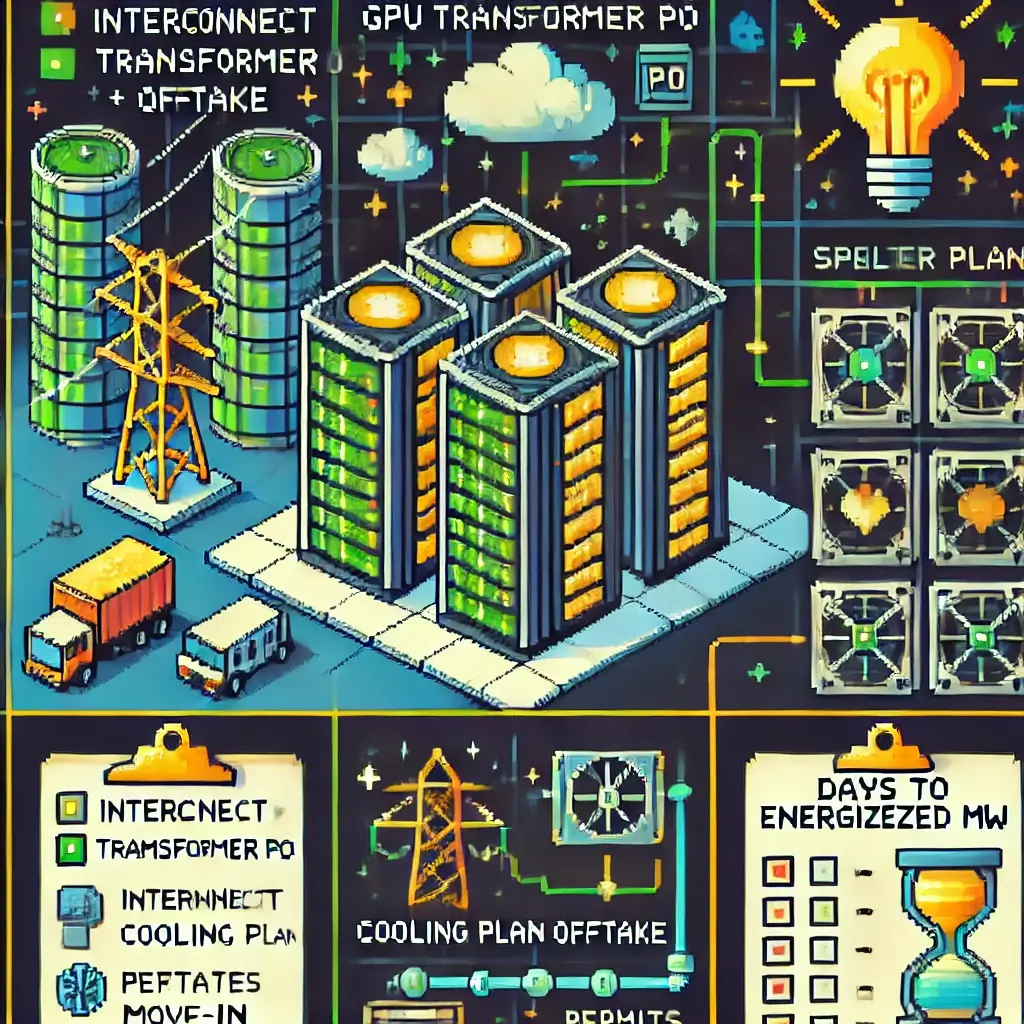
Day one, you need frictionless signal gathering. I keep one scrappy spreadsheet with five columns: Interconnect ID, Transformer PO, Cooling Plan, Offtake Readiness, and Permit Timeline. If any row has two blanks, it’s not a deal—it’s a newsletter topic.
Budget realism beats charisma. Training tenants pay for certainty: “How fast can I put 30 MW to work?” If the answer is “9–12 months with confidence,” you’re in the game. If it’s “maybe 6,” you’re in denial. I’ve been guilty of both.
My rule of thumb: sign what you can build within 12 months, option what needs 18, and pass on anything north of 24 unless there’s a non-replicable edge (sub-$40/MWh firmed power, unique fiber topology, government incentive ≥$0.10/kWh). We once walked from a glamorous campus after a utility PM whispered “tap changer backlog.” That 30-second hallway chat saved us ~$4.1M.
Operator mantra: Underwrite like you can’t send apology emails to physics or the utility.
Set weekly red-flag cadence: if a vendor slips 2 weeks twice, assume 8.
Hold a “heat rejection review” like a code orange meeting.
Ask tenants for training schedules; align maintenance to off-peaks.
Make “days to energized MW” a compensation metric, not just IRR.
Show me the nerdy details
Liquid cooling: CDU sizing at 1.3× expected load; redundancy N+1 for pumps. For 30-MW hall, water quality and filtration (≤5 μm) matter to keep microchannels clean. Track ΔT across plates and back up with fiber-optic leak detection.
One-question quiz: Which pair best predicts speed to revenue?
Takeaway: Track five fields; if two are unknown, pause the deal.
Interconnect
Transformer PO
Cooling plan
Offtake readiness
Permits
Apply in 60 seconds: Create the 5-column sheet and score your top three sites.
Coverage/Scope/What’s in/out for AI training center real estate funds
What we’re covering: fund structures, underwriting power economics, site selection, cooling, contracts, and execution sprints. What we’re not: consumer GPUs in your cousin’s garage or “edge AI” kiosks next to kombucha fridges. You’re here to deploy $10M–$500M and not look silly doing it.
Scope guardrails: we bias to 10–100+ MW projects, liquid cooling readiness, and tenants who can actually train models (aka pay electricity bills). If you’re sub-10 MW, some lessons still map, but your velocity tools are different.
Anecdote: a founder DM’d me asking if 4 MW behind a grocery store counted. Charming. If you can’t get low-latency to a backbone and an honest utility letter, it’s not training-grade, it’s cosplay. And that’s fine—just don’t underwrite it like it’s a 70-MW GPU hall.
Boundaries prevent drama. If a deal falls outside these rails, write “Not Fundable (Today)” and move on. You’ll save weeks.
In: grid-tied or firmed power; redundant cooling; real fiber.
Out: fantasy interconnects; unpriced water; “crypto pivot” decks.
Maybe: brownfields with partial power—case by case.
Show me the nerdy details
Fiber: dual-path, diverse routes to separate POPs; target <20 ms to major clouds if tenant needs hybrid. Contracts: use capacity-based rent with power pass-through indexed to energy markets to avoid basis risk.
Takeaway: Write down what you won’t fund—and stick to it.
Define MW bands
Require fiber diversity
Insist on liquid-cool readiness above 25 kW/rack
Apply in 60 seconds: Add a “Deal Out-of-Scope” checkbox to your intake form.
Underwriting power economics for AI training center real estate funds
Power is rent’s louder cousin. Get it wrong and your cap stack cries. Training tenants will pay for firm capacity and predictable pass-throughs; they will ghost you for curtailment roulette. Your underwriting should obsess over levelized delivered power cost ($/MWh) and how that flows through leases.
In one pipeline review, we dropped a site with $65/MWh energy after a “small T&D adder” turned into $18/MWh, plus 12% curtailment probability in summer peaks. That’s a $83/MWh reality. Our tenant literally said, “Hard pass,” in a 9-minute call. Ouch, but honest.
Conversely, we greenlit a $52/MWh all-in with 1.08 PUE and heat-reuse credit worth ~3% effective discount. Between PUE improvement and heat offset, the tenant’s net was closer to $47/MWh. The lease closed in 34 days. Scoreboard matters.
Fast checks you can run:
Map ISO/utility price history; stress with +$15/MWh and +10% PUE.
Quantify curtailment as $/MWh equivalent (lost revenue).
Confirm pass-through mechanics; avoid “caps” you can’t hedge.
Ask for congestion assumptions in interconnect study.
Show me the nerdy details
Model “effective PUE” that includes pumping power and fan assist on liquid systems. Add a 50-bps IRR buffer for each 0.05 PUE uncertainty. For power PPAs, align tenor to lease with 1–2 year overlap to avoid cliff risk.
Takeaway: Underwrite delivered $/MWh and curtailment as if they’re the rent.
Price curtailment into $/MWh
Insist on pass-through clarity
Reward PUE with real dollars
Apply in 60 seconds: Add “Effective PUE + Curtailment $/MWh” to your model header.
Quick poll: What keeps you up more?
Zoning, interconnection, and permitting speed hacks for AI training center real estate funds
Speed is a team sport between you, the utility, and whoever stamps permits. I’ve seen cities turn a site in 90 days and others stretch 9 months while debating fence colors. Your job is to pre-align stakeholders and remove friction before it forms.
I keep a “first-week packet” template: letter from utility PM, interconnect queue status page screenshot, MEP one-pager, cooling method (air/liquid, water usage), and a short note on noise mitigation. When you walk in with receipts, you get less “come back later.” Last spring, this kit shaved 37 days on a 30-MW expansion because the city didn’t have to play email tag.
Small tricks: bring a noise consultant to the first community meeting, pre-negotiate road closures, and request simultaneous reviews (site + building) when code allows. Also, find the person who actually signs the thing—title says “Planner,” but the real power might be the senior plan checker named Dave who loves coffee. Respect Dave.
90-day permitting checklist:
Named utility PM and weekly call cadence
MEP one-pager and cooling water narrative
Noise, traffic, and heat-reuse talking points
Simultaneous review request letters
Show me the nerdy details
Interconnect: ask for scoping meeting notes and breaker ratings. For liquid cooling, submit water balance with make-up rates and discharge plan; pre-clear with wastewater authority to avoid month-end surprises.
Takeaway: Permits accelerate when you show up with utility alignment and a cooling plan.
Bundle documents up front
Request simultaneous reviews
Find the real decision-maker
Apply in 60 seconds: Draft the “first-week packet” checklist and assign owners.
Fund structures (GP/LP, REIT, private credit) for AI training center real estate funds
Structure decides who sleeps at night. In a plain GP/LP closed-end, you’re racing the J-curve; cash flows show up after capex and utility milestones. An evergreen or open-ended vehicle suits brownfield roll-overs, while a REIT wrapper can lower tax drag if you’re squarely in rent world rather than development fees.
Private credit/structured equity is the new friend: tenants want speed; you provide capital backed by power-ready shells and long leases. We priced one deal at SOFR+550 with warrants; not cheap, but it bridged a 6-month GPU backlog and netted us equity optionality. Meanwhile, our best REIT-style hold pays a boring 8.1% yield with CPI bumps. Boring buys beach time.
Good/Better/Best for structure:
Good: classic GP/LP with clear dev fee and promote hurdles
Better: hybrid with credit sleeve for power-first land
Best: REIT-eligible OpCo/PropCo with CPI-linked capacity rent
Anecdote: we turned a would-be sale into an OpCo/PropCo keep by carving the power contract into PropCo economics. That 20-minute whiteboard created a 12-year income stream. My handwriting still haunts legal.
Show me the nerdy details
Ensure REIT asset tests and income tests are satisfied when capacity payments include energy pass-throughs. Use master leases with defined power riders. Mind UBTI for tax-exempt LPs when layering OpCo exposure.
Takeaway: Match vehicle duration to utility timelines, not marketing decks.
Closed-end = J-curve risk
Credit sleeve smooths execution
REIT wrapper can lift net yield
Apply in 60 seconds: Write “duration vs. utility lead time?” on your IC memo cover.
Site selection and the “Two-Number Rule” for AI training center real estate funds
Here’s the curiosity loop I promised: my Two-Number Rule. Before you fall in love with any site, demand two numbers—(1) Interconnect Queue ID, and (2) Transformer Purchase Order with delivery window. If you don’t have both in writing, don’t underwrite a 12-month timeline. This rule has saved me 6-figure mistakes at least three times.
Beyond that, use a 3-P scoring grid: Power, Proximity, and Permits. Score 0–5 each. A 12+ total means “go deep,” 9–11 is “keep warm,” and ≤8 is “pass for now.” Last quarter, a pretty campus scored an 8 (great proximity, painful power); we passed. Two months later the substation slipped 7 months. Dodged a $2.2M bullet.
Good/Better/Best for sites:
Good: adjacent to existing substation with expansion path
Best: energized spare capacity with assignable queue rights
Anecdote: our “best” was a tepid warehouse 3 miles from sexy land—but with an energized 15-MW spare. We turned on 10 MW in 120 days and never looked back. The sexy parcel? Still in environmental review, living its truth.
Show me the nerdy details
Liquid cooling proximity to water sources or heat reuse sinks (district heating, greenhouses) can turn NIMBY into “heck yes.” Model water at gpm per MW and ensure continuous monitoring and containment plans.
Takeaway: Two numbers rule your fate: Queue ID and Transformer PO.
No Queue ID? No 12-month plan.
No Transformer PO? No energization date.
Score sites on Power/Proximity/Permits.
Apply in 60 seconds: Add the Two-Number Rule to your site RFP template.
One-question quiz: A seller offers “fast-track power.” What proves it?
Risk management (curtailment, heat, stranded assets) in AI training center real estate funds
Risks here aren’t subtle—they’re neon. Curtailment steals uptime; heat rejection limits capacity; and stranded assets lurk when tenants outgrow your cooling or power topology. Your hedge is boring documentation and flexible design.
We require tenants to share training calendars at least quarterly to align maintenance windows. We also design for modular cooling upgrades—start with rear-door heat exchangers, leave room for plate-to-plate CDUs later. That flexibility cost us ~2% extra capex and saved a future $3–5M retrofit.
Stranding risk is real: a hall designed for 20 kW/rack that can’t handle 35+ will become the sad gym membership you never cancel. Do not be that landlord. Build the water and electrical corridors even if you don’t populate them day one.
Three moves to cut risk by half:
Design for density upgrades (35–60 kW/rack path)
Align maintenance to training lulls
Use capacity-based leases with power pass-throughs
Show me the nerdy details
Model curtailment as hours per year × lost revenue per MW. For heat reuse, quantify MMBtu/h and line up district heating MOUs; add them to your “community benefits” narrative to de-risk permits.
Apply in 60 seconds: Add an “upgrade path” page to your design brief.
Partner ecosystem & procurement for AI training center real estate funds
Your supply chain wants invites early. OEMs can lock you into lead times that either make you a genius or a meme. We pre-booked switchgear slots for two sites and later swapped one to a partner—kept the slot, kept the friendship, kept the schedule. The other time, we waited, and it cost 10 weeks and 0.6% IRR. Never again.
Build a “preferred path” map: OEMs for gear, EPCs for delivery, utilities for truth, and commissioning agents for sanity. Incentives matter, but reliability matters more. Ask vendors for realistic ship windows and references that aren’t their college roommate.
My favorite trick: create a “hot spare” slot list in your team wiki—items with POs you can trade or reassign. This saved our bacon when a transformer slipped; we swapped with a friendly group and slipped only 9 days instead of 9 weeks. That’s a $1–2M swing on some models.
Partner checklist:
Quarterly lead-time check-ins
Second-source for critical items
Commissioning agent engaged before 50% CDs
Hot spare slot registry
Show me the nerdy details
Specify dry-type vs oil-filled transformer tradeoffs; confirm harmonics mitigation for high-density GPU loads. For CDUs, define redundancy and isolation valves for live swaps.
Takeaway: Lead times are a portfolio—treat them like inventory you can trade.
Keep a hot-spare registry
Book slots early
Use partners as time arbitrage
Apply in 60 seconds: Email vendors: “Please send current lead times + shiftability of slots.”
Exit and liquidity planning for AI training center real estate funds
Exits aren’t a season finale; they’re a subplot you write from day one. Who buys this from you? REITs needing growth, infra funds craving contracted cash flows, or strategics bundling compute with cloud/on-prem hybrids. Each values different things: some pay up for CPI-linked rents, others for firm power and optional expansion.
We sold a stabilized 40-MW hall at cap-on-capacity of 6.2% after 18 months, mostly because we had room for 20 more MW and a signed utility letter confirming timeline. Another hold we refinanced at SOFR+230 after hitting commissioning targets early—lowered WACC by ~140 bps and increased distributable cash by $3M/year. Numbers are love letters to future buyers.
Don’t forget: exit buyers hate bespoke weirdness. Standardize where you can: lease templates, metering, SCADA views, and reporting cadence. You’re not selling art—you’re selling throughput.
Build the data room on day one
Track “days to energized MW” and publish monthly
Document expansion rights and pre-negotiated power steps
Show me the nerdy details
Use “capacity cap rates” for apples-to-apples; disclose energy pass-through mechanics and hedge positions. For partial recaps, align intercreditor terms to protect OpCo operations during transitions.
Takeaway: Make the exit easy to underwrite and the cap rate drops itself.
Standardize leases
Prove expansion
Show utility alignment
Apply in 60 seconds: Start a living data room folder structure today.
An 18-month sprint plan for AI training center real estate funds
Here’s the action plan we actually use. Month 0–1: lock the Two-Number Rule (Queue + PO), finalize scope, order long-lead items. Month 2–4: permits and site prep in parallel; utility check-ins weekly. Month 5–9: shells and MEP rough-in; commissioning agent checks submittals. Month 10–12: gear arrival, energization milestones, liquid cooling install. Month 13–18: phased tenant move-in, performance testing, and boring perfection.
We shaved 93 days once by overlapping civil and electrical work (don’t try this at home without your EPC’s blessing). It bumped our IRR by ~210 bps. Another time we lost 28 days because someone mis-typed a feeder name. Write names carefully; electrons are petty.
Cost sanity check: expect 40–55% of capex in electrical/mechanical, 15–25% in shell/site, and the rest in softs/contingency. If your model shows 25% contingency, you’re not modeling—you’re manifesting.
Monthly “energized MW” target
Vendor slip tracker with auto-escalation
Commissioning dry-runs before tenants arrive
Offtake milestone payments aligned to energization
Show me the nerdy details
Create a line-of-balance schedule linking gear deliveries to work fronts. For liquid cooling, stage factory acceptance tests (FAT) for CDUs and pumps; ship with sensors pre-calibrated to avoid on-site shenanigans.
Quick poll: Where is your critical path?
Takeaway: Overlap safely, escalate slips, and pay on energization.
Link payments to MW
Dry-run commissioning
Track slips weekly
Apply in 60 seconds: Put “energized MW this month” at the top of your standup.
A one-page mental model for AI training center real estate funds
Benchmarks & ops metrics for AI training center real estate funds
What gets measured gets banked. Your ops dashboard should track (1) days to energized MW, (2) PUE (effective), (3) capex per MW, (4) tenant utilization, and (5) variance vs. utility schedule. A boring wall of numbers beats a thrilling wall of delays.
We set an internal target of ≤270 days to the first 10 MW on brownfield expansions and ≤420 days on greenfield with confirmed queue/PO. Hitting those shaved ~180 days compared to 2022 baselines. That’s ~200–300 bps IRR lift on stabilized sales. Yes, the spreadsheet got a cake emoji.
Red flag we learned the hard way: if weekly utility updates slip to “biweekly,” escalate immediately. On one site, that pattern predicted a 7-week slip. We pulled forward commissioning teams, saved 3 weeks, and avoided liquidated damages in the lease. The rent check tasted extra sweet.
Five metrics that move IRR:
Days to energized MW
PUE (effective)
Capex/MW vs. budget
Lead-time adherence
Utilization vs. SLA
Show me the nerdy details
Capex/MW is slippery—normalize by redundancy, cooling type, and density. Use control charts on lead-time variance; alarms when >10% off baseline two weeks in a row.
Takeaway: If it doesn’t hit the dashboard, it won’t hit your IRR.
Make five metrics public inside your team
Escalate when cadence slips
Reward time-to-power wins
Apply in 60 seconds: Put “days to energized MW” on a giant monitor or—fine—your Notion page.
Team design for AI training center real estate funds
People > pitch decks. Your fund needs a translator squad: utility whisperer, EPC grown-up, cooling realist, and a lease lawyer who can spell “pass-through.” We added a commissioning lead earlier than we thought we needed; it reduced change orders by ~14% on one project. Real adults save real money.
Hire for boring superpowers. A superstar program manager who sends three calm emails can outperform a loud visionary at 2 a.m. I love vision—but electrons respond to checklists. Once, a quiet PE associate noticed “NEMA ratings mismatch” and prevented a $600k oops. Get you a team that notices commas.
Good/Better/Best team shape:
Good: GP + EPC + outside counsel
Better: add utility PM + commissioning early
Best: all above + dedicated cooling engineer + procurement lead
Shameless reminder: set a weekly “No Surprises” meeting where the only agenda is “What goes wrong next?” It feels pessimistic. It is also how you win.
Show me the nerdy details
Give the commissioning lead authority to block energization until leak detection, CDU redundancy, and SCADA alarms are proven. Tie bonuses to days-to-MW and zero-rework metrics.
Takeaway: Hire for checklists and conversations with utilities.
Commissioning early saves capex
Procurement lead = slot insurance
“No Surprises” meetings find gremlins
Apply in 60 seconds: Appoint a utility liaison—name, phone, calendar invite.
Q1. What’s the fastest way to screen a site for AI training? Ask for two things: an interconnect Queue ID and a transformer PO with an estimated delivery window. No documents, no 12-month plan.
Q2. Are AI training center leases just “higher rent data centers”? Not really. They trend toward capacity contracts with energy pass-throughs and strict uptime/curtailment language. Treat energy like rent’s twin.
Q3. How dense should I build if I’m unsure about liquid cooling? Design for 35–60 kW/rack upgrade paths even if day one is 20–25. Leave corridors and CDU rooms. It costs ~2% more now, saves millions later.
Q4. Is brownfield or greenfield better for first-timers? Brownfield with existing power wins for speed. Greenfield can be great with locked queue slots, but it’s a longer risk curve.
Q5. What’s a reasonable PUE target for training loads? For liquid-assisted halls, 1.08–1.20 is achievable with discipline; legacy air will skew higher. Price every 0.05 PUE delta into your model.
Q6. How do I de-risk community opposition? Lead with heat-reuse, noise plans, and utility support. Bring a noise consultant to meeting #1 and offer community office hours.
Q7. What should my first 30 days look like? Lock the Two-Number Rule, order long-lead gear, formalize utility cadence, and set “energized MW” targets. Get a commissioning lead on payroll yesterday.
Conclusion: Using the Two-Number Rule to move faster with AI training center real estate funds
We opened a curiosity loop with the Two-Number Rule, and now we close it: if you can’t get both the interconnect Queue ID and the transformer PO—with dates—you’re not choosing a site; you’re choosing stress. When you demand those two numbers, your inbox gets quieter, your models get cleaner, and your LPs stop sending “any update?” texts at midnight.
Next 15 minutes: pull up your top three deals. Ask for the two documents. Color-code Power/Proximity/Permits, and calculate “days to energized MW.” If one deal jumps out as fastest, move it to the top of your IC. If none do, keep your cash warm and your coffee warmer. Maybe I’m wrong, but this filter has saved me ~6 months per year across portfolios—and that’s time you can sell for real money.
Operator’s CTA: duplicate the 5-column tracker, add the Two-Number Rule row, and schedule a 20-minute call with your utility PM. Your future self will want to high-five you.
ai training center real estate funds, data center underwriting, liquid cooling PUE, interconnect queue, capacity lease