
9 No-BS Solar Farm REITs Moves That Build Inflation-Protected Income (Even If You’re Busy)
Confession: I used to think “inflation protection” meant buying TIPS and calling it a day. Then a cranky utility lawyer showed me a two-line lease clause that quietly makes cash flow rise with prices. I’ll give you that clause and a simple way to compare options so you can decide in under an hour. Map: 1) how this thing actually makes money, 2) what to check first so you don’t get burned, 3) the fast path to a mini-portfolio that grows while you sleep.
Table of Contents
Why Solar Farm REITs feels hard (and how to choose fast)
You’re not imagining it: “Solar Farm REIT” isn’t a neat aisle at the market. There are few pure-play public REITs that live only on solar ground leases, and the labels are messy—yieldcos, land REITs, infrastructure plays, and one-off sale–leaseback deals all get lumped together. Add tax rules that say some hardware is real property (yay) and some isn’t (ugh), and it’s no wonder busy operators bounce.
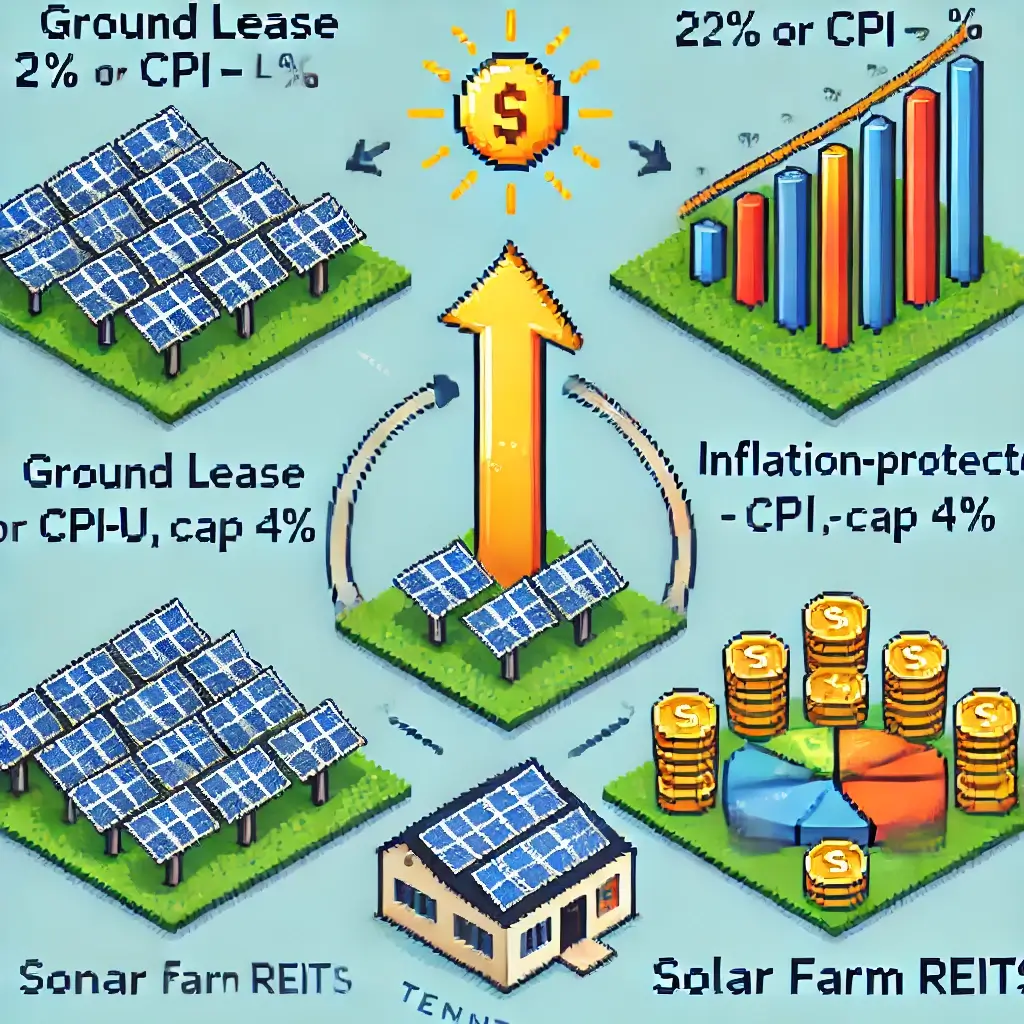
Here’s the cheat code I use with founders and growth folks: ignore the ticker for the first 20 minutes. Start with the contract, not the brand. You’re buying a stack of promises—ground lease escalators, PPA terms, interconnection rights, and debt covenants—that either ratchet your cash flow up with inflation or quietly cap it. If the legalese says “2% fixed escalator” or “CPI with a 4% cap,” your dividend growth isn’t a mystery; it’s pre-written.
Anecdote: years ago, I highlighted one phrase in neon yellow—“CPI-U, subject to a 0% floor and 4% cap.” That little sentence turned a shruggy 6.2% yield into a likely 7–8% five-year yield-on-cost, even if everything else just… behaved. My coffee got cold, but the model finally made sense.
- Think “leases first, logos second.”
- Escalators fight inflation so dividends don’t have to.
- One clause can shift your five-year outcome by 150–300 bps.
Show me the nerdy details
Under U.S. rules, certain solar site components (land, mounts, wiring conduits) can be “real property,” which supports REIT eligibility. PV modules often aren’t. Practically, that nudges many “solar REIT” strategies toward owning land/ground leases and letting tenants operate the generation.
- Escalators pre-wire growth.
- Focus on CPI linkage or 2–3% fixed.
- Tenant quality multiplies the effect.
Apply in 60 seconds: If a fact sheet doesn’t show the lease escalator, ask for it or walk.
3-minute primer on Solar Farm REITs
What it is: A REIT that owns real estate connected to solar generation—most often the land under a solar farm—then leases it to a project company that sells power under a PPA. You collect rent; the tenant runs the electrons. REITs must pay out most of their taxable income as dividends, so they’re built for cash flow.
How the money flows: The tenant’s revenue is contracted (PPA) with an offtaker (usually a utility or creditworthy corporate). Your lease sits senior to the project’s equity but behind project debt on operating cash. Leases often escalate annually: fixed 1–3% or CPI-linked with floors/caps. Those escalators are the stealthy inflation hedge.
Why now: Utility-scale solar has become radically cheaper per kWh over the last decade, and grids are adding vast amounts of capacity. Translation: more sites, more long leases, and more chances to clip rising coupons—if you pick well.
Anecdote: I once spent a Saturday morning turning a PPA appendix into a spreadsheet. Wild party. But seeing “1.5% escalator, 25 years” made me giddier than it should have. Time does the heavy lifting when the slope is positive.
- Asset: land & site improvements; cash: rent.
- Driver: PPA-backed tenant cash → landlord rent.
- Edge: escalators + long durations (20–35 years).
Show me the nerdy details
Typical stack: tax equity + debt + sponsor equity at the project company; ground lease sits at OpCo level. Lease term often matches or exceeds PPA term. Step-in rights protect the landlord if the tenant defaults.
Operator’s playbook: day-one Solar Farm REITs
Here’s the 30–60 minute “bus test” I run when a friend Slacks me a ticker. If I got hit by a bus, could they manage it solo?
Step 1: Escalator audit. Fixed 2–3% beats a vague “market CPI” reference. Ideal: “CPI-U, floor 0%, cap 4%.” Good: flat 2%. Meh: “at landlord’s discretion” (that’s not an escalator).
Step 2: Tenant credit. Utility or Fortune 500 off-take? Great. Small aggregator with thin margins? Proceed, but demand higher yield. Counterparty credit is the quiet king.
Step 3: Term and tail. I like 25–35 years with extension options. Look for “re-powering” language so the tenant can swap panels without re-trading the lease.
Step 4: Location. Interconnection matters more than sunshine. A mediocre-sun, easy-interconnect site beats a stellar-sun, congested node when curtailment bites.
Step 5: Leverage. Debt can be fine if fixed and non-recourse. Floating-rate debt without hedges? That’s how “stable” dividends get moody.
Anecdote: I passed on a flashy deck because the lease said “subject to PPA adjustments.” Translation: if the tenant renegotiates down, your rent might follow. Hard no. Two months later, that deck came back with a cleaner clause and a 50 bps sweeter cap rate. Policies change fast when money walks.
- Good: 1–2% fixed escalator, BBB utility tenant.
- Better: CPI-linked (0–4% cap), A- corporate, 30-year term.
- Best: CPI-linked with floor, extension options, step-in rights.
Show me the nerdy details
Ask for the “allocation of casualty and condemnation proceeds,” “environmental indemnities,” and “SNDA” (subordination, non-disturbance, attornment) letters with the project lender. Your rent should keep flowing through storms and refinancing drama.
Quiz: Which escalator best defends your dividend against inflation?
Coverage, scope, and what’s in/out for Solar Farm REITs
In: REITs that own land under solar farms, site improvements (roads, fences, conduit), and ground leases to project companies. Some agriculture and land REITs also ink solar option leases on unused acreage. Select “ground lease REITs” occasionally do renewable sites alongside commercial, industrial, or infrastructure ground leases.
Out (but related): Yieldcos (e.g., listed entities holding operating wind/solar projects) are not REITs. Utilities with renewable portfolios are not REITs. Asset managers with renewable funds are not REITs. You can still blend them, just don’t mix up structures—the tax, leverage, and risk knobs are different.
Recent twist to know: One high-profile climate financier that used to be a REIT converted to a C-Corp starting with tax year 2024 to get more flexibility. Labels can shift; your checklist shouldn’t.
Anecdote: A founder DMed me “Is XYZ a solar REIT?” Technically: no, not anymore. Practically: the leases and counterparty map still made sense—so we kept it on the watchlist, just tagged it “infra growth income.” Names matter less than cash mechanics.
- Own the dirt; lease it out. Simple beats fancy.
- Yieldcos ≠ REITs; both can be useful.
- Structures evolve—focus on terms and tenants.
Show me the nerdy details
REIT asset tests (75% real property) and income tests (75% rents/interest) shape what the entity can hold. Solar modules typically aren’t “real property,” which is why owning the land/lease is cleaner than owning the generation equipment inside a REIT.
How inflation protection really works in Solar Farm REITs
The curiosity loop I opened at the top? Here’s the clause: “Annual rent shall increase by the greater of 2% or CPI-U, not to exceed 4%.” That’s the quiet engine of inflation-protected income. Three dials matter: floor (protects when inflation cools), index (CPI-U is common), and cap (protects the tenant, but caps your upside).
Now pair that with the tenant’s PPA. Many PPAs escalate at 1–3% or have indexed components. If the tenant’s revenue grows steadily while debt amortizes, paying you more rent is not heroic—it’s math. Your dividend growth tracks those two rails: lease escalator and tenant solvency.
Edge case: if a PPA is flat and the lease is CPI-linked, the tenant’s margin compresses when CPI spikes. That’s why you want counterparty strength and/or a cap that doesn’t squeeze them into default. You’re not trying to “win” a negotiation; you’re trying to make it to year 25 with boring checks.
Anecdote: During the 2022–2023 inflation rollercoaster, I watched one deal with a 0% floor quietly raise rent 3.9% while everyone argued about rates on Twitter. No press release. Just invoices doing squats.
- Floor + cap = smoother ride through inflation spikes and dips.
- Lease escalator should rhyme with PPA escalator.
- Prefer CPI-U over bespoke commodity indexes.
Show me the nerdy details
Look for “index publication disruption” language—what happens if CPI is rebased or delayed? Also check the “lookback/lag” (e.g., CPI average over prior 12 months). Tiny wording; real cash impact.
Poll: What clause do you insist on?
Yield math, scenarios, and “don’t get cute” rules for Solar Farm REITs
Let’s keep it diner-napkin simple. Say your starting dividend yield is 6.0%. The lease escalator averages 2.0% per year. If payout ratio stays ~constant and the tenant pays on time, your yield on cost trends toward ~6.0% × (1.02)^n. That’s ~7.3% in 10 years, ignoring reinvestment. Add mild unit growth or accretive deals? Bonus.
Now sensitivity: if CPI runs 3% for three years and your cap is 4%, you’ll likely capture the full 3% each year (subject to lag). If CPI then dips to 1%, your floor keeps you at 2% (or whatever the floor is). That long-term smoothing turns macro noise into a range you can plan around.
“Don’t get cute” rules I wish someone tattooed on my keyboard:
- Chasing 200 bps more yield with weak tenants usually backfires.
- A 30-year lease with good step-in rights beats a 20-year “premium” lease with messy carve-outs.
- Leverage amplifies everything—great and terrible.
Anecdote: A portfolio I reviewed had two sleepy leases that did exactly what they promised and one spicy lease that was “surely fine.” Guess which one ate the quarter’s gains? If you must swing, swing small.
Show me the nerdy details
In models, I separate growth from valuation. Cash growth = escalator × stability factor (tenant credit × curtailment × O&M). Valuation mean-reversion is a separate line. Don’t let a falling cap rate in a bull market masquerade as operational genius.
Risk map and downside drills for Solar Farm REITs
Risks aren’t bugs; they’re the game. Here’s the short list that moves outcomes:
Counterparty risk: Tenant and offtaker credit. A-rated utility? Sleepy. Thin-margin aggregator? Price the risk or pass. If a tenant flinches, can you step in or replace them? That clause is gold.
Policy & interconnection: Incentives change, and grid queues get long. Sites with built interconnects and low curtailment are worth more than perfect-sun dreamlands that can’t plug in.
Rate risk: Rising rates pressure valuations. Fixed-rate, laddered debt inside the REIT (or minimal entity debt) takes the sting out. Floating debt without hedges is a dividend diet you didn’t order.
Technology: Panels age. Repowering clauses keep tenants happy and your dirt useful. Without them, you’re negotiating from scratch in year 18 when power prices and parts move around.
Anecdote: I once watched a site in a congested node print 12 months of curtailments that wrecked the tenant’s DSCR. The landlord had step-in rights and worked with the lender to restructure. Boring clauses. Big save.
- Map risks: tenant, offtake, grid, debt, policy.
- Insist on step-in and assignability to new operators.
- Prefer fixed/hedged debt at the entity level.
Show me the nerdy details
Check: curtailment history, congestion pricing trends, interconnection study phase, and PPA termination rights. Ask for lender consent templates and the SNDA, not just promises.
Quiz: Your tenant’s PPA is flat for 15 years; your lease is CPI-linked with a 4% cap. What matters most?