
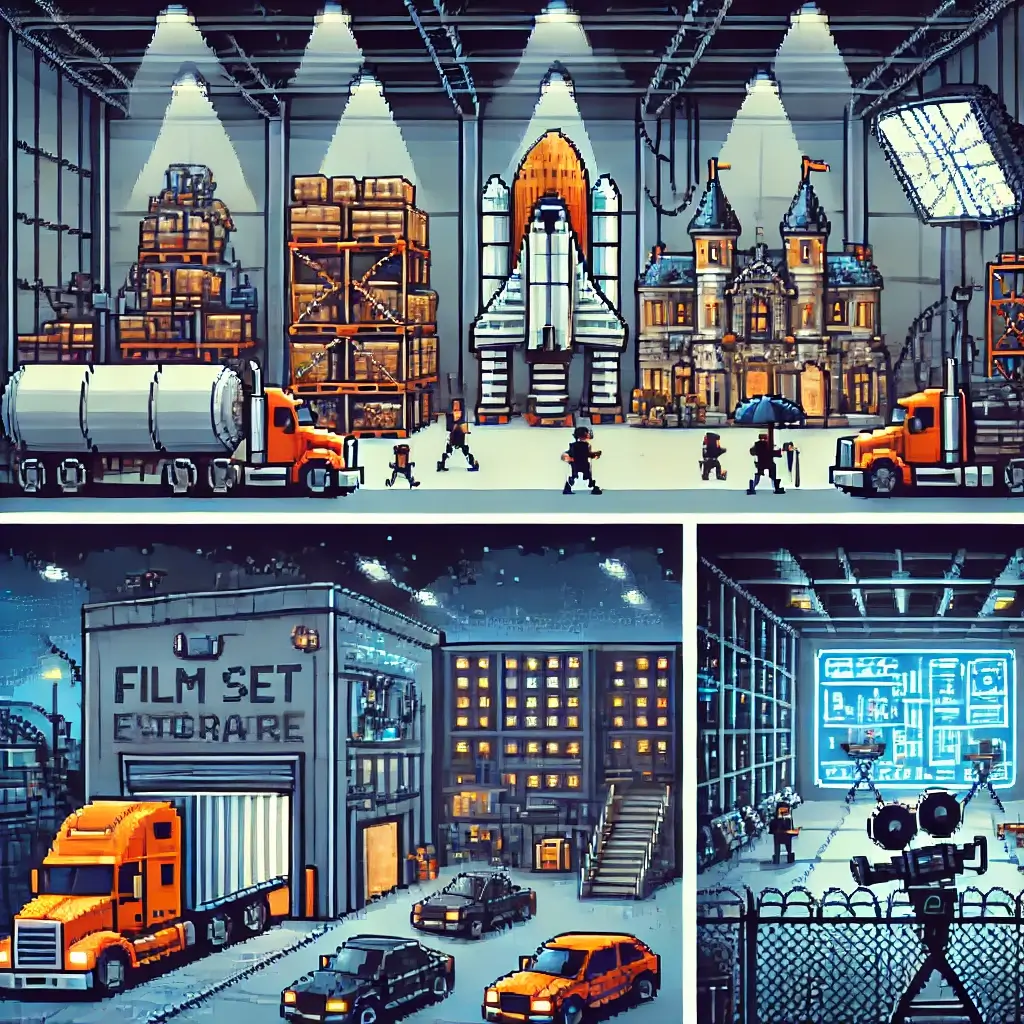
The Untold Truth: Why 90% of Film Set Real Estate Investors Fail and How to Be in the 10%
Hello, and welcome to the wild, wacky, and incredibly profitable world of film set and prop storage real estate. If you’re here, you’re probably looking for a new frontier in property investment, something a little different from the usual office buildings and suburban homes. You’ve come to the right place. I’ve spent years navigating this very specific, very fascinating market. I’ve seen fortunes made and, just as often, burned. I’m going to pull back the curtain and show you what it really takes to succeed. This isn’t a get-rich-quick scheme. It’s an investment strategy that requires grit, knowledge, and a little bit of Hollywood magic.
Trust me, the stories you hear are true. The demand for industrial properties for film sets and prop storage is absolutely insane. With the rise of streaming services like Netflix, Disney+, and Amazon Prime, content production is at an all-time high. Every single one of those productions, from the massive blockbuster to the indie darling, needs a place to build its world, and a place to store all the stuff that makes that world real. That’s where you come in. But it’s not as simple as buying a warehouse and slapping a “For Rent” sign on it. Not by a long shot.
My first venture into this space was a disaster. I bought an old, cavernous warehouse in a seemingly perfect location, thinking I’d be a hero. Turns out, it lacked the specific ceiling height and power infrastructure that most film production companies require. I was stuck with a white elephant, a beautiful building that no one in my target market could actually use. It was a tough lesson, and I’m going to make sure you don’t have to learn it the hard way. So, let’s get into the nitty-gritty.
—
Table of Contents
—
The Unseen Demand: Why Film Set and Prop Storage Real Estate is Booming
Think about it. Every single show, every movie, every commercial you watch… it’s all built from scratch. A street in New York, a castle in a fantasy land, a futuristic spaceship—these are all created inside massive, empty warehouses. And once the cameras stop rolling, all those sets, all those incredible props, need a home. They can’t just disappear. The storage part of this business is often overlooked, but it’s a massive, consistent revenue stream.
It’s not just about soundstages either. A lot of productions need space for pre-production, where they build the sets, and then a separate space for storage once the shoot is wrapped. This creates a dual-market opportunity for you. You can specialize in building and leasing out soundstages, or you can focus on the long-term, stable income from prop and set storage. Or, if you’re feeling ambitious, you can do both.
The rise of streaming platforms has fundamentally changed the game. Instead of a handful of major studios producing content, you now have dozens, even hundreds of companies churning out shows and movies at an unprecedented rate. This isn’t a temporary blip. This is the new normal. And it means the demand for specialized **film set real estate** isn’t just steady—it’s skyrocketing.
—
The 5 Critical Factors That Separate a Goldmine from a Money Pit
This is the most important part of this entire guide. Miss any of these, and you’re toast. You’ll end up with an expensive piece of property that no one wants. Trust me, I’ve been there. I’ve seen countless investors get so excited about the idea of owning a piece of Hollywood that they overlook the basic, non-negotiable requirements.
The five factors are:
1. Location, location, location (but not in the way you think)
2. Power infrastructure
3. Ceiling height and floor load capacity
4. Security and accessibility
5. Zoning and permitting
Let’s break down each one.
—
Location, Location, Location: Beyond the Obvious
When you think of film production, you probably think of Los Angeles, Atlanta, or maybe New York. You’re not wrong, but you’re not entirely right, either. The key isn’t just being in a “film city.” The key is being in the right part of that city. You need to be close to where the talent and crew live, and, more importantly, close to other major production hubs.
A beautiful warehouse in a remote, rural area might seem like a bargain, but it’s a non-starter. Production crews work long, brutal hours. The last thing they want is a two-hour commute to the middle of nowhere. Think about a 2 a.m. wrap time. Do you really think an entire crew is going to want to drive an hour and a half home? Absolutely not.
Instead, look for properties in established industrial zones near major film studios. Areas with easy access to major highways are also a huge plus. This makes it easy for huge trucks carrying sets and equipment to get in and out. Think of it like this: a film set is like a small, self-contained city that moves from place to place. The easier you make it for that city to set up shop, the more attractive your property becomes.
—
Powering Up: Electrical Infrastructure and Why It’s a Dealbreaker
This is where I learned my most expensive lesson. A soundstage isn’t just a big room. It’s a big room with a massive power grid. Think about the sheer amount of electricity needed for all the lighting, cameras, computers, and other equipment. A standard commercial electrical setup simply won’t cut it.
You need a property with heavy power capabilities, often requiring a dedicated substation or a very robust connection to the grid. We’re talking three-phase power, high amperage, and the ability to handle a huge load without blowing a fuse. When you’re looking at a property, don’t just ask about the total power—ask about the **amps, voltage, and distribution**. This is non-negotiable. If a property doesn’t have it, or can’t easily be upgraded, walk away. Period.
—
Size Matters: Ceiling Height and Square Footage Requirements
You can’t build a two-story spaceship set if your ceiling is only 20 feet high. The rule of thumb in this business is: the higher, the better. Most modern productions require a minimum clear height of 30-40 feet. Anything less, and you’re limiting your market to smaller, independent projects.
Similarly, the square footage needs to be significant. A large blockbuster might require a 100,000-square-foot facility just for one or two sets. And don’t forget the floor load capacity. Sets are heavy. A massive medieval castle set made of plywood and plaster can weigh a ton. You need a floor that can handle that kind of weight without buckling.
—
Security and Accessibility: The Unsung Heroes of Film Production
This is where many investors get it wrong. They think a lock on the door is enough. It’s not. **Film sets and props** are incredibly valuable. A single prop can be worth tens of thousands of dollars. The security needs to be top-notch. We’re talking 24/7 surveillance, a secure perimeter, and controlled access points.
But it’s not just about keeping people out. It’s about letting the right people in at all hours of the day and night. Production schedules are crazy. A crew might need to get in at 3 a.m. to grab a prop for a shoot. You need to have a system in place that allows for this kind of flexibility without compromising security.
And let’s talk about accessibility for a moment. I’m not just talking about proximity to major highways. I’m talking about loading docks, drive-in doors, and a huge lot for all the production trucks. A property that requires a ten-point turn for a 53-foot semi-truck is not going to get a second look.
—
Infographic: A Visual Breakdown of a Film Studio Warehouse
To help you visualize what we’re talking about, here’s a little infographic I put together. It’s a simple blueprint of an ideal **film set storage** warehouse, highlighting the key features you need to look for.
Blueprint for a Perfect Film & Prop Storage Facility
High Ceilings
Minimum 30-40 ft clear height for large set construction.
Heavy Power
Three-phase power with high amperage for lighting and equipment.
24/7 Security
Controlled access, surveillance, and secure perimeter.
Truck Access
Wide driveways and multiple loading docks for easy entry and exit.
Fiber Internet
High-speed internet is essential for modern production offices.
—
Navigating the Red Tape: Zoning and Permitting
This one is less about the property itself and more about the bureaucracy. Before you even think about putting down an offer, you need to check the local zoning laws. Is the property zoned for industrial use? Can it be used for film production? Some areas have very specific rules about noise levels and operating hours, which can be a deal-breaker for a production that might need to shoot all night long.
A good real estate attorney who specializes in commercial property is worth their weight in gold. They can help you navigate the labyrinthine world of local government and ensure you’re not walking into a legal nightmare. This is one area where you absolutely cannot, under any circumstances, cut corners.
—
Building Your Network: Why Relationships Are Everything
This isn’t a passive investment. You can’t just buy a warehouse and expect the calls to come pouring in. The film industry is all about relationships. You need to get to know location managers, production coordinators, and studio executives.
Go to industry events. Join local film commissions. Get your name out there. You want to be the first person a location scout thinks of when they need a new **film set** location. A great property with a bad owner will sit empty. A decent property with a well-connected owner will be booked solid.
This is where your inner hustler needs to come out. Think of yourself not just as a property owner, but as a partner in the creative process. You’re helping bring someone’s vision to life, and that’s a powerful selling point.
—
Financing Your Film Set & Prop Storage Real Estate Dream
Now, for the part that makes everyone nervous: the money. Film set and prop storage properties are not your typical residential loans. Banks can be wary of these kinds of niche industrial properties because they’re not a cookie-cutter asset.
You’ll likely need to work with a commercial lender who specializes in industrial properties. Be prepared to present a very detailed business plan. You’ll need to show them not just the value of the property, but the immense demand and the potential for a high, consistent return on investment.
Don’t be afraid to think outside the box. Some investors have found success with private equity firms or even a consortium of smaller investors. The key is to demonstrate that you understand the market and have a solid plan to generate revenue.
—
Case Study: From Abandoned Warehouse to Hollywood Hotspot
Let me tell you a story about a friend of mine, let’s call him Alex. Alex found an old, abandoned manufacturing plant in a suburb of Atlanta. It had been sitting empty for a decade, a monument to a bygone era. It was huge, but it needed a ton of work.
Most people saw a money pit. Alex saw a goldmine. He checked the zoning, which was already industrial. He talked to the local city council and got a sense of their willingness to work with the film industry. The ceilings were 45 feet high, and the concrete floors could handle a tank if they needed to. The power, however, was a mess.
He spent a year and a half, and a considerable amount of money, upgrading the electrical grid, adding a dedicated substation, and installing fiber optic cables. He put in high-tech security systems and built a proper, large loading bay. He spent another six months networking, meeting every location manager he could find.
The day he finished, he had a production company ready to sign a lease. They were building a massive futuristic city set. They needed every single one of those 150,000 square feet. The rent they paid was astronomical. Alex is now a multi-millionaire, and he’s looking for his next project.
Why did he succeed where so many others fail? He understood the specific needs of the industry. He didn’t just buy a warehouse; he built a solution.
—
The Future is Now: Emerging Trends to Watch
The industry is always evolving. Here are a few things to keep an eye on:
1. Virtual Production: The rise of LED video walls is changing the game. These massive screens can display digital environments, reducing the need for physical sets. But guess what? They still need a massive warehouse to house them. In fact, they need a special kind of warehouse—one with an even higher ceiling to accommodate the huge LED walls.
2. Tax Incentives: Many states and countries are offering huge tax breaks to lure film productions. Keep an eye on these incentives. They can make a less-obvious location incredibly attractive.
3. The Gig Economy of Sets: Smaller productions are increasingly looking for short-term rentals. This opens up a new market for properties that can offer flexible lease terms.
—
The Final Act: Are You Ready for Your Close-Up?
Investing in **film set and prop storage real estate** isn’t easy. It’s not for the faint of heart. But for those who are willing to do the research, understand the unique needs of the industry, and build the right relationships, the rewards can be incredible. You’re not just buying a building; you’re becoming a part of the magic of filmmaking. And honestly, what’s cooler than that?
Do your homework. Check the power, the height, the zoning. Talk to people in the industry. And when you find the right property, you’ll know. It’ll feel like you’ve just found the perfect location for your own blockbuster.
Read The Hollywood Reporter Explore Variety Learn About Film Tax Credits
Film Set Real Estate, Prop Storage, Industrial Property, Film Industry, Investment
🔗 Space Launch & Satellite Ground Station Posted 2025-08-15 03:06 UTC 🔗 Climate-Proofed Real Estate Posted 2025-08-14 06:30 UTC 🔗 Blockchain Tokenized Real Estate Funds Posted 2025-08-13 05:59 UTC 🔗 The Dark Store Revolution Posted 2025-08-12 01:15 UTC 🔗 Speedy E-Commerce Deliveries Posted 2025-08-11 UTC 🔗 Blast Off: 7 Reasons Your Next Million Awaits in Space Posted 2025-08-15 UTC