
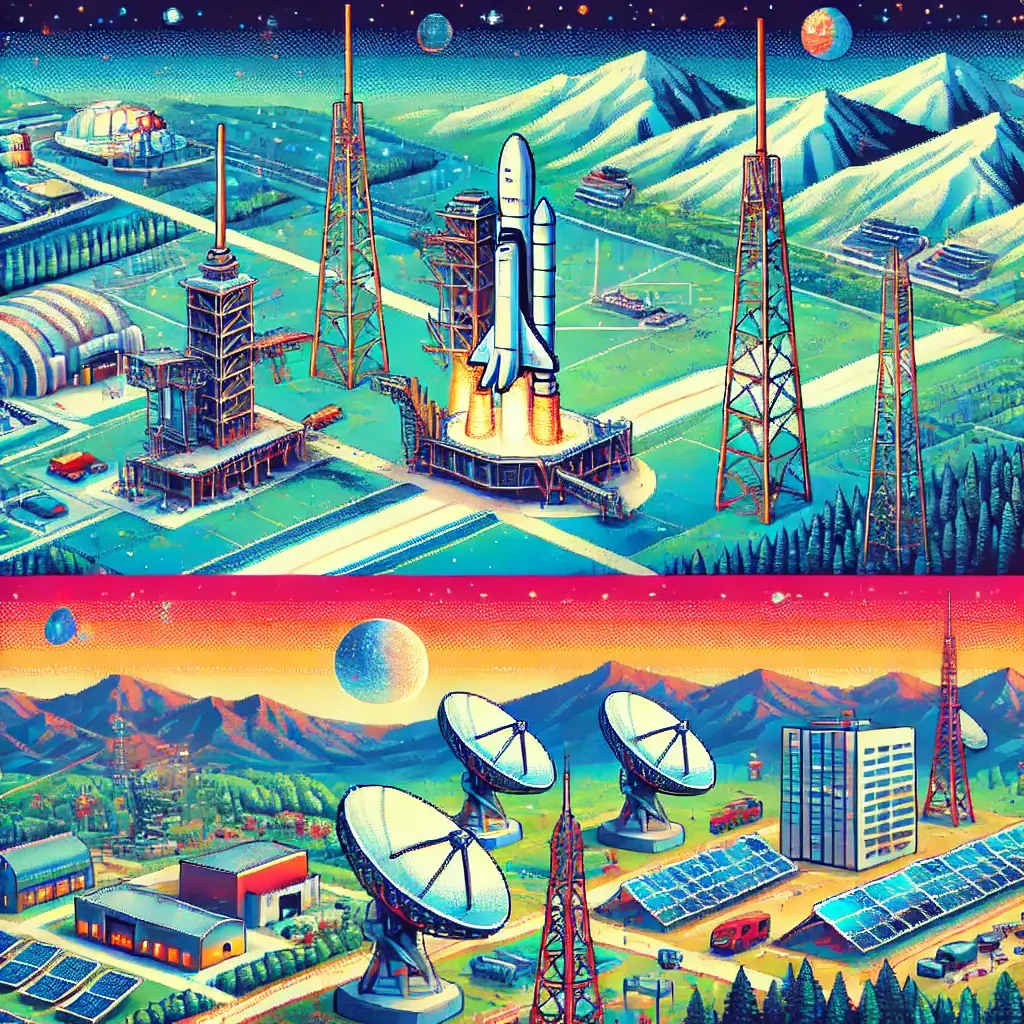
Space Launch & Satellite Ground Station Real Estate: Powering the New Frontier
The space industry isn’t just about rockets and satellites anymore. It’s a rapidly expanding economy, and like any major industry, it needs a home base—right here on Earth. As private companies and governments race to build out the infrastructure for a new era of space exploration and commerce, a new sector of real estate is taking off.
This isn’t your typical commercial property market. It’s a highly specialized field that includes everything from massive, multi-million-dollar launch complexes to unassuming, but critical, satellite ground stations. As a real estate professional who’s fascinated by the intersection of property and technology, I can tell you that this market is poised for explosive growth.
We’re going to explore the unique properties that support the burgeoning space industry, the key players, and what makes these assets a critical part of the new space economy.
Get ready to have your mind expanded, because we’re diving deep into the properties that are launching the future.
Table of Contents
Quick Poll: If you could invest in any part of the space industry, what would it be? Leave a comment below!
The Launchpad: Where It All Begins
A spaceport is the most recognizable piece of real estate in the space industry. These are not just fields with a launchpad; they are complex, high-tech facilities that can span hundreds of acres and require billions of dollars in investment. They are the gateway to orbit, and their location is a matter of strategic importance.
A key factor in a spaceport’s value is its location relative to the equator. Launches from locations closer to the equator can take advantage of the Earth’s rotational speed, which provides a “slingshot” effect, reducing fuel consumption and increasing payload capacity. This makes sites like the Kennedy Space Center in Florida particularly valuable.
However, spaceports aren’t just for launching rockets. Many, like the Houston Spaceport, are being developed as integrated campuses. They offer a variety of facilities beyond the launchpad itself, including:
- Manufacturing Facilities: Buildings where rockets and other space hardware are assembled.
- Mission Control and Training Centers: Facilities for monitoring launches and training astronauts.
- Research and Development Labs: Spaces where new technologies are created and tested.
These properties often operate under public-private partnerships, with government agencies like NASA working alongside commercial entities to create business-friendly environments. As the space industry moves toward a higher cadence of launches, the demand for this specialized real estate is surging.
The value of a spaceport lies not just in its physical assets, but in its ability to support an entire ecosystem of related businesses, from aerospace suppliers to logistics companies.
The Ground Station: The “Cell Towers” of Space
If a spaceport is the on-ramp to space, then a ground station is the off-ramp for data. These facilities are the crucial link between satellites in orbit and the terrestrial networks on Earth. A ground station is a terrestrial radio station with an antenna that receives data from, and sends commands to, spacecraft.
While they may not be as flashy as a launchpad, ground stations are an essential part of the space economy. Think of them as the “cell towers” of space, providing the point of presence where satellite data can be routed to the internet and private networks.
The real estate requirements for ground stations are specific and often counterintuitive. Key factors include:
- A Clear View of the Sky: Ground stations are often located in remote, elevated areas to avoid signal blockage from physical objects or other radio interference.
- Access to Power and Fiber: They require a reliable power source and a high-speed fiber connection to quickly backhaul the massive amounts of data they receive.
- Strategic Location: The geographical location is paramount. For example, ground stations in polar regions are vital for communicating with satellites in polar orbits, which are used for a variety of tasks like climate monitoring.
The ground station market is evolving rapidly. Once primarily owned by satellite operators, these assets are now being acquired and leased by independent businesses. This “Ground Segment as a Service” (GSaaS) model allows satellite operators to focus on their core business without the significant capital expenditure of building and maintaining their own ground network. For investors, these properties offer a profile similar to data centers or fiber networks, with stable, long-term cash flows.
Beyond the Basics: The Broader Space Real Estate Market
The space industry’s real estate needs extend far beyond launchpads and ground stations. The growth of this sector is creating new opportunities in traditional commercial real estate.
- Headquarters and R&D Campuses: Companies like SpaceX and Axiom Space require massive facilities for their corporate offices, labs, and manufacturing. These are often located near existing spaceports to create a synergistic ecosystem. For example, Axiom Space’s new headquarters in Houston is an 11-acre site, showcasing the need for large-scale, specialized properties.
- Hospitality and Tourism: The rise of space tourism is creating a new niche for hospitality real estate. Hotels and resorts are being developed in areas with clear views of launch sites, like the Westin Cocoa Beach Resort & Spa on Florida’s Space Coast. These properties cater to a growing market of “rocket tourists” who want a prime viewing location.
- Flex and Industrial Space: Smaller companies and suppliers in the space ecosystem need flexible commercial spaces. These can be industrial warehouses for manufacturing components or smaller office suites for engineering and software teams. Houston’s spaceport, for instance, is planning a multipurpose building to accommodate these smaller companies.
This ripple effect shows how the space economy is creating demand for a wide range of commercial properties, from large-scale, purpose-built facilities to traditional office and industrial spaces.
Key Players and Investment Opportunities
Investing in space real estate requires a keen understanding of the market’s unique dynamics. It’s no longer just a government-funded endeavor; it’s a competitive commercial marketplace.
Key players to watch include:
- Commercial Space Companies: Companies like SpaceX, Blue Origin, and Rocket Lab are the anchors of this market, driving demand for launchpads and production facilities.
- Real Estate Investors and Developers: Specialized real estate firms and private equity groups are beginning to focus on this sector. Companies like Space Leasing International (SLI) are pioneering new business models by acquiring and leasing assets like ground stations.
- Government Agencies: NASA, through its Enhanced Use Lease (EUL) agreements, is actively partnering with private companies to develop its land assets, creating new opportunities for commercial entities to build on government-owned property.
From an investment standpoint, space real estate is seen as a high-growth, long-term play. It’s a market with high barriers to entry and a stable, predictable demand from an industry that is only expected to grow.
The Future of Space Real Estate
The future of space real estate is as vast as the cosmos itself. As we look ahead, we can expect to see a continued evolution in this market. The focus will likely shift to a few key areas:
- More Specialized Infrastructure: The development of in-space manufacturing and lunar bases will create a need for specialized terrestrial facilities to support these new frontiers.
- Increased Automation: Ground stations and other properties will become more automated, with AI and robotics handling routine operations. This could reduce the need for on-site personnel and change the way these properties are managed.
- A Global Ecosystem: The space economy is inherently global, and the real estate market will reflect this. We can expect to see new spaceports and ground stations developed in new locations around the world to support an ever-growing network of satellites and space missions.
The space real estate market is still in its early stages, but it’s a clear sign that the space economy is maturing. It’s a testament to the fact that for all our ambitions of reaching for the stars, the journey still begins with a solid foundation here on Earth.
So, as you look up at the night sky, remember that the rockets you see are supported by a complex and innovative real estate market below.
space real estate, space launch, satellite ground station, spaceports, commercial space CNBC Property Play: Real estate opportunities in outer space This video provides a CNBC report on the real estate opportunities emerging in the outer space industry, which aligns with the topic of properties supporting the burgeoning space sector.
🔗 Climate-Proofed Real Estate Posted 2025-08-14 06:30 UTC 🔗 Blockchain Tokenized Real Estate Funds Posted 2025-08-13 05:59 UTC 🔗 Dark Store Revolution Posted 2025-08-12 01:15 UTC 🔗 Speedy E-Commerce Deliveries Posted 2025-08-11 06:58 UTC 🔗 Coworking Space REITs Posted (no date provided) 🔗 How 3 Blockchain Real Estate Funds Will Change the Market Posted (date unknown)